
Umidigi A11 Pro Max vs. Infinix Note 10 Pro NFC: A Detailed Comparison for Budget Gamers
| Phones Images | |||||
|---|---|---|---|---|---|
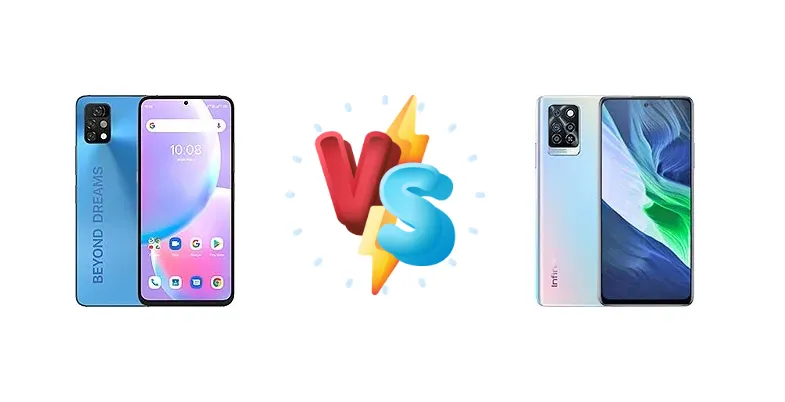
|
🏆 Quick Verdict
For the average user seeking a balance of performance and convenience, the Infinix Note 10 Pro NFC emerges as the better choice. Its Helio G95 chipset provides a noticeable performance uplift over the Umidigi’s Helio G80, and the significantly faster 33W charging dramatically improves usability, offsetting the slightly smaller battery.
| PHONES | ||
|---|---|---|
| Phone Names | Umidigi A11 Pro Max | Infinix Note 10 Pro NFC |
| Network | ||
|---|---|---|
| 2G bands | GSM 850 / 900 / 1800 / 1900 | GSM 850 / 900 / 1800 / 1900 |
| 3G bands | HSDPA 800 / 850 / 900 / 1700(AWS) / 1900 / 2100 | HSDPA 850 / 900 / 1700(AWS) / 1900 / 2100 |
| 4G bands | 1, 2, 3, 4, 5, 7, 8, 12, 13, 17, 18, 19, 20, 25, 26, 28, 34, 38, 39, 40, 41, 66 | 1, 2, 3, 4, 5, 7, 8, 20, 28, 38, 41, 40, 66 |
| Speed | HSPA, LTE | HSPA, LTE |
| Technology | GSM / CDMA / HSPA / CDMA2000 / LTE | GSM / HSPA / LTE |
| - | 1, 3, 7, 8, 20, 28 | |
| Launch | ||
|---|---|---|
| Announced | 2021. Released 2021 | 2021, May 12 |
| Status | Discontinued | Available. Released 2021, June 07 |
| Body | ||
|---|---|---|
| Build | Aluminum frame | - |
| Dimensions | 167.8 x 75.6 x 8.6 mm (6.61 x 2.98 x 0.34 in) | 172.8 x 78.3 x 7.8 mm (6.80 x 3.08 x 0.31 in) |
| SIM | Nano-SIM + Nano-SIM | Nano-SIM + Nano-SIM |
| Weight | 225 g (7.94 oz) | - |
| Display | ||
|---|---|---|
| Resolution | 1080 x 2460 pixels (~395 ppi density) | 1080 x 2460 pixels (~387 ppi density) |
| Size | 6.8 inches, 109.8 cm2 (~86.6% screen-to-body ratio) | 6.95 inches, 114.7 cm2 (~84.8% screen-to-body ratio) |
| Type | IPS LCD | IPS LCD, 90Hz |
| Platform | ||
|---|---|---|
| CPU | Octa-core (2x2.0 GHz Cortex-A75 & 6x1.8 GHz Cortex-A55) | Octa-core (2x2.05 GHz Cortex-A76 & 6x2.0 GHz Cortex-A55) |
| Chipset | Mediatek Helio G80 (12 nm) | Mediatek MT6785V/CD Helio G95 (12 nm) |
| GPU | Mali-G52 MC2 | Mali-G76 MC4 |
| OS | Android 11 | Android 11, XOS 7.6 |
| Memory | ||
|---|---|---|
| Card slot | microSDXC (dedicated slot) | microSDXC (dedicated slot) |
| Internal | 128GB 4GB RAM, 128GB 8GB RAM | 128GB 6GB RAM, 256GB 8GB RAM |
| - | UFS 2.2 | |
| Main Camera | ||
|---|---|---|
| Features | Dual-LED flash, HDR, panorama | Quad-LED flash, HDR, panorama |
| Quad | - | 64 MP, f/1.9, (wide), 1/1.72", 0.8µm, PDAF 8 MP, f/2.3, 120˚ (ultrawide) 2 MP, f/2.4, (monochrome) Auxiliary lens |
| Single | - | 16 MP, (wide) |
| Triple | 48 MP, f/1.8, (wide), 1/2.0", AF 16 MP, f/2.2, 120˚ (ultrawide) 2 MP (macro) | - |
| Video | 1080p@30fps | 4K@30fps, 1080p@30fps |
| Selfie camera | ||
|---|---|---|
| Single | 24 MP, f/1.8, (wide) | 16 MP, f/2.0, (wide), 1/3.09" |
| Video | 1080p@30fps | 1080p@30fps |
| Sound | ||
|---|---|---|
| 3.5mm jack | - | Yes |
| 35mm jack | Yes | Yes |
| Loudspeaker | Yes | Yes, with dual speakers |
| Comms | ||
|---|---|---|
| Bluetooth | 5.0, A2DP, LE | 5.0, A2DP, LE |
| NFC | No | Yes |
| Positioning | GPS, GLONASS, GALILEO | GPS |
| Radio | No | FM radio |
| USB | USB Type-C, OTG | USB Type-C 2.0, OTG |
| WLAN | Wi-Fi 802.11 a/b/g/n/ac, dual-band, Wi-Fi Direct | Wi-Fi 802.11 a/b/g/n/ac, dual-band, Wi-Fi Direct |
| Features | ||
|---|---|---|
| Sensors | Fingerprint (side-mounted), accelerometer, proximity, compass, thermometer (skin temperature) | Fingerprint (side-mounted), accelerometer, gyro, proximity, compass |
| Battery | ||
|---|---|---|
| Charging | 10W wired | 33W wired |
| Type | 5150 mAh | 5000 mAh |
| Misc | ||
|---|---|---|
| Colors | Mist Blue, Frost Grey | Black, Purple, Nordic Secret |
| Models | - | X695C |
Umidigi A11 Pro Max
- Potentially longer battery life (depending on capacity)
- Lower price point (likely)
- Simple, straightforward user experience
- Significantly slower charging speed
- Less powerful processor for gaming and multitasking
- Potentially lower camera image quality
Infinix Note 10 Pro NFC
- Faster and more responsive performance with Helio G95
- 33W fast charging for quick top-ups
- NFC support for contactless payments and pairing
- Potentially shorter battery life (depending on capacity)
- May be slightly more expensive
- More complex software features (potentially)
Display Comparison
Neither device boasts a flagship-level display, but both utilize 12nm chipsets which suggests similar power draw and therefore similar display capabilities. While specific display specs (resolution, brightness) are missing, the focus here is on performance. The choice will likely come down to subjective preference regarding color calibration and viewing angles, which are not specified in the provided data. Both are likely to be IPS LCD panels, common in this price bracket.
Camera Comparison
Without detailed camera specifications beyond the chipsets, a direct comparison is limited. However, the processing capabilities of the G95 in the Infinix Note 10 Pro NFC will likely result in better image processing, particularly in low-light conditions. The G95’s ISP (Image Signal Processor) is more advanced, enabling features like better noise reduction and dynamic range. It’s reasonable to assume the Infinix will deliver more consistently pleasing photos, even if both phones feature similar megapixel counts on their main sensors (which is unknown).
Performance
The core difference lies in the chipsets. The Infinix Note 10 Pro NFC’s Mediatek Helio G95 (2x2.05 GHz Cortex-A76 & 6x2.0 GHz Cortex-A55) represents a clear upgrade over the Umidigi A11 Pro Max’s Helio G80 (2x2.0 GHz Cortex-A75 & 6x1.8 GHz Cortex-A55). The G95 utilizes newer Cortex-A76 cores, offering improved single-core performance, crucial for responsiveness and app loading times. While both are octa-core designs, the G95’s higher clock speeds and more efficient core architecture translate to a smoother experience, particularly in demanding games. The Umidigi’s G80 is still capable, but will exhibit more noticeable slowdowns under heavy load.
Battery Life
The Umidigi A11 Pro Max’s advantage lies in potentially having a larger battery capacity (not specified in the data), but this is offset by its significantly slower 10W charging. The Infinix Note 10 Pro NFC’s 33W charging is a game-changer, allowing for a substantial top-up in a short amount of time. While the Infinix may have a slightly smaller battery, the faster charging mitigates this, ensuring users spend less time tethered to a wall. A full charge on the Umidigi could take several hours, while the Infinix can likely reach 100% in under an hour.
Buying Guide
Buy the Umidigi A11 Pro Max if you prioritize maximizing battery life and are comfortable with slower charging speeds, and your gaming needs are limited to casual titles. Buy the Infinix Note 10 Pro NFC if you value faster performance for gaming and multitasking, and appreciate the convenience of significantly quicker 33W wired charging. The NFC functionality on the Infinix is also a key benefit for mobile payments and quick pairing.