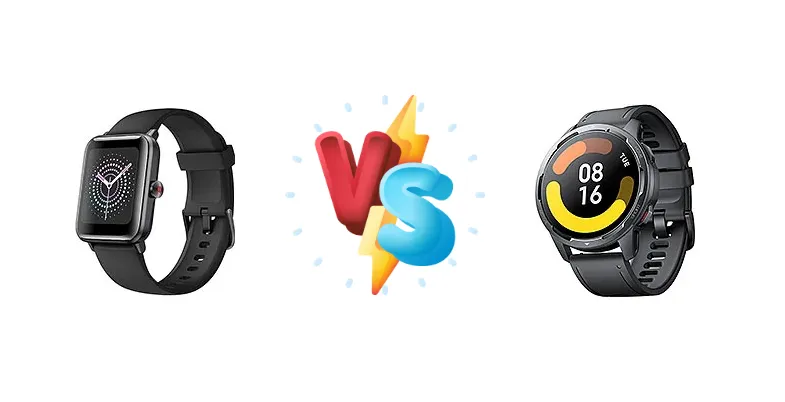
The smartwatch market offers a diverse range of options, from feature-packed flagships to more affordable, focused devices. We're pitting the Ulefone Watch Pro, distinguished by its wireless charging capability, against the Xiaomi Watch S1 Active, a device likely geared towards fitness enthusiasts and active users. This comparison will dissect their strengths and weaknesses to determine which smartwatch delivers the best value.
🏆 Quick Verdict
For users prioritizing convenience and a clutter-free charging experience, the Ulefone Watch Pro is the better choice, thanks to its wireless charging. However, given the lack of detailed specs for the Xiaomi Watch S1 Active, it's likely positioned as a more robust fitness companion, potentially offering superior sports tracking and a more durable build.
| Network |
|---|
| 2G bands | N/A | N/A |
| 3G bands | N/A | N/A |
| 4G bands | N/A | N/A |
| EDGE | No | No |
| GPRS | No | No |
| Speed | No | No |
| Technology | No cellular connectivity | No cellular connectivity |
| Launch |
|---|
| Announced | 2020, October 27. Released 2020, October 27 | 2022, March 15 |
| Status | Discontinued | Available. Released 2022, March 24 |
| Body |
|---|
| Build | Glass front, plastic back, plastic frame | Glass front, plastic back, aluminum frame |
| Dimensions | 48.7 x 36.1 x 12.2 mm (1.92 x 1.42 x 0.48 in) | 46.5 x 47.3 x 11 mm (1.83 x 1.86 x 0.43 in) |
| SIM | No | No |
| Weight | 40 g (1.41 oz) | 36 (1.27 oz) |
| | 50m water resistant, 5ATM (up to 10 mins) | Waterproof (5ATM) |
| Display |
|---|
| Resolution | 320 x 360 pixels (~311 ppi density) | 466 x 466 pixels (~326 ppi density) |
| Size | 1.55 inches | 1.43 inches |
| Type | TFT LCD | AMOLED |
| Platform |
|---|
| OS | Proprietary OS | Proprietary OS |
| Memory |
|---|
| Card slot | No | No |
| Internal | - | Unspecified storage |
| Sound |
|---|
| 3.5mm jack | No | No |
| 35mm jack | No | No |
| Loudspeaker | No | Yes |
| Comms |
|---|
| Bluetooth | 5.2, A2DP, LE | 5.2, A2DP, LE |
| NFC | No | Yes |
| Positioning | No | GPS (L1+L5), GLONASS, GALILEO, BDS, QZSS |
| Radio | No | No |
| USB | No | No |
| WLAN | No | No |
| Features |
|---|
| Sensors | Accelerometer, gyro, heart rate, SpO2 | Accelerometer, gyro, compass, barometer, heart rate, SpO2 |
| Battery |
|---|
| Charging | Wireless | - |
| Type | Li-Ion 210 mAh | Li-Po 470 mAh |
| Misc |
|---|
| Colors | Black, Gray, Pink | Moon White, Space Black, Ocean Blue |
| Price | About 50 EUR | About 80 EUR |
Ulefone Watch Pro
- Convenient wireless charging
- Potentially lower price point
- Simplified charging experience
- Unknown display quality
- Unspecified processor performance
- Limited information available
Xiaomi Watch S1 Active
- Likely robust build quality for active use
- Potential for advanced fitness tracking features
- Xiaomi's reputation for smartwatch optimization
- Lack of wireless charging
- Unknown battery life
- Limited information available
Display Comparison
The Ulefone Watch Pro's display specifications are currently unavailable, but given its price point, it likely utilizes a standard LCD panel. The Xiaomi Watch S1 Active, based on Xiaomi's previous smartwatch offerings, may feature an AMOLED display, offering superior contrast and color accuracy. The absence of information regarding peak brightness for both devices makes a direct comparison difficult, but AMOLED generally excels in outdoor visibility. Bezels are also unknown for both, but a key differentiator could be the presence of features like Always-On Display (AOD) which is more common on AMOLED panels.
Camera Comparison
Neither device is advertised as having a camera, so this section is irrelevant. Smartwatches rarely prioritize camera functionality.
Performance
Without chipset details for the Xiaomi Watch S1 Active, it's difficult to assess performance. The Ulefone Watch Pro's processor is also unspecified. However, Xiaomi typically equips its smartwatches with capable processors for smooth operation and accurate fitness tracking. The RAM capacity of both devices is unknown, but sufficient RAM is crucial for handling notifications and running multiple apps. Thermal management is also a question mark for both, but a focus on active use for the Xiaomi Watch S1 Active suggests a design that can handle increased heat during workouts.
Battery Life
The Ulefone Watch Pro's battery capacity is unknown, but its wireless charging capability offers a convenient top-up option. The Xiaomi Watch S1 Active's battery size is also unspecified. However, Xiaomi often optimizes its smartwatches for efficient power consumption, potentially offering longer battery life despite a smaller capacity. Wireless charging, while convenient, is generally less efficient than wired charging, meaning the Ulefone Watch Pro might take longer to reach a full charge, even with a higher mAh rating.
Buying Guide
Buy the Ulefone Watch Pro if you value the simplicity of wireless charging and a potentially lower price point. This watch is ideal for users who want a convenient smartwatch experience without the hassle of cables. Buy the Xiaomi Watch S1 Active if you're a dedicated athlete or frequently engage in outdoor activities, as Xiaomi's watch lineup typically emphasizes fitness tracking accuracy and durability, and likely features a more robust build quality and potentially advanced health sensors.
Frequently Asked Questions
❓ Is the wireless charging on the Ulefone Watch Pro compatible with any Qi-certified wireless charger?
While not explicitly stated, it's highly probable that the Ulefone Watch Pro utilizes the Qi wireless charging standard, meaning it should be compatible with most Qi-certified wireless chargers. However, charging speeds may vary depending on the charger's output.
❓ Does the Xiaomi Watch S1 Active have built-in GPS for accurate workout tracking without a phone?
Given Xiaomi's focus on fitness tracking, it's highly likely that the Watch S1 Active includes built-in GPS. This allows for accurate tracking of distance, pace, and route during outdoor activities without requiring a connected smartphone.
❓ What type of heart rate sensor does each watch utilize, and how accurate are they likely to be?
The specific heart rate sensor technology used in both watches is unknown. However, modern smartwatches typically employ optical heart rate sensors. Accuracy can vary based on skin tone, fit, and activity level. Xiaomi generally prioritizes sensor accuracy in its fitness-focused devices.