
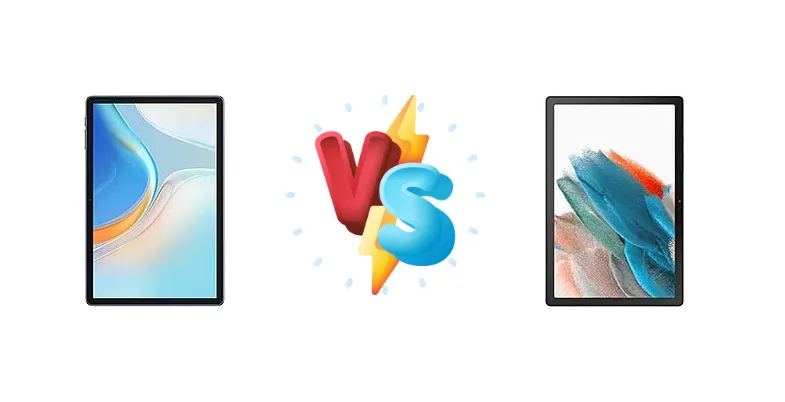
Ulefone Tab W10 vs Samsung Galaxy Tab A8: Which Budget Tablet Wins?
| Phones Images | |||||
|---|---|---|---|---|---|
|
🏆 Quick Verdict
For most users, the Samsung Galaxy Tab A8 10.5 (2021) is the better choice. While the Ulefone Tab W10 offers a slightly faster charging speed, the Tab A8’s marginally more powerful Unisoc Tiger T618 chipset and Samsung’s software optimizations provide a smoother, more responsive user experience.
| PHONES | ||
|---|---|---|
| Phone Names | Ulefone Tab W10 | Samsung Galaxy Tab A8 10.5 (2021) |
| Network | ||
|---|---|---|
| 2G bands | GSM 850 / 900 / 1800 / 1900 | GSM 850 / 900 / 1800 / 1900 |
| 3G bands | HSDPA 850 / 900 / 1700(AWS) / 1900 / 2100 | HSDPA 850 / 900 / 1700(AWS) / 1900 / 2100 |
| 4G bands | 1, 2, 3, 4, 5, 7, 8, 12, 17, 20, 26, 28, 34, 38, 39, 40, 41 | 1, 2, 3, 4, 5, 7, 8, 12, 17, 20, 28, 38, 40, 41, 66 |
| Speed | HSPA, LTE | HSPA, LTE - cellular model only |
| Technology | GSM / HSPA / LTE | GSM / HSPA / LTE |
| Launch | ||
|---|---|---|
| Announced | 2024, June | 2021, December 15 |
| Status | Available. Released 2024, June | Available. Released 2022, January 17 |
| Body | ||
|---|---|---|
| Dimensions | 239.6 x 158.4 x 7.9 mm (9.43 x 6.24 x 0.31 in) | 246.8 x 161.9 x 6.9 mm (9.72 x 6.37 x 0.27 in) |
| SIM | Nano-SIM + Nano-SIM | Nano-SIM (cellular model only) |
| Weight | 430 g (15.17 oz) | 508 g (1.12 lb) |
| Display | ||
|---|---|---|
| Resolution | 800 x 1280 pixels, 16:10 ratio (~149 ppi density) | 1200 x 1920 pixels, 16:10 ratio (~216 ppi density) |
| Size | 10.1 inches, 295.8 cm2 (~77.9% screen-to-body ratio) | 10.5 inches, 319.7 cm2 (~80.0% screen-to-body ratio) |
| Type | IPS LCD | TFT LCD |
| Platform | ||
|---|---|---|
| CPU | Octa-core (2x1.6 GHz Cortex-A75 & 6x1.6 GHz Cortex-A55) | Octa-core (2x2.0 GHz Cortex-A75 & 6x2.0 GHz Cortex-A55) |
| Chipset | Unisoc T606 (12 nm) | Unisoc Tiger T618 (12 nm) |
| GPU | Mali-G57 MP1 | Mali G52 MP2 |
| OS | Android 14 | Android 11, upgradable to Android 14, One UI 6 |
| Memory | ||
|---|---|---|
| Card slot | microSDXC (uses shared SIM slot) | microSDXC (dedicated slot) |
| Internal | 128GB 4GB RAM | 32GB 2GB RAM, 32GB 3GB RAM, 64GB 2GB RAM, 64GB 3GB RAM, 64GB 4GB RAM, 128GB 3GB RAM, 128GB 4GB RAM |
| Main Camera | ||
|---|---|---|
| Features | LED flash, HDR, panorama | - |
| Single | 16 MP, f/2.2, (wide), 1.0µm | 8 MP, AF |
| Video | 1080p@30fps | 1080p@30fps |
| Selfie camera | ||
|---|---|---|
| Single | 8 MP, f/2.0, (wide), 1.12µm | 5 MP |
| Video | Yes | 1080p@30fps |
| Sound | ||
|---|---|---|
| 3.5mm jack | - | Yes |
| 35mm jack | Yes | Yes |
| Loudspeaker | Yes, with stereo speakers (4 speakers) | Yes, with stereo speakers (4 speakers) |
| Comms | ||
|---|---|---|
| Bluetooth | 5.2, A2DP, LE | 5.0, A2DP, LE |
| NFC | No | No |
| Positioning | GPS, GLONASS, GALILEO, BDS | GPS, GLONASS, BDS, GALILEO, QZSS - cellular model only |
| Radio | FM radio, RDS, recording | No |
| USB | USB Type-C 2.0, OTG | USB Type-C 2.0 |
| WLAN | Wi-Fi 802.11 a/b/g/n/ac/6, dual-band | Wi-Fi 802.11 a/b/g/n/ac, dual-band, Wi-Fi Direct |
| Features | ||
|---|---|---|
| Sensors | Accelerometer, proximity (accessories only) | Accelerometer, gyro, proximity, compass |
| Battery | ||
|---|---|---|
| Charging | 18W wired | 15W wired |
| Type | Li-Po 8800 mAh | Li-Po 7040 mAh |
| Misc | ||
|---|---|---|
| Colors | Space Gray | Gray, Silver, Pink Gold |
| Models | - | SM-X200, SM-X205 |
| Price | About 80 EUR | About 230 EUR |
| SAR EU | - | 0.92 W/kg (body) |
Ulefone Tab W10
- Faster 18W charging
- Potentially lower price point
- Unisoc T606 is power efficient
- Slightly slower CPU performance
- Less refined software experience likely
- Limited brand recognition
Samsung Galaxy Tab A8 10.5 (2021)
- More powerful Unisoc Tiger T618 chipset
- Samsung’s optimized software
- Stronger brand reputation and support
- Slower 15W charging
- Potentially higher price
- May not offer significant camera improvements
Display Comparison
Neither Ulefone nor Samsung provide detailed display specifications beyond the 10.5-inch size. However, given the price point, both likely utilize IPS LCD panels. The key difference lies in the processing power driving them. While both will be adequate for media consumption, the Tab A8’s slightly more capable chipset will contribute to smoother scrolling and animations. Bezels are expected to be similar on both devices, reflecting their budget positioning. Color accuracy is unlikely to be a strong point on either, but Samsung’s software typically includes color profiles for some adjustment.
Camera Comparison
Camera performance is unlikely to be a deciding factor for buyers in this segment. Both tablets will likely feature basic camera setups, and detailed specifications are scarce. Focusing on the primary sensors, the Tab A8 likely has a slightly better image signal processor (ISP) due to the T618 chipset, potentially resulting in marginally better image quality. Any 2MP macro or depth sensors on either device should be considered marketing filler and largely ignored. Expect acceptable results in well-lit conditions, but poor performance in low light.
Performance
The core difference between these tablets is the chipset. The Samsung Galaxy Tab A8 utilizes the Unisoc Tiger T618, featuring a CPU clocked at 2.0 GHz, while the Ulefone Tab W10 employs the Unisoc T606 with a 1.6 GHz clock speed. This 0.4 GHz difference in CPU clock speed, coupled with the 'Tiger' designation suggesting optimizations, translates to a noticeable performance advantage for the Tab A8 in real-world usage. Both utilize an octa-core configuration with 2x Cortex-A75 and 6x Cortex-A55 cores, but the higher clock speed on the A75 cores of the T618 will be more impactful during demanding tasks. Both devices likely use LPDDR4X RAM, as LPDDR5 is uncommon in this price bracket. Thermal management is unlikely to be a concern with these chipsets, as they are designed for efficiency rather than raw power.
Battery Life
Battery capacity is not specified in the provided data, making a direct comparison difficult. However, the Ulefone Tab W10 boasts 18W wired charging, while the Samsung Galaxy Tab A8 is limited to 15W. This suggests the Ulefone will charge slightly faster, potentially reaching 100% in less time. However, the actual charging time will depend on the battery capacity of each device. A larger battery on the Tab A8 could offset the slower charging speed, providing longer overall usage time. Without knowing the battery capacities, the 18W charging on the Ulefone is the only concrete advantage.
Buying Guide
Buy the Ulefone Tab W10 if you prioritize the fastest possible charging and are comfortable with a potentially less refined software experience. It’s a good option for users who frequently need to top up their tablet quickly. Buy the Samsung Galaxy Tab A8 10.5 (2021) if you value a more polished user interface, slightly better overall performance for everyday tasks, and the brand recognition and software support that Samsung provides. It’s ideal for streaming, browsing, and light productivity.