
Ulefone Tab A11 vs Samsung Galaxy Tab A7 Lite: Which Budget Tablet Wins?
| Phones Images | |||||
|---|---|---|---|---|---|
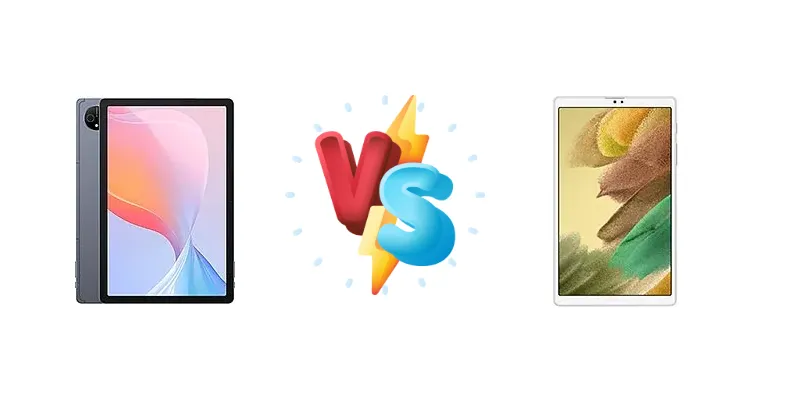
|
🏆 Quick Verdict
For most users, the Ulefone Tab A11 emerges as the better choice. Its Unisoc T620 chipset, featuring Cortex-A75 cores, provides a noticeable performance advantage over the Samsung Galaxy Tab A7 Lite’s older Helio P22T, making it more responsive for everyday tasks and light multitasking. While Samsung benefits from brand recognition, the Ulefone delivers more processing power for the price.
| PHONES | ||
|---|---|---|
| Phone Names | Ulefone Tab A11 | Samsung Galaxy Tab A7 Lite |
| Network | ||
|---|---|---|
| 2G bands | GSM 850 / 900 / 1800 / 1900 | GSM 850 / 900 / 1800 / 1900 |
| 3G bands | HSDPA 850 / 900 / 1700(AWS) / 1900 / 2100 | HSDPA 850 / 900 / 1700(AWS) / 1900 / 2100 |
| 4G bands | 1, 2, 3, 4, 5, 7, 8, 12, 17, 20, 26, 28, 34, 38, 39, 40, 41 | 1, 2, 3, 4, 5, 7, 8, 12, 17, 20, 28, 38, 40, 66 |
| Speed | HSPA, LTE | HSPA, LTE - cellular model only |
| Technology | GSM / HSPA / LTE | GSM / HSPA / LTE |
| Launch | ||
|---|---|---|
| Announced | 2024, June | 2021, May 27 |
| Status | Available. Released 2024, June | Available. Released 2021, June 18 |
| Body | ||
|---|---|---|
| Build | - | Glass front, aluminum back, aluminum frame, plastic ends |
| Dimensions | 256.9 x 168.4 x 7.6 mm (10.11 x 6.63 x 0.30 in) | 212.5 x 124.7 x 8 mm (8.37 x 4.91 x 0.31 in) |
| SIM | Nano-SIM + Nano-SIM | Nano-SIM (cellular model only) |
| Weight | 500.5 g (1.10 lb) | 366 g (Wi-Fi), 371 g (LTE) (12.91 oz) |
| Display | ||
|---|---|---|
| Resolution | 1200 x 1920 pixels, 16:10 ratio (~206 ppi density) | 800 x 1340 pixels, 5:3 ratio (~179 ppi density) |
| Size | 11.0 inches, 350.9 cm2 (~81.1% screen-to-body ratio) | 8.7 inches, 214.9 cm2 (~81.1% screen-to-body ratio) |
| Type | IPS LCD, 90Hz | TFT LCD |
| Platform | ||
|---|---|---|
| CPU | Octa-core (2x2.2 GHz Cortex-A75 & 6x1.8 GHz Cortex-A55) | Octa-core (4x2.3 GHz Cortex-A53 & 4x1.8 GHz Cortex-A53) |
| Chipset | Unisoc T620 (12 nm) | Mediatek MT8768T Helio P22T (12 nm) |
| GPU | Mali-G57 | PowerVR GE8320 |
| OS | Android 14 | Android 11, upgradable to Android 14, One UI 6.1 |
| Memory | ||
|---|---|---|
| Card slot | microSDXC (uses shared SIM slot) | microSDXC (dedicated slot) |
| Internal | 128GB 4GB RAM, 256GB 8GB RAM | 32GB 2GB RAM, 32GB 3GB RAM, 64GB 4GB RAM |
| - | eMMC 5.1 | |
| Main Camera | ||
|---|---|---|
| Features | LED flash, HDR, panorama | - |
| Single | 16 MP, f/2.2, (wide), 1.0µm | 8 MP, AF |
| Video | 1080p@30fps | 1080p@30fps |
| Selfie camera | ||
|---|---|---|
| Single | 8 MP, f/2.0, (wide), 1.12µm | 2 MP |
| Video | Yes | - |
| Sound | ||
|---|---|---|
| 3.5mm jack | - | Yes |
| 35mm jack | Yes | Yes |
| Loudspeaker | Yes, with stereo speakers (4 speakers) | Yes, with stereo speakers |
| Comms | ||
|---|---|---|
| Bluetooth | 5.0, A2DP, LE | 5.0, A2DP, LE |
| NFC | No | No |
| Positioning | GPS, GLONASS, GALILEO, BDS | GPS, GLONASS, BDS, GALILEO - cellular model only |
| Radio | FM radio, RDS, recording | No |
| USB | USB Type-C 2.0, OTG | USB Type-C 2.0 |
| WLAN | Wi-Fi 802.11 a/b/g/n/ac/6, dual-band | Wi-Fi 802.11 a/b/g/n/ac, dual-band, Wi-Fi Direct |
| Features | ||
|---|---|---|
| Sensors | Accelerometer, proximity (accessories only) | Accelerometer, compass |
| Battery | ||
|---|---|---|
| Charging | 18W wired | 15W wired |
| Type | Li-Po 8800 mAh | Li-Po 5100 mAh |
| Misc | ||
|---|---|---|
| Colors | Space Gray | Gray, Silver |
| Models | - | SM-T225, SM-T220, SM-T225N, SM-T227U |
| Price | About 200 EUR | About 140 EUR |
| SAR | - | 0.68 W/kg (body) |
| SAR EU | - | 0.64 W/kg (head) 0.99 W/kg (body) |
Ulefone Tab A11
- Superior processor performance with the Unisoc T620
- Faster 18W charging
- Better value for money
- Less established brand reputation
- Software experience may not be as refined as Samsung’s
Samsung Galaxy Tab A7 Lite
- Well-known and trusted Samsung brand
- Potentially more polished software experience
- Compact and lightweight design
- Inferior processor performance with the Helio P22T
- Slower 15W charging
- Higher price for comparable features
Display Comparison
Neither tablet boasts a particularly impressive display. Both utilize 12nm chipsets, suggesting a focus on cost optimization over premium display features. While specific display specs (resolution, panel type) are missing, the focus here is on performance. The absence of high refresh rates or advanced panel technologies like LTPO is expected at this price point. Bezels are likely comparable, contributing minimally to differentiating factors.
Camera Comparison
Camera performance is unlikely to be a deciding factor for either tablet. Both are positioned as budget devices, and camera quality typically takes a backseat. Without specific sensor details, it’s safe to assume both feature basic camera setups suitable for casual snapshots. The presence of a 2MP macro camera on either device is largely a marketing gimmick, offering limited practical benefit due to the low resolution and lack of optical image stabilization (OIS).
Performance
The core difference lies in the chipsets. The Ulefone Tab A11’s Unisoc T620 features two Cortex-A75 cores clocked at 2.2 GHz, paired with six Cortex-A55 cores at 1.8 GHz. This architecture is significantly more modern and powerful than the Samsung Galaxy Tab A7 Lite’s MediaTek Helio P22T, which utilizes four Cortex-A53 cores at 2.3 GHz and another four at 1.8 GHz. The A75 cores in the Ulefone offer a substantial improvement in single-core performance, crucial for app responsiveness. While the P22T’s higher clock speed on the A53 cores might offer a slight advantage in heavily multi-threaded tasks, the older architecture will likely be a bottleneck. The Ulefone’s chipset is built on a 12nm process, matching the Samsung’s, suggesting similar power efficiency, but the architectural advantages will translate to better performance per watt.
Battery Life
The Ulefone Tab A11 supports 18W wired charging, while the Samsung Galaxy Tab A7 Lite is limited to 15W. While battery capacity isn’t specified, the faster charging on the Ulefone will result in quicker top-ups. The 12nm process node of both chipsets suggests comparable power efficiency. Therefore, the Ulefone’s faster charging is a tangible advantage, reducing downtime and improving usability, even if the battery capacity is similar.
Buying Guide
Buy the Ulefone Tab A11 if you prioritize performance for the price and need a tablet capable of handling more demanding apps or light gaming. It’s ideal for users who want a responsive experience without sacrificing affordability. Buy the Samsung Galaxy Tab A7 Lite if you value brand reliability, a more polished software experience, and a slightly more compact form factor, and are willing to trade some processing power for these benefits. It’s a good fit for casual users primarily focused on media consumption.