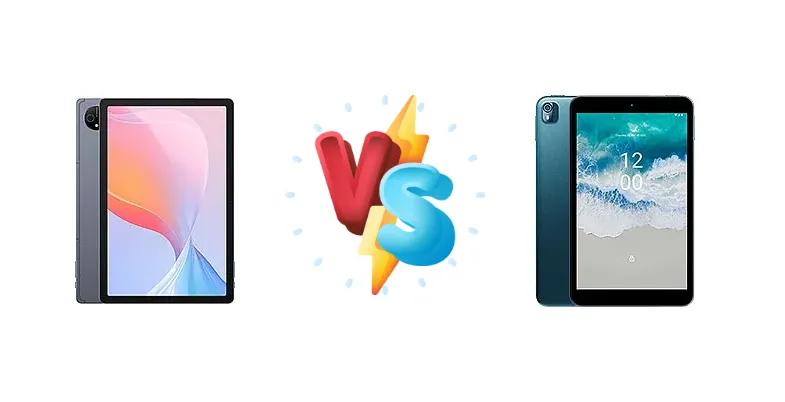
The Ulefone Tab A11 and Nokia T10 represent compelling options in the increasingly crowded budget tablet space. Both leverage Unisoc chipsets to deliver affordable Android experiences, but key differences in CPU clock speeds and charging capabilities create distinct user experiences. This comparison dives deep into these nuances to help you choose the right tablet for your needs.
🏆 Quick Verdict
For users prioritizing performance in tasks like multitasking and light gaming, the Ulefone Tab A11 emerges as the better choice thanks to its faster Unisoc T620 chipset. However, the Nokia T10 offers a more streamlined software experience and a potentially longer-lasting battery due to its lower power draw, making it ideal for basic media consumption.
| Network |
|---|
| 2G bands | GSM 850 / 900 / 1800 / 1900 | GSM 850 / 900 / 1800 / 1900 |
| 3G bands | HSDPA 850 / 900 / 1700(AWS) / 1900 / 2100 | HSDPA 850 / 900 / 2100 |
| 4G bands | 1, 2, 3, 4, 5, 7, 8, 12, 17, 20, 26, 28, 34, 38, 39, 40, 41 | 1, 3, 5, 7, 8, 20, 28, 38, 40, 41 |
| Speed | HSPA, LTE | HSPA 42.2/5.76 Mbps, LTE Cat4 150/50 Mbps |
| Technology | GSM / HSPA / LTE | GSM / HSPA / LTE |
| Launch |
|---|
| Announced | 2024, June | 2022, July 12 |
| Status | Available. Released 2024, June | Available. Released 2022, August 20 |
| Body |
|---|
| Build | - | Glass front, plastic back, plastic frame |
| Dimensions | 256.9 x 168.4 x 7.6 mm (10.11 x 6.63 x 0.30 in) | 208 x 123.2 x 9 mm (8.19 x 4.85 x 0.35 in) |
| SIM | Nano-SIM + Nano-SIM | Nano-SIM |
| Weight | 500.5 g (1.10 lb) | 375 g (13.23 oz) |
| | - | Splash resistant |
| Display |
|---|
| Resolution | 1200 x 1920 pixels, 16:10 ratio (~206 ppi density) | 800 x 1280 pixels, 16:10 ratio (~189 ppi density) |
| Size | 11.0 inches, 350.9 cm2 (~81.1% screen-to-body ratio) | 8.0 inches, 185.6 cm2 (~72.4% screen-to-body ratio) |
| Type | IPS LCD, 90Hz | IPS LCD, 360 nits (typ), 450 nits (peak) |
| Platform |
|---|
| CPU | Octa-core (2x2.2 GHz Cortex-A75 & 6x1.8 GHz Cortex-A55) | Octa-core (2x1.6 GHz Cortex-A75 & 6x1.6 GHz Cortex-A55) |
| Chipset | Unisoc T620 (12 nm) | Unisoc T606 (12 nm) |
| GPU | Mali-G57 | Mali-G57 MP1 |
| OS | Android 14 | Android 12, upgradable to Android 13 |
| Memory |
|---|
| Card slot | microSDXC (uses shared SIM slot) | microSDXC |
| Internal | 128GB 4GB RAM, 256GB 8GB RAM | 32GB 3GB RAM, 64GB 4GB RAM |
| Main Camera |
|---|
| Features | LED flash, HDR, panorama | LED flash |
| Single | 16 MP, f/2.2, (wide), 1.0µm | 8 MP, 1/4.0", 1.12µm, AF |
| Video | 1080p@30fps | 1080p |
| Selfie camera |
|---|
| Single | 8 MP, f/2.0, (wide), 1.12µm | 2 MP, 1/5.0", 1.65µm |
| Video | Yes | 720p |
| Sound |
|---|
| 3.5mm jack | - | Yes |
| 35mm jack | Yes | Yes |
| Loudspeaker | Yes, with stereo speakers (4 speakers) | Yes, with stereo speakers |
| Comms |
|---|
| Bluetooth | 5.0, A2DP, LE | 5.0, A2DP, LE |
| NFC | No | No |
| Positioning | GPS, GLONASS, GALILEO, BDS | GPS, GLONASS, GALILEO |
| Radio | FM radio, RDS, recording | No |
| USB | USB Type-C 2.0, OTG | USB Type-C 2.0, OTG |
| WLAN | Wi-Fi 802.11 a/b/g/n/ac/6, dual-band | Wi-Fi 802.11 a/b/g/n/ac, dual-band |
| Features |
|---|
| Sensors | Accelerometer, proximity (accessories only) | Accelerometer, proximity |
| Battery |
|---|
| Charging | 18W wired | 10W wired |
| Type | Li-Po 8800 mAh | Li-Po 5250 mAh |
| Misc |
|---|
| Colors | Space Gray | Ocean Blue |
| Models | - | TA-1503, TA-1472, TA-1462, TA-1457 |
| Price | About 200 EUR | About 160 EUR |
| SAR | - | 1.19 W/kg (body) |
| SAR EU | - | 0.27 W/kg (head) 1.57 W/kg (body) |
Ulefone Tab A11
- Faster Processor: The Unisoc T620 provides a noticeable performance boost.
- Faster Charging: 18W charging significantly reduces charging times.
- Better Multitasking: The more powerful CPU handles multiple apps more efficiently.
- Potentially Shorter Battery Life: Higher performance may lead to faster battery drain.
- Software Support: Ulefone’s software update track record is less consistent than Nokia’s.
Nokia T10
- Efficient Chipset: The Unisoc T606 offers good battery life for basic tasks.
- Reliable Brand: Nokia is known for its build quality and software stability.
- Lower Price: Often available at a lower price point than the Ulefone Tab A11.
- Slower Processor: The Unisoc T606 struggles with demanding applications.
- Slow Charging: 10W charging takes a long time to fully charge the device.
Display Comparison
Neither Ulefone nor Nokia provide display specifications beyond screen size. Assuming both utilize IPS LCD panels common in this price bracket, the display experience will likely be similar in terms of color accuracy and viewing angles. The absence of details like peak brightness or resolution makes a direct comparison impossible, but the focus here is on internal performance.
Camera Comparison
Given the target market, camera performance is unlikely to be a deciding factor. Both tablets likely feature basic camera setups. Without specific sensor details, it’s safe to assume image quality will be adequate for casual snapshots but not competitive with smartphones. Focusing on the processing power of the chipsets, the Ulefone Tab A11’s T620 may offer slightly faster image processing, but the difference will be minimal.
Performance
The core difference lies in the chipsets. The Ulefone Tab A11’s Unisoc T620 features a CPU clocked up to 2.2 GHz using two Cortex-A75 cores, while the Nokia T10’s Unisoc T606 tops out at 1.6 GHz with the same Cortex-A75 architecture. This 0.6 GHz difference, coupled with the T620’s slightly higher clock speed on the Cortex-A55 efficiency cores (1.8 GHz vs 1.6 GHz), translates to a noticeable performance advantage for the Ulefone Tab A11 in CPU-bound tasks. While both are 12nm chips, the T620’s architecture allows for quicker processing, benefiting multitasking and app loading times. The GPU performance is likely similar, but the CPU headroom on the A11 will prevent bottlenecks.
Battery Life
While battery capacity isn’t specified, the Nokia T10’s 10W charging is a significant disadvantage compared to the Ulefone Tab A11’s 18W charging. This means the A11 will reach a full charge considerably faster. Although the T10’s less powerful chipset consumes less energy, the slower charging speed could negate any battery life advantage for users who frequently need to top up their device. The A11’s faster charging is a practical benefit for on-the-go users.
Buying Guide
Buy the Ulefone Tab A11 if you need a tablet capable of handling more demanding applications, occasional gaming, and appreciate a faster overall system response. Buy the Nokia T10 if you prioritize simplicity, extended battery life for primarily passive tasks like video streaming, and prefer a brand known for reliable software updates, even if they are infrequent.
Frequently Asked Questions
❓ Will the Ulefone Tab A11 handle demanding games like PUBG Mobile?
While the Unisoc T620 is capable, PUBG Mobile will likely require low to medium graphics settings for a smooth experience. The T620’s CPU provides enough power, but the GPU may struggle with higher settings. Expect some frame drops during intense action.
❓ How long will it take to fully charge the Nokia T10 with the 10W charger?
Given the 10W charging rate, a full charge from 0% will likely take between 3-4 hours, potentially longer depending on background app activity. This is a significant drawback compared to the Ulefone Tab A11’s faster 18W charging.
❓ Does the Ulefone Tab A11 support software updates?
Ulefone’s software update track record is less consistent than Nokia’s. While the Tab A11 will likely ship with a recent version of Android, long-term software support and security updates are not guaranteed.
❓ Is the Nokia T10 a good choice for reading ebooks and browsing the web?
Yes, the Nokia T10 is well-suited for these tasks. Its efficient Unisoc T606 chipset provides ample power for basic web browsing and ebook reading, while also maximizing battery life for extended use.