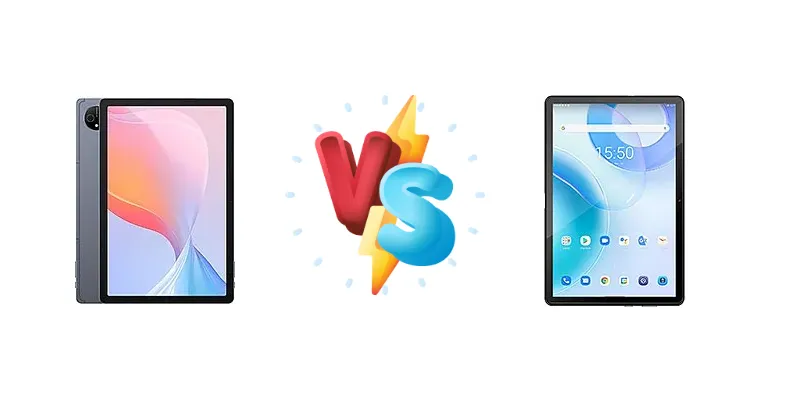
The Ulefone Tab A11 and Blackview Tab 10 Pro represent a growing segment of affordable Android tablets aiming to deliver a functional experience without breaking the bank. Both devices target users seeking larger screens for media consumption and light productivity, but they diverge significantly in their core hardware. This comparison dissects those differences, focusing on the impact of their respective chipsets and charging capabilities.
🏆 Quick Verdict
For the average user prioritizing faster charging and potentially smoother multitasking, the Blackview Tab 10 Pro edges out the Ulefone Tab A11. Its 30W charging significantly reduces downtime, and the Mediatek MT8788V, while older, offers a CPU architecture that may handle demanding tasks slightly better. However, the A11 remains a viable option for those on a tighter budget.
| Network |
|---|
| 2G bands | GSM 850 / 900 / 1800 / 1900 | GSM 850 / 900 / 1800 / 1900 |
| 3G bands | HSDPA 850 / 900 / 1700(AWS) / 1900 / 2100 | HSDPA 900 / 2100 |
| 4G bands | 1, 2, 3, 4, 5, 7, 8, 12, 17, 20, 26, 28, 34, 38, 39, 40, 41 | 1, 3, 7, 8, 20, 40 |
| Speed | HSPA, LTE | HSPA, LTE |
| Technology | GSM / HSPA / LTE | GSM / HSPA / LTE |
| Launch |
|---|
| Announced | 2024, June | 2021, December 16 |
| Status | Available. Released 2024, June | Available. Released 2021, December |
| Body |
|---|
| Dimensions | 256.9 x 168.4 x 7.6 mm (10.11 x 6.63 x 0.30 in) | 243 x 162 x 8.8 mm (9.57 x 6.38 x 0.35 in) |
| SIM | Nano-SIM + Nano-SIM | Nano-SIM + Nano-SIM |
| Weight | 500.5 g (1.10 lb) | 588 g (1.30 lb) |
| Display |
|---|
| Protection | - | Asahi Glass |
| Resolution | 1200 x 1920 pixels, 16:10 ratio (~206 ppi density) | 1200 x 1920 pixels, 16:10 ratio (~224 ppi density) |
| Size | 11.0 inches, 350.9 cm2 (~81.1% screen-to-body ratio) | 10.1 inches, 295.8 cm2 (~75.1% screen-to-body ratio) |
| Type | IPS LCD, 90Hz | IPS LCD |
| Platform |
|---|
| CPU | Octa-core (2x2.2 GHz Cortex-A75 & 6x1.8 GHz Cortex-A55) | Octa-core (4x2.0 GHz Cortex-A73 & 4x2.0 GHz Cortex-A53) |
| Chipset | Unisoc T620 (12 nm) | Mediatek MT8788V |
| GPU | Mali-G57 | Mali-G72 MP3 |
| OS | Android 14 | Android 11 |
| Memory |
|---|
| Card slot | microSDXC (uses shared SIM slot) | microSDXC |
| Internal | 128GB 4GB RAM, 256GB 8GB RAM | 128GB 8GB RAM |
| Main Camera |
|---|
| Features | LED flash, HDR, panorama | LED flash |
| Single | 16 MP, f/2.2, (wide), 1.0µm | 13 MP, f/2.2, (wide) |
| Video | 1080p@30fps | 1080p@30fps |
| Selfie camera |
|---|
| Single | 8 MP, f/2.0, (wide), 1.12µm | 8 MP, f/2.2, (wide) |
| Video | Yes | 1080p@30fps |
| Sound |
|---|
| 35mm jack | Yes | No |
| Loudspeaker | Yes, with stereo speakers (4 speakers) | Yes, with stereo speakers |
| Comms |
|---|
| Bluetooth | 5.0, A2DP, LE | 5.0, A2DP, LE |
| NFC | No | No |
| Positioning | GPS, GLONASS, GALILEO, BDS | GPS, GLONASS, BDS |
| Radio | FM radio, RDS, recording | FM radio |
| USB | USB Type-C 2.0, OTG | USB Type-C, OTG |
| WLAN | Wi-Fi 802.11 a/b/g/n/ac/6, dual-band | Wi-Fi 802.11 a/b/g/n/ac, dual-band |
| Features |
|---|
| Sensors | Accelerometer, proximity (accessories only) | Accelerometer, gyro, proximity, compass |
| Battery |
|---|
| Charging | 18W wired | 30W wired |
| Type | Li-Po 8800 mAh | 6580 mAh |
| Misc |
|---|
| Colors | Space Gray | Gray, Gold, Silver |
| Price | About 200 EUR | About 220 EUR |
Ulefone Tab A11
- Potentially lower price point
- More modern CPU core configuration (more cores)
- Unisoc chipset may offer better software support in the long run
- Slower 18W charging
- Unisoc T620 CPU cores are less powerful than MT8788V's
- Likely less responsive UI
Blackview Tab 10 Pro
- Faster 30W charging
- Mediatek MT8788V CPU cores are more powerful
- Potentially smoother multitasking
- Older chipset architecture
- May be slightly more expensive
- Mediatek chipset software support can be inconsistent
Display Comparison
Neither Ulefone nor Blackview provide detailed display specifications beyond screen size. However, given the price point, both likely utilize IPS LCD panels. The real difference lies in the underlying processing power driving the display. A more powerful chipset, like the MT8788V in the Tab 10 Pro, can contribute to smoother animations and faster response times, even on a similar panel. Without knowing the peak brightness or color gamut coverage, it's difficult to definitively declare a winner, but the Tab 10 Pro's chipset gives it a potential edge.
Camera Comparison
Both tablets likely feature modest camera setups geared towards basic functionality. Without detailed sensor information, it’s difficult to make a meaningful comparison. Given the market segment, expect both to struggle in low-light conditions. Focusing on the chipset’s image signal processor (ISP) capabilities, the Mediatek MT8788V may offer slightly better image processing due to its more mature architecture, but the difference will likely be minimal. The presence of a 2MP macro camera on either device is largely a marketing gimmick and shouldn't influence purchasing decisions.
Performance
The core of the performance difference lies in the chipsets. The Ulefone Tab A11’s Unisoc T620, built on a 12nm process, features a dual-cluster configuration with 2x Cortex-A75 cores for performance and 6x Cortex-A55 cores for efficiency. The Blackview Tab 10 Pro utilizes the Mediatek MT8788V, employing a quad-core Cortex-A73 setup alongside four Cortex-A53 cores. While the T620 has more cores, the A73 cores in the MT8788V are architecturally more powerful than the A75 cores in the T620, potentially leading to better single-core performance. This translates to snappier app launches and a more responsive UI. The MT8788V’s age means it may lack some of the newer optimizations found in the T620, but its core architecture provides a performance advantage in many scenarios.
Battery Life
While battery capacity isn't specified, the key differentiator here is charging speed. The Ulefone Tab A11 supports 18W wired charging, while the Blackview Tab 10 Pro boasts 30W wired charging. This is a significant advantage for the Tab 10 Pro, allowing for substantially faster top-ups. Even with a similar battery capacity, the 30W charging will minimize downtime and provide a more convenient user experience. The faster charging is particularly beneficial for users who rely on their tablets throughout the day and need quick bursts of power.
Buying Guide
Buy the Ulefone Tab A11 if you need a basic, functional tablet for casual browsing, reading, and video playback, and are willing to accept slower charging speeds. Buy the Blackview Tab 10 Pro if you prioritize quicker charging, potentially smoother multitasking, and a slightly more responsive user experience, even if it comes at a small price premium.
Frequently Asked Questions
❓ Will the Mediatek MT8788V in the Blackview Tab 10 Pro struggle with demanding games like PUBG?
While the MT8788V isn't a gaming powerhouse, it should be capable of running PUBG Mobile at medium settings with reasonable frame rates. However, expect some frame drops during intense action sequences. The Unisoc T620 in the Ulefone Tab A11 will likely offer a similar, or slightly worse, gaming experience.
❓ How long will it take to fully charge the Blackview Tab 10 Pro with the 30W charger?
Without knowing the battery capacity, it's difficult to provide an exact figure. However, with 30W charging, a full charge from 0% is likely to take between 2 to 3 hours, significantly faster than the Ulefone Tab A11's 18W charging which could take 4+ hours.
❓ Is the Unisoc T620 chipset known for overheating under sustained load?
The Unisoc T620 is generally considered to be relatively efficient, and overheating isn't a widespread issue. However, prolonged gaming or video encoding could lead to some thermal throttling, reducing performance slightly. The Blackview Tab 10 Pro's MT8788V may experience similar throttling under heavy load.