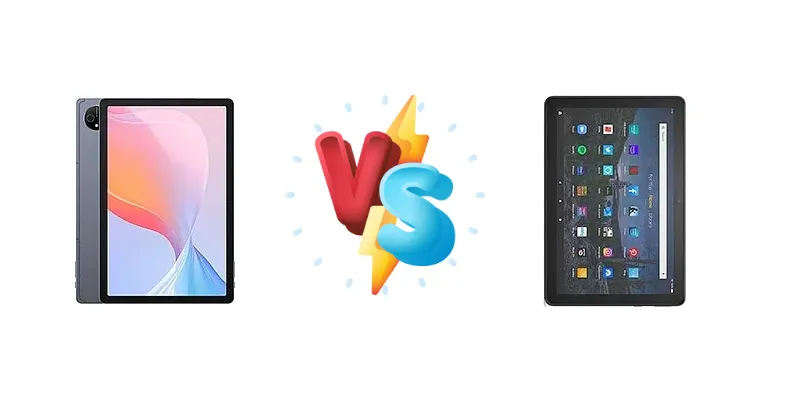
The budget tablet market is fiercely competitive, offering a surprising amount of functionality for under $200. We pit the Ulefone Tab A11, a relatively new Android entrant, against the well-established Amazon Fire HD 10 Plus (2021) to determine which provides the best experience for everyday tasks, media consumption, and light productivity.
🏆 Quick Verdict
For users prioritizing raw performance and a more open Android experience, the Ulefone Tab A11 emerges as the winner. Its Unisoc T620 chipset, while not a powerhouse, offers a noticeable edge over the aging Helio P60T in the Fire HD 10 Plus, making it more responsive for multitasking and demanding apps. However, the Fire HD 10 Plus's wireless charging and Amazon ecosystem integration remain compelling advantages.
| Network |
|---|
| 2G bands | GSM 850 / 900 / 1800 / 1900 | N/A |
| 3G bands | HSDPA 850 / 900 / 1700(AWS) / 1900 / 2100 | - |
| 4G bands | 1, 2, 3, 4, 5, 7, 8, 12, 17, 20, 26, 28, 34, 38, 39, 40, 41 | - |
| EDGE | - | No |
| GPRS | - | No |
| Speed | HSPA, LTE | - |
| Technology | GSM / HSPA / LTE | No cellular connectivity |
| Launch |
|---|
| Announced | 2024, June | 2021, April 27. Released 2021, May 26 |
| Status | Available. Released 2024, June | Discontinued |
| Body |
|---|
| Dimensions | 256.9 x 168.4 x 7.6 mm (10.11 x 6.63 x 0.30 in) | 247 x 166 x 9.2 mm (9.72 x 6.54 x 0.36 in) |
| SIM | Nano-SIM + Nano-SIM | No |
| Weight | 500.5 g (1.10 lb) | 468 g (1.03 lb) |
| Display |
|---|
| Protection | - | Aluminosilicate glass |
| Resolution | 1200 x 1920 pixels, 16:10 ratio (~206 ppi density) | 1920 x 1200 pixels, 16:10 ratio (~224 ppi density) |
| Size | 11.0 inches, 350.9 cm2 (~81.1% screen-to-body ratio) | 10.1 inches, 295.8 cm2 (~72.1% screen-to-body ratio) |
| Type | IPS LCD, 90Hz | IPS LCD |
| Platform |
|---|
| CPU | Octa-core (2x2.2 GHz Cortex-A75 & 6x1.8 GHz Cortex-A55) | Octa-core (4x2.0 GHz Cortex-A73 & 4x2.0 GHz Cortex-A53) |
| Chipset | Unisoc T620 (12 nm) | Mediatek MT8183 Helio P60T (12 nm) |
| GPU | Mali-G57 | Mali-G72 MP3 |
| OS | Android 14 | Android 9.0 (Pie), Fire OS 7 |
| Memory |
|---|
| Card slot | microSDXC (uses shared SIM slot) | microSDXC (dedicated slot) |
| Internal | 128GB 4GB RAM, 256GB 8GB RAM | 32GB 4GB RAM, 64GB 4GB RAM |
| | - | eMMC 5.1 |
| Main Camera |
|---|
| Features | LED flash, HDR, panorama | - |
| Single | 16 MP, f/2.2, (wide), 1.0µm | 5 MP |
| Video | 1080p@30fps | 720p |
| Selfie camera |
|---|
| Single | 8 MP, f/2.0, (wide), 1.12µm | 2 MP |
| Video | Yes | 720p |
| Sound |
|---|
| 3.5mm jack | - | Yes |
| 35mm jack | Yes | Yes |
| Loudspeaker | Yes, with stereo speakers (4 speakers) | Yes, with stereo speakers |
| Comms |
|---|
| Bluetooth | 5.0, A2DP, LE | 5.0, A2DP, LE |
| NFC | No | No |
| Positioning | GPS, GLONASS, GALILEO, BDS | No |
| Radio | FM radio, RDS, recording | No |
| USB | USB Type-C 2.0, OTG | USB Type-C 2.0, OTG |
| WLAN | Wi-Fi 802.11 a/b/g/n/ac/6, dual-band | Wi-Fi 802.11 a/b/g/n/ac, dual-band |
| Features |
|---|
| Sensors | Accelerometer, proximity (accessories only) | Accelerometer |
| | - | Text-to-Speech English-language content reader |
| Battery |
|---|
| Charging | 18W wired | Wireless |
| Type | Li-Po 8800 mAh | Li-Ion |
| Misc |
|---|
| Colors | Space Gray | Slate |
| Models | - | T76N2P |
| Price | About 200 EUR | About 150 EUR |
Ulefone Tab A11
- More modern processor architecture (Unisoc T620)
- Standard Android OS for greater app compatibility
- 18W wired charging for faster top-ups
- Battery capacity and display specs are unknown
- Brand recognition is lower than Amazon
Amazon Fire HD 10 Plus (2021)
- Wireless charging for added convenience
- Deep integration with Amazon's ecosystem
- Established brand and reliable software updates
- Older and less efficient processor (Helio P60T)
- Fire OS is a heavily customized Android experience
Display Comparison
Neither tablet boasts a cutting-edge display. Both utilize 12nm chipsets, suggesting similar power constraints impacting display capabilities. While specific display specs (resolution, brightness) are missing for the Ulefone Tab A11, the Fire HD 10 Plus features a 10.1-inch 1920x1200 IPS LCD. The Ulefone's potential advantage lies in a potentially newer panel, but without data, it's speculative. Both will likely suffice for media consumption, but don't expect vibrant colors or high peak brightness. Bezels are expected to be substantial on both devices, typical of this price bracket.
Camera Comparison
Camera performance is unlikely to be a deciding factor for either tablet. Both are geared towards basic video calls and casual snapshots. Given the context data, detailed camera analysis is limited. We can assume both will feature modest camera sensors. The absence of information regarding sensor size or aperture makes a direct comparison impossible. Focusing on the chipset, the Unisoc T620's ISP (Image Signal Processor) *may* offer slightly better image processing capabilities, but the difference will likely be minimal.
Performance
The core difference lies in the chipsets. The Ulefone Tab A11’s Unisoc T620, with its 2x2.2 GHz Cortex-A75 and 6x1.8 GHz Cortex-A55 cores, represents a more modern architecture than the Amazon Fire HD 10 Plus’s MediaTek MT8183 Helio P60T (4x2.0 GHz Cortex-A73 & 4x2.0 GHz Cortex-A53). The Cortex-A75 cores in the Ulefone offer a significant IPC (Instructions Per Clock) advantage over the A73 cores in the Fire tablet, translating to snappier app launches and smoother multitasking. While both are 12nm chips, the architectural improvements in the Unisoc T620 give it the edge. Thermal management is unlikely to be a major concern on either device given the moderate power draw.
Battery Life
Battery capacity is not specified for the Ulefone Tab A11, but given its market segment, it's likely comparable to the Fire HD 10 Plus’s 6100 mAh battery. The Fire HD 10 Plus offers the convenience of wireless charging, a feature absent on the Ulefone Tab A11. The Ulefone compensates with 18W wired charging, which, while not exceptionally fast, should provide reasonable recharge times. The Fire HD 10 Plus's wireless charging is a significant convenience factor, but the Ulefone's potentially faster wired charging could offset the difference for users who don't prioritize wireless capabilities.
Buying Guide
Buy the Ulefone Tab A11 if you need a tablet with a standard Android experience, better performance for the price, and the flexibility to install apps from any source. Buy the Amazon Fire HD 10 Plus (2021) if you are heavily invested in the Amazon ecosystem, value wireless charging convenience, and primarily consume Amazon content like Prime Video and Kindle books. Consider the Fire HD 10 Plus if parental controls are a high priority.
Frequently Asked Questions
❓ Does the Unisoc T620 in the Ulefone Tab A11 struggle with demanding games?
While the Unisoc T620 isn't a gaming powerhouse, it's capable of handling less intensive games and older titles at medium settings. Demanding games like Genshin Impact will likely require significant graphical compromises and may still experience frame drops. The Helio P60T in the Fire HD 10 Plus will likely perform even worse in these scenarios.
❓ Can I easily install Google Play Store on the Amazon Fire HD 10 Plus?
Yes, but it requires a workaround. Amazon doesn't officially support Google Play Store on Fire OS. You'll need to sideload a third-party app store or manually install the Play Store APK, which can be a complex process and may not always be stable. The Ulefone Tab A11 comes with Google Play Store pre-installed.
❓ How does the Amazon Fire OS affect app availability?
Amazon Fire OS primarily utilizes the Amazon Appstore, which has a smaller app selection compared to Google Play Store. While many popular apps are available, you may find some apps are missing or outdated. Sideloading apps is possible, but carries security risks.