
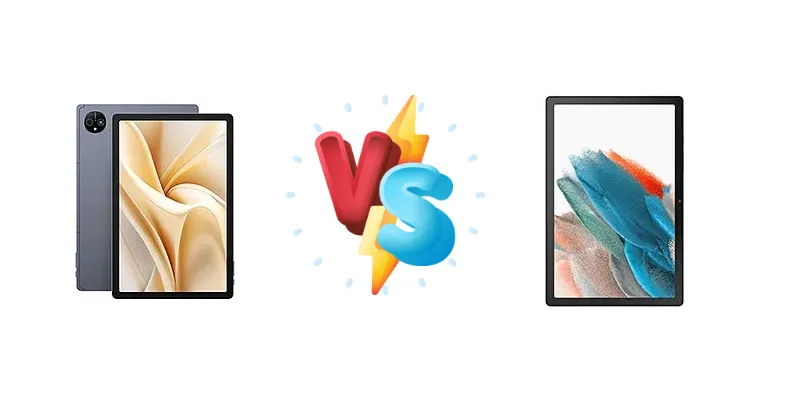
Ulefone Tab A11 Pro vs Samsung Galaxy Tab A8: Which Budget Tablet Reigns Supreme?
| Phones Images | |||||
|---|---|---|---|---|---|
|
🏆 Quick Verdict
For the average user prioritizing performance and future-proofing, the Ulefone Tab A11 Pro is the better choice. Its Mediatek Helio G99, built on a 6nm process, delivers a noticeable performance advantage and superior power efficiency compared to the Samsung Galaxy Tab A8’s 12nm Unisoc Tiger T618, making it ideal for gaming and multitasking.
| PHONES | ||
|---|---|---|
| Phone Names | Ulefone Tab A11 Pro | Samsung Galaxy Tab A8 10.5 (2021) |
| Network | ||
|---|---|---|
| 2G bands | GSM 850 / 900 / 1800 / 1900 | GSM 850 / 900 / 1800 / 1900 |
| 3G bands | HSDPA 850 / 900 / 1700(AWS) / 1900 / 2100 | HSDPA 850 / 900 / 1700(AWS) / 1900 / 2100 |
| 4G bands | 1, 2, 3, 4, 5, 7, 8, 12, 17, 20, 26, 28, 34, 38, 39, 40, 41 | 1, 2, 3, 4, 5, 7, 8, 12, 17, 20, 28, 38, 40, 41, 66 |
| Speed | HSPA, LTE | HSPA, LTE - cellular model only |
| Technology | GSM / HSPA / LTE | GSM / HSPA / LTE |
| Launch | ||
|---|---|---|
| Announced | 2024, June | 2021, December 15 |
| Status | Available. Released 2024, June | Available. Released 2022, January 17 |
| Body | ||
|---|---|---|
| Dimensions | 256.9 x 168.4 x 7.6 mm (10.11 x 6.63 x 0.30 in) | 246.8 x 161.9 x 6.9 mm (9.72 x 6.37 x 0.27 in) |
| SIM | Nano-SIM + Nano-SIM | Nano-SIM (cellular model only) |
| Weight | 500.5 g (1.10 lb) | 508 g (1.12 lb) |
| Display | ||
|---|---|---|
| Resolution | 1200 x 1920 pixels, 16:10 ratio (~206 ppi density) | 1200 x 1920 pixels, 16:10 ratio (~216 ppi density) |
| Size | 11.0 inches, 350.9 cm2 (~81.1% screen-to-body ratio) | 10.5 inches, 319.7 cm2 (~80.0% screen-to-body ratio) |
| Type | IPS LCD, 90Hz | TFT LCD |
| Platform | ||
|---|---|---|
| CPU | Octa-core (2x2.2 GHz Cortex-A76 & 6x2.0 GHz Cortex-A55) | Octa-core (2x2.0 GHz Cortex-A75 & 6x2.0 GHz Cortex-A55) |
| Chipset | Mediatek Helio G99 (6 nm) | Unisoc Tiger T618 (12 nm) |
| GPU | Mali-G57 MC2 | Mali G52 MP2 |
| OS | Android 14 | Android 11, upgradable to Android 14, One UI 6 |
| Memory | ||
|---|---|---|
| Card slot | microSDXC (uses shared SIM slot) | microSDXC (dedicated slot) |
| Internal | 128GB 8GB RAM, 256GB 8GB RAM | 32GB 2GB RAM, 32GB 3GB RAM, 64GB 2GB RAM, 64GB 3GB RAM, 64GB 4GB RAM, 128GB 3GB RAM, 128GB 4GB RAM |
| Main Camera | ||
|---|---|---|
| Features | LED flash, HDR, panorama | - |
| Single | 16 MP, f/2.2, (wide), 1.0µm | 8 MP, AF |
| Video | 1080p@30fps | 1080p@30fps |
| Selfie camera | ||
|---|---|---|
| Single | 8 MP | 5 MP |
| Video | Yes | 1080p@30fps |
| Sound | ||
|---|---|---|
| 3.5mm jack | - | Yes |
| 35mm jack | Yes | Yes |
| Loudspeaker | Yes, with stereo speakers (4 speakers) | Yes, with stereo speakers (4 speakers) |
| Comms | ||
|---|---|---|
| Bluetooth | 5.2, A2DP, LE | 5.0, A2DP, LE |
| NFC | No | No |
| Positioning | GPS, GLONASS, GALILEO, BDS | GPS, GLONASS, BDS, GALILEO, QZSS - cellular model only |
| Radio | FM radio, RDS, recording | No |
| USB | USB Type-C 2.0, OTG | USB Type-C 2.0 |
| WLAN | Wi-Fi 802.11 a/b/g/n/ac/6, dual-band | Wi-Fi 802.11 a/b/g/n/ac, dual-band, Wi-Fi Direct |
| Features | ||
|---|---|---|
| Sensors | Accelerometer, proximity (accessories only) | Accelerometer, gyro, proximity, compass |
| Battery | ||
|---|---|---|
| Charging | 18W wired | 15W wired |
| Type | Li-Po 8800 mAh | Li-Po 7040 mAh |
| Misc | ||
|---|---|---|
| Colors | Gray | Gray, Silver, Pink Gold |
| Models | - | SM-X200, SM-X205 |
| Price | About 200 EUR | About 230 EUR |
| SAR EU | - | 0.92 W/kg (body) |
Ulefone Tab A11 Pro
- More powerful and efficient Mediatek Helio G99 chipset
- Faster 18W charging
- Potentially longer battery life due to 6nm process
- Less established brand reputation
- Software updates may be less frequent
Samsung Galaxy Tab A8 10.5 (2021)
- Well-known and trusted Samsung brand
- Polished One UI software experience
- Generally reliable software updates
- Less powerful Unisoc Tiger T618 chipset
- Slower 15W charging
- Lower power efficiency
Display Comparison
Neither device boasts a particularly advanced display. While specific panel details (like brightness in nits or color gamut coverage) are unavailable, the focus here is on the internal hardware. Both are 10.5-inch displays, but the processing power driving the UI and video decoding will impact perceived smoothness. The A11 Pro’s more powerful GPU should translate to smoother video playback, especially with higher resolution content. Bezels are likely comparable given the price points, and color accuracy is expected to be standard for this segment.
Camera Comparison
Camera performance is unlikely to be a deciding factor for most buyers in this segment. Both tablets likely feature basic camera setups. Given the lack of detailed specifications, it’s safe to assume both will struggle in low-light conditions. The focus should be on video conferencing capabilities rather than photography. Any differences in image quality will likely be minimal and overshadowed by the limitations of the sensors and image processing.
Performance
The core differentiator lies in the chipsets. The Ulefone Tab A11 Pro’s Mediatek Helio G99 (6nm) is a significant upgrade over the Samsung Galaxy Tab A8’s Unisoc Tiger T618 (12nm). The 6nm fabrication process inherently offers better power efficiency, meaning the A11 Pro will generate less heat and consume less battery for the same level of performance. Architecturally, the G99 features two Cortex-A76 cores clocked at 2.2 GHz, paired with six Cortex-A55 cores at 2.0 GHz. The Tab A8 uses two Cortex-A75 cores at 2.0 GHz and six Cortex-A55 cores at 2.0 GHz. While core counts are similar, the A76 cores in the G99 offer a performance advantage over the A75 cores. This translates to faster app loading times, smoother multitasking, and a more responsive user experience. The G99’s integrated GPU will also provide a better gaming experience.
Battery Life
The Ulefone Tab A11 Pro’s 18W charging is slightly faster than the Samsung Galaxy Tab A8’s 15W charging. However, the real benefit of the G99’s 6nm process is its power efficiency. While battery capacity isn’t specified, the A11 Pro will likely achieve longer screen-on times and overall battery life due to its more efficient chipset. The faster charging will also reduce downtime, getting you back to using the tablet quicker.
Buying Guide
Buy the Ulefone Tab A11 Pro if you need a tablet capable of handling demanding applications, enjoy mobile gaming, and value a more efficient processor for longer battery life. Buy the Samsung Galaxy Tab A8 10.5 (2021) if you prioritize brand recognition, a polished software experience, and are primarily focused on basic media consumption and light tasks, accepting a trade-off in raw processing power.