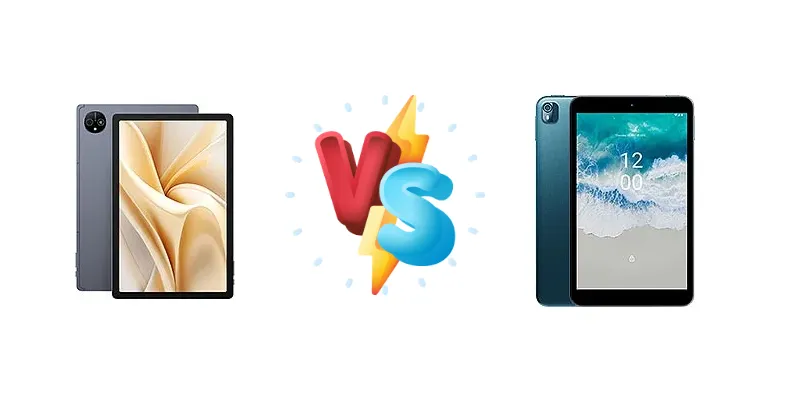
The Ulefone Tab A11 Pro and Nokia T10 represent compelling options in the increasingly crowded budget tablet space. While both aim to deliver an affordable Android experience, they diverge significantly in their core hardware, particularly in the chipset department. This comparison will dissect those differences, helping you determine which tablet best suits your needs.
🏆 Quick Verdict
For users prioritizing performance and responsiveness, the Ulefone Tab A11 Pro is the clear winner. Its Mediatek Helio G99 chipset offers a substantial advantage over the Nokia T10’s Unisoc T606, making it better suited for gaming and multitasking. However, the Nokia T10 remains a viable option for basic tasks and media consumption.
| Network |
|---|
| 2G bands | GSM 850 / 900 / 1800 / 1900 | GSM 850 / 900 / 1800 / 1900 |
| 3G bands | HSDPA 850 / 900 / 1700(AWS) / 1900 / 2100 | HSDPA 850 / 900 / 2100 |
| 4G bands | 1, 2, 3, 4, 5, 7, 8, 12, 17, 20, 26, 28, 34, 38, 39, 40, 41 | 1, 3, 5, 7, 8, 20, 28, 38, 40, 41 |
| Speed | HSPA, LTE | HSPA 42.2/5.76 Mbps, LTE Cat4 150/50 Mbps |
| Technology | GSM / HSPA / LTE | GSM / HSPA / LTE |
| Launch |
|---|
| Announced | 2024, June | 2022, July 12 |
| Status | Available. Released 2024, June | Available. Released 2022, August 20 |
| Body |
|---|
| Build | - | Glass front, plastic back, plastic frame |
| Dimensions | 256.9 x 168.4 x 7.6 mm (10.11 x 6.63 x 0.30 in) | 208 x 123.2 x 9 mm (8.19 x 4.85 x 0.35 in) |
| SIM | Nano-SIM + Nano-SIM | Nano-SIM |
| Weight | 500.5 g (1.10 lb) | 375 g (13.23 oz) |
| | - | Splash resistant |
| Display |
|---|
| Resolution | 1200 x 1920 pixels, 16:10 ratio (~206 ppi density) | 800 x 1280 pixels, 16:10 ratio (~189 ppi density) |
| Size | 11.0 inches, 350.9 cm2 (~81.1% screen-to-body ratio) | 8.0 inches, 185.6 cm2 (~72.4% screen-to-body ratio) |
| Type | IPS LCD, 90Hz | IPS LCD, 360 nits (typ), 450 nits (peak) |
| Platform |
|---|
| CPU | Octa-core (2x2.2 GHz Cortex-A76 & 6x2.0 GHz Cortex-A55) | Octa-core (2x1.6 GHz Cortex-A75 & 6x1.6 GHz Cortex-A55) |
| Chipset | Mediatek Helio G99 (6 nm) | Unisoc T606 (12 nm) |
| GPU | Mali-G57 MC2 | Mali-G57 MP1 |
| OS | Android 14 | Android 12, upgradable to Android 13 |
| Memory |
|---|
| Card slot | microSDXC (uses shared SIM slot) | microSDXC |
| Internal | 128GB 8GB RAM, 256GB 8GB RAM | 32GB 3GB RAM, 64GB 4GB RAM |
| Main Camera |
|---|
| Features | LED flash, HDR, panorama | LED flash |
| Single | 16 MP, f/2.2, (wide), 1.0µm | 8 MP, 1/4.0", 1.12µm, AF |
| Video | 1080p@30fps | 1080p |
| Selfie camera |
|---|
| Single | 8 MP | 2 MP, 1/5.0", 1.65µm |
| Video | Yes | 720p |
| Sound |
|---|
| 3.5mm jack | - | Yes |
| 35mm jack | Yes | Yes |
| Loudspeaker | Yes, with stereo speakers (4 speakers) | Yes, with stereo speakers |
| Comms |
|---|
| Bluetooth | 5.2, A2DP, LE | 5.0, A2DP, LE |
| NFC | No | No |
| Positioning | GPS, GLONASS, GALILEO, BDS | GPS, GLONASS, GALILEO |
| Radio | FM radio, RDS, recording | No |
| USB | USB Type-C 2.0, OTG | USB Type-C 2.0, OTG |
| WLAN | Wi-Fi 802.11 a/b/g/n/ac/6, dual-band | Wi-Fi 802.11 a/b/g/n/ac, dual-band |
| Features |
|---|
| Sensors | Accelerometer, proximity (accessories only) | Accelerometer, proximity |
| Battery |
|---|
| Charging | 18W wired | 10W wired |
| Type | Li-Po 8800 mAh | Li-Po 5250 mAh |
| Misc |
|---|
| Colors | Gray | Ocean Blue |
| Models | - | TA-1503, TA-1472, TA-1462, TA-1457 |
| Price | About 200 EUR | About 160 EUR |
| SAR | - | 1.19 W/kg (body) |
| SAR EU | - | 0.27 W/kg (head) 1.57 W/kg (body) |
Ulefone Tab A11 Pro
- Significantly faster processor (Helio G99)
- Faster 18W charging
- Potentially better gaming performance
- Likely higher price point
- Brand recognition is lower than Nokia
Nokia T10
- Lower price point
- Familiar Nokia brand
- Simple and user-friendly experience
- Slower processor (Unisoc T606)
- Slower 10W charging
- Limited performance for demanding tasks
Display Comparison
Neither device’s display specifications are provided, so a direct comparison is limited. However, given the A11 Pro’s focus on performance, it’s reasonable to expect a higher resolution or refresh rate panel than the T10. The Nokia T10, aligning with its budget positioning, likely utilizes a standard 60Hz IPS LCD. Bezels are likely to be more pronounced on the Nokia T10, contributing to a less immersive viewing experience. Color accuracy will likely be similar, leaning towards standard sRGB coverage on both.
Camera Comparison
Without specific camera sensor details, a detailed comparison is difficult. However, given the market segment, both tablets likely feature modest camera setups. It’s probable that the Ulefone Tab A11 Pro, positioned as a slightly more premium device, may have a higher resolution main sensor. The Unisoc T606’s image signal processor (ISP) is less capable than the one found in the Helio G99, meaning the A11 Pro will likely produce better image quality, particularly in low-light conditions. Expect both to include basic features, but don’t anticipate flagship-level camera performance.
Performance
The core difference lies in the chipsets. The Ulefone Tab A11 Pro’s Mediatek Helio G99, built on a 6nm process, significantly outperforms the Nokia T10’s Unisoc T606 (12nm). The G99’s Cortex-A76 cores, clocked at 2.2 GHz, provide a substantial CPU performance boost compared to the T10’s 1.6 GHz Cortex-A75 cores. This translates to faster app loading times, smoother multitasking, and a more responsive user interface. The 6nm node also implies better power efficiency, potentially offsetting the performance gains. While both are octa-core CPUs, the architectural advantages of the G99 are undeniable. The G99’s integrated GPU will also deliver a far superior gaming experience.
Battery Life
Battery capacity isn’t specified, but the charging speeds reveal a key difference. The Ulefone Tab A11 Pro’s 18W wired charging is significantly faster than the Nokia T10’s 10W charging. This means the A11 Pro will reach a full charge much quicker, minimizing downtime. While a larger battery capacity on the T10 could partially offset the slower charging, the A11 Pro’s faster charging is a significant convenience factor. The more efficient 6nm process of the G99 may also contribute to better battery life during typical usage.
Buying Guide
Buy the Ulefone Tab A11 Pro if you need a tablet capable of handling demanding applications, light gaming, and smoother multitasking. Its more powerful processor and faster charging will appeal to users who value performance. Buy the Nokia T10 if you prioritize simplicity, a familiar brand reputation, and a lower price point for basic tasks like web browsing, video streaming, and reading – and aren’t concerned with pushing the tablet’s performance limits.
Frequently Asked Questions
❓ Will the Ulefone Tab A11 Pro handle demanding games like Genshin Impact or Call of Duty Mobile?
While the Helio G99 is capable, don't expect flagship-level performance. Genshin Impact will likely require low to medium settings for playable frame rates. Call of Duty Mobile should run more smoothly, but sustained performance may be limited by thermal throttling. It's a step up from the T10, but still a budget gaming experience.
❓ Is the Unisoc T606 in the Nokia T10 sufficient for everyday tasks like browsing, email, and video streaming?
Yes, the Unisoc T606 is perfectly adequate for basic tasks. Web browsing, email, and video streaming (YouTube, Netflix) will run smoothly. However, multitasking with several apps open simultaneously may result in noticeable slowdowns. It's designed for light usage, not power users.
❓ How long will it take to fully charge each tablet from 0%?
With 18W charging, the Ulefone Tab A11 Pro should fully charge in approximately 2.5 to 3.5 hours, depending on battery capacity. The Nokia T10, with its 10W charging, will likely take 4 to 6 hours for a full charge. This is a significant difference for users who need quick top-ups.