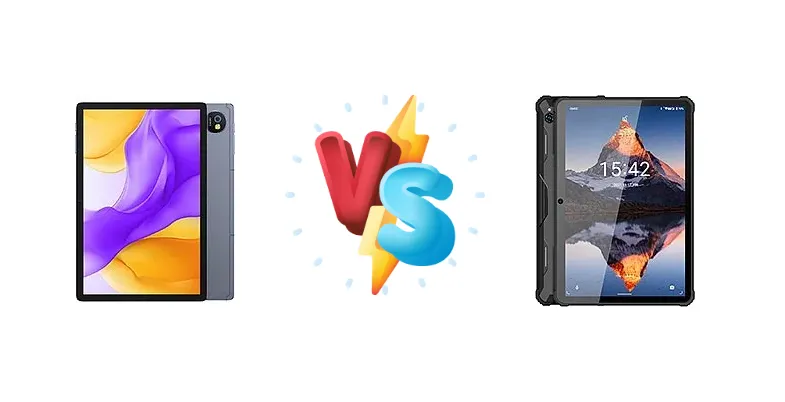
The Ulefone Tab A10 and Oukitel RT1 represent the increasingly competitive sub-$200 tablet market. Both aim to deliver a functional Android experience without breaking the bank, but they take different approaches to achieving this. The key differentiator lies in their chipsets, impacting everything from everyday responsiveness to sustained performance during demanding tasks.
🏆 Quick Verdict
For the average user prioritizing consistent performance and longer-term usability, the Ulefone Tab A10 is the better choice. Its Unisoc T615 chipset, featuring Cortex-A75 cores, provides a noticeable advantage over the Oukitel RT1’s older Helio P22, despite the RT1’s slightly higher clock speed on paper.
| Network |
|---|
| 2G bands | GSM 850 / 900 / 1800 / 1900 | GSM 850 / 900 / 1800 / 1900 |
| 3G bands | HSDPA 850 / 900 / 1700(AWS) / 1900 / 2100 | HSDPA 900 / 2100 |
| 4G bands | 1, 2, 3, 4, 5, 7, 8, 12, 13, 17, 20, 26, 28, 34, 38, 39, 40, 41, 66, 71 | 1, 3, 7, 8, 19, 20 |
| Speed | HSPA, LTE | HSPA, LTE |
| Technology | GSM / HSPA / LTE | GSM / HSPA / LTE |
| Launch |
|---|
| Announced | 2025, March | 2021, November |
| Status | Available. Released 2025, March | Available. Released 2021, December |
| Body |
|---|
| Dimensions | 237.7 x 156.5 x 7.8 mm (9.36 x 6.16 x 0.31 in) | - |
| SIM | Nano-SIM + Nano-SIM | Nano-SIM + Nano-SIM |
| Weight | 452.5 g (1.00 lb) | - |
| Display |
|---|
| Protection | Mohs level 4 | - |
| Resolution | 800 x 1280 pixels, 16:10 ratio (~149 ppi density) | 1200 x 1920 pixels, 16:10 ratio (~224 ppi density) |
| Size | 10.1 inches, 295.8 cm2 (~79.5% screen-to-body ratio) | 10.1 inches, 295.8 cm2 |
| Type | IPS LCD, 400 nits | IPS LCD |
| Platform |
|---|
| CPU | Octa-core (2x1.8 GHz Cortex-A75 & 6x1.6 GHz Cortex-A55) | Octa-core 2.0 GHz Cortex-A53 |
| Chipset | Unisoc T615 (12 nm) | Mediatek MT8768WA Helio P22 (12 nm) |
| GPU | Mali-G57 MP1 | PowerVR GE8320 |
| OS | Android 15 | Android 11 |
| Memory |
|---|
| Card slot | microSDXC (uses shared SIM slot) | microSDXC (uses shared SIM slot) |
| Internal | 128GB 4GB RAM | 64GB 4GB RAM |
| Main Camera |
|---|
| Features | LED flash, HDR, panorama | LED flash, panorama |
| Single | 13 MP, f/2.0, (wide) | 16 MP |
| Video | 1080p@30fps | 1080p@30fps |
| Selfie camera |
|---|
| Single | 5 MP, f/2.2, (wide) | 16 MP |
| Video | Yes | Yes |
| Sound |
|---|
| 35mm jack | Yes | Unspecified |
| Loudspeaker | Yes, with stereo speakers | Yes |
| Comms |
|---|
| Bluetooth | 5.0, A2DP, LE | Yes |
| NFC | No | No |
| Positioning | GPS, GLONASS, GALILEO, BDS | GPS, GLONASS, GALILEO, BDS |
| Radio | FM radio, RDS, recording | Unspecified |
| USB | USB Type-C 2.0, OTG | Yes |
| WLAN | Wi-Fi 802.11 a/b/g/n/ac, dual-band | Yes |
| Features |
|---|
| Sensors | Accelerometer, proximity (accessories only) | Unspecified |
| Battery |
|---|
| Charging | 18W wired | - |
| Type | Li-Po 6600 mAh | Li-Po 10000 mAh |
| Misc |
|---|
| Colors | Space Gray | Black, Orange |
| Price | - | About 220 EUR |
| EU LABEL |
|---|
| Battery | 66:45h endurance, 1000 cycles | - |
| Energy | Class F | - |
| Free fall | Class D (52 falls) | - |
| Repairability | Class B | - |
Ulefone Tab A10
- Superior chipset performance with Cortex-A75 cores
- Excellent battery endurance (66:45h)
- Advertised 1000 charge cycles for long-term battery health
- Limited detailed specifications available
- Likely basic camera performance
Oukitel RT1
- Potentially lower price point
- Acceptable for very basic tasks
- 12nm process node
- Outdated Helio P22 chipset with Cortex-A53 cores
- Likely shorter battery life
- Slower overall performance
Display Comparison
Neither Ulefone nor Oukitel provide detailed display specifications. However, given the price bracket, both likely utilize IPS LCD panels. The performance difference will be negligible. The focus here is on chipset performance, as display quality is unlikely to be a deciding factor.
Camera Comparison
Both tablets likely feature basic camera setups geared towards casual use. Without detailed sensor information, a meaningful comparison is difficult. It’s safe to assume image quality will be similar, and neither device will compete with dedicated cameras or higher-end tablets. Focusing on the chipset difference is more relevant for the overall user experience.
Performance
The Ulefone Tab A10’s Unisoc T615 chipset is the clear winner in this comparison. While the Oukitel RT1 boasts a 2.0 GHz clock speed on its Helio P22, the architecture is significantly older, relying on Cortex-A53 cores. The T615’s combination of two Cortex-A75 cores (1.8 GHz) and six Cortex-A55 cores (1.6 GHz) provides a substantial boost in both single-core and multi-core performance. This translates to snappier app launches, smoother scrolling, and a more responsive user interface. The T615’s 12nm process node is also comparable to the P22’s, suggesting similar thermal efficiency, but the core architecture is the key advantage.
Battery Life
The Ulefone Tab A10 boasts a 66:45h endurance rating, suggesting excellent battery life. While the Oukitel RT1’s endurance isn’t specified, the less efficient Helio P22 chipset will likely result in shorter runtimes. The A10’s 18W wired charging is standard for this price range, and the advertised 1000 charge cycles indicate a focus on long-term battery health. The A10’s superior chipset efficiency will contribute to longer usage times between charges.
Buying Guide
Buy the Ulefone Tab A10 if you need a tablet capable of handling multitasking, moderate gaming, and video streaming without significant slowdowns. Its more modern chipset architecture ensures a smoother experience over the device’s lifespan. Buy the Oukitel RT1 if your primary use case is extremely light – primarily reading ebooks, browsing the web with few tabs open, and basic media consumption – and you’re prioritizing the absolute lowest price point.
Frequently Asked Questions
❓ Will the Ulefone Tab A10 handle demanding games like PUBG Mobile?
While the Unisoc T615 can run PUBG Mobile, expect to play at lower graphics settings and frame rates for a smooth experience. It’s not a gaming powerhouse, but it’s significantly better suited for gaming than the Oukitel RT1’s Helio P22.
❓ Is the difference in CPU architecture between the Unisoc T615 and Helio P22 noticeable in everyday use?
Yes, the difference is quite noticeable. The T615’s Cortex-A75 cores provide a significant performance boost in tasks like app launching, web browsing, and multitasking. The RT1’s older Cortex-A53 cores will struggle with these tasks, resulting in a less responsive experience.
❓ How does the 1000 charge cycle claim for the Ulefone Tab A10 affect its long-term value?
The 1000 charge cycle claim suggests the battery is designed to retain a significant portion of its capacity even after extended use. This is a valuable feature, as battery degradation is a common issue with tablets, potentially extending the usable lifespan of the Ulefone Tab A10.