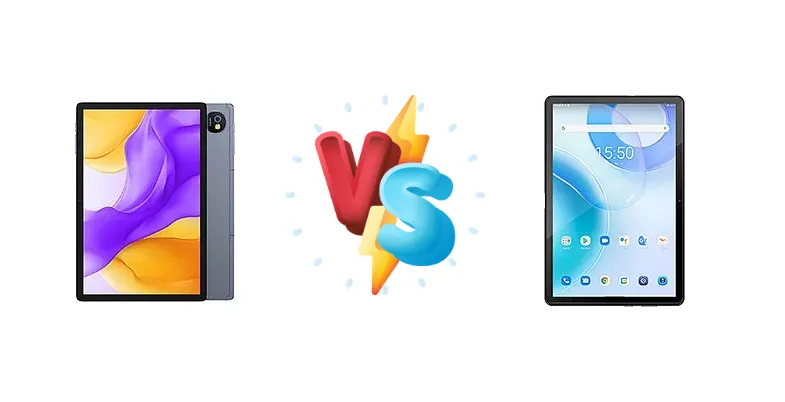
The Ulefone Tab A10 and Blackview Tab 10 Pro represent a growing segment of affordable Android tablets aiming to deliver a functional experience without breaking the bank. Both devices target users needing a larger screen for media consumption and light productivity, but they diverge significantly in their core hardware choices, particularly in chipset and charging technology. This comparison dives deep into those differences to determine which tablet offers the best value.
🏆 Quick Verdict
For the average user prioritizing quick top-ups and slightly better CPU performance, the Blackview Tab 10 Pro is the stronger choice. Its 30W charging significantly reduces downtime compared to the Ulefone Tab A10’s 18W. While the Ulefone boasts impressive battery endurance, the charging speed difference is a practical advantage for most.
| Network |
|---|
| 2G bands | GSM 850 / 900 / 1800 / 1900 | GSM 850 / 900 / 1800 / 1900 |
| 3G bands | HSDPA 850 / 900 / 1700(AWS) / 1900 / 2100 | HSDPA 900 / 2100 |
| 4G bands | 1, 2, 3, 4, 5, 7, 8, 12, 13, 17, 20, 26, 28, 34, 38, 39, 40, 41, 66, 71 | 1, 3, 7, 8, 20, 40 |
| Speed | HSPA, LTE | HSPA, LTE |
| Technology | GSM / HSPA / LTE | GSM / HSPA / LTE |
| Launch |
|---|
| Announced | 2025, March | 2021, December 16 |
| Status | Available. Released 2025, March | Available. Released 2021, December |
| Body |
|---|
| Dimensions | 237.7 x 156.5 x 7.8 mm (9.36 x 6.16 x 0.31 in) | 243 x 162 x 8.8 mm (9.57 x 6.38 x 0.35 in) |
| SIM | Nano-SIM + Nano-SIM | Nano-SIM + Nano-SIM |
| Weight | 452.5 g (1.00 lb) | 588 g (1.30 lb) |
| Display |
|---|
| Protection | Mohs level 4 | Asahi Glass |
| Resolution | 800 x 1280 pixels, 16:10 ratio (~149 ppi density) | 1200 x 1920 pixels, 16:10 ratio (~224 ppi density) |
| Size | 10.1 inches, 295.8 cm2 (~79.5% screen-to-body ratio) | 10.1 inches, 295.8 cm2 (~75.1% screen-to-body ratio) |
| Type | IPS LCD, 400 nits | IPS LCD |
| Platform |
|---|
| CPU | Octa-core (2x1.8 GHz Cortex-A75 & 6x1.6 GHz Cortex-A55) | Octa-core (4x2.0 GHz Cortex-A73 & 4x2.0 GHz Cortex-A53) |
| Chipset | Unisoc T615 (12 nm) | Mediatek MT8788V |
| GPU | Mali-G57 MP1 | Mali-G72 MP3 |
| OS | Android 15 | Android 11 |
| Memory |
|---|
| Card slot | microSDXC (uses shared SIM slot) | microSDXC |
| Internal | 128GB 4GB RAM | 128GB 8GB RAM |
| Main Camera |
|---|
| Features | LED flash, HDR, panorama | LED flash |
| Single | 13 MP, f/2.0, (wide) | 13 MP, f/2.2, (wide) |
| Video | 1080p@30fps | 1080p@30fps |
| Selfie camera |
|---|
| Single | 5 MP, f/2.2, (wide) | 8 MP, f/2.2, (wide) |
| Video | Yes | 1080p@30fps |
| Sound |
|---|
| 35mm jack | Yes | No |
| Loudspeaker | Yes, with stereo speakers | Yes, with stereo speakers |
| Comms |
|---|
| Bluetooth | 5.0, A2DP, LE | 5.0, A2DP, LE |
| NFC | No | No |
| Positioning | GPS, GLONASS, GALILEO, BDS | GPS, GLONASS, BDS |
| Radio | FM radio, RDS, recording | FM radio |
| USB | USB Type-C 2.0, OTG | USB Type-C, OTG |
| WLAN | Wi-Fi 802.11 a/b/g/n/ac, dual-band | Wi-Fi 802.11 a/b/g/n/ac, dual-band |
| Features |
|---|
| Sensors | Accelerometer, proximity (accessories only) | Accelerometer, gyro, proximity, compass |
| Battery |
|---|
| Charging | 18W wired | 30W wired |
| Type | Li-Po 6600 mAh | 6580 mAh |
| Misc |
|---|
| Colors | Space Gray | Gray, Gold, Silver |
| Price | - | About 220 EUR |
| EU LABEL |
|---|
| Battery | 66:45h endurance, 1000 cycles | - |
| Energy | Class F | - |
| Free fall | Class D (52 falls) | - |
| Repairability | Class B | - |
Ulefone Tab A10
- Exceptional battery endurance (66:45h)
- Long-term battery health with 1000 charge cycles
- Potentially more efficient CPU architecture (Cortex-A75)
- Slow 18W charging
- Less powerful CPU compared to the Blackview
Blackview Tab 10 Pro
- Faster 30W charging
- More powerful CPU with Cortex-A73 cores
- Snappier multitasking performance
- Battery endurance likely lower than the Ulefone
- Potentially shorter battery lifespan (unknown charge cycles)
Display Comparison
Display specifications are not provided, so a direct comparison is limited. However, given the price point, both tablets likely utilize IPS LCD panels. The absence of details like resolution, peak brightness, or refresh rate suggests neither device is aiming for display excellence. Users should expect adequate, but not exceptional, viewing experiences. Bezels are likely to be noticeable on both models, typical for this market segment.
Camera Comparison
Camera details are minimal. Without sensor size or aperture information, a meaningful comparison is impossible. It’s safe to assume both tablets feature basic camera setups geared towards casual snapshots rather than serious photography. The absence of details suggests neither device will excel in low-light conditions or offer advanced features like optical image stabilization. Users should manage expectations accordingly.
Performance
The core performance difference lies in the chipsets. The Blackview Tab 10 Pro’s Mediatek MT8788V features four Cortex-A73 cores clocked at 2.0 GHz, paired with four Cortex-A53 cores. This architecture provides a noticeable uplift in single-core and multi-core performance compared to the Ulefone Tab A10’s Unisoc T615. The T615 utilizes two Cortex-A75 cores at 1.8 GHz and six Cortex-A55 cores. While the A75 is more efficient than the A53, the A73 offers a higher peak clock speed and generally better performance in demanding tasks. This translates to snappier app launches and smoother multitasking on the Blackview. The Unisoc T615’s 12nm process node is competitive, but the MT8788V’s architecture gives it an edge.
Battery Life
The Ulefone Tab A10 boasts an impressive 66:45h endurance rating, suggesting excellent battery life for typical usage. However, its 18W wired charging is comparatively slow. The Blackview Tab 10 Pro, while lacking a specified battery capacity, compensates with 30W wired charging. This faster charging speed significantly reduces the time required to replenish the battery, making it more convenient for users who frequently use their tablet throughout the day. The Ulefone’s 1000 charge cycles suggest a focus on long-term battery health, but the slower charging speed is a trade-off.
Buying Guide
Buy the Ulefone Tab A10 if you prioritize maximizing screen-on time and anticipate infrequent charging opportunities, making its 66:45h endurance a key benefit. Buy the Blackview Tab 10 Pro if you value faster charging and a slightly more responsive user experience, particularly when multitasking, thanks to the Cortex-A73 cores in its Mediatek chipset.
Frequently Asked Questions
❓ Will the Mediatek MT8788V in the Blackview Tab 10 Pro struggle with demanding games?
While the MT8788V is a capable chipset for everyday tasks, it's not a gaming powerhouse. Expect to play less graphically intensive games smoothly, but demanding titles like PUBG or Genshin Impact will likely require reduced graphics settings and may still experience occasional frame drops. It's best suited for casual gaming.
❓ How long will it realistically take to fully charge the Ulefone Tab A10 with its 18W charger?
Given the lack of battery capacity information, a precise estimate is difficult. However, with 18W charging, a full charge from 0% will likely take between 3.5 to 5 hours. This is considerably longer than the Blackview Tab 10 Pro’s 30W charging.
❓ Is the Unisoc T615 chipset in the Ulefone Tab A10 sufficient for video streaming and web browsing?
Yes, the Unisoc T615 is perfectly adequate for video streaming (YouTube, Netflix) and web browsing. It's designed for efficient performance in everyday tasks and won't struggle with these common use cases. The focus on Cortex-A55 cores contributes to good power efficiency during these activities.