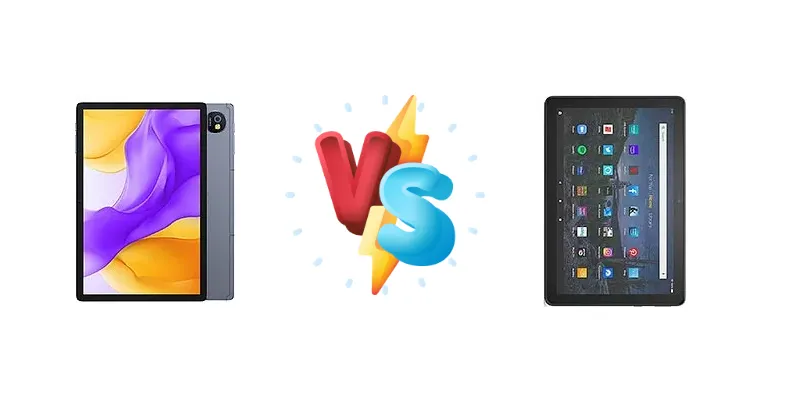
The budget tablet market is fiercely competitive, with options like the Ulefone Tab A10 and Amazon Fire HD 10 Plus (2021) vying for your attention. Both aim to deliver a functional tablet experience without breaking the bank, but they take different approaches. The Ulefone focuses on a more standard Android experience with a newer chipset, while the Fire HD 10 Plus leverages Amazon’s ecosystem and offers wireless charging. This comparison dives deep into the specs and real-world implications to determine which tablet provides the best value.
🏆 Quick Verdict
For users prioritizing raw performance and a standard Android experience, the Ulefone Tab A10 emerges as the winner. Its Unisoc T615 chipset, featuring Cortex-A75 cores, offers a noticeable performance edge over the Fire HD 10 Plus’s older Helio P60T. However, the Fire HD 10 Plus’s wireless charging and Amazon ecosystem integration make it a compelling choice for existing Amazon users.
| Network |
|---|
| 2G bands | GSM 850 / 900 / 1800 / 1900 | N/A |
| 3G bands | HSDPA 850 / 900 / 1700(AWS) / 1900 / 2100 | - |
| 4G bands | 1, 2, 3, 4, 5, 7, 8, 12, 13, 17, 20, 26, 28, 34, 38, 39, 40, 41, 66, 71 | - |
| EDGE | - | No |
| GPRS | - | No |
| Speed | HSPA, LTE | - |
| Technology | GSM / HSPA / LTE | No cellular connectivity |
| Launch |
|---|
| Announced | 2025, March | 2021, April 27. Released 2021, May 26 |
| Status | Available. Released 2025, March | Discontinued |
| Body |
|---|
| Dimensions | 237.7 x 156.5 x 7.8 mm (9.36 x 6.16 x 0.31 in) | 247 x 166 x 9.2 mm (9.72 x 6.54 x 0.36 in) |
| SIM | Nano-SIM + Nano-SIM | No |
| Weight | 452.5 g (1.00 lb) | 468 g (1.03 lb) |
| Display |
|---|
| Protection | Mohs level 4 | Aluminosilicate glass |
| Resolution | 800 x 1280 pixels, 16:10 ratio (~149 ppi density) | 1920 x 1200 pixels, 16:10 ratio (~224 ppi density) |
| Size | 10.1 inches, 295.8 cm2 (~79.5% screen-to-body ratio) | 10.1 inches, 295.8 cm2 (~72.1% screen-to-body ratio) |
| Type | IPS LCD, 400 nits | IPS LCD |
| Platform |
|---|
| CPU | Octa-core (2x1.8 GHz Cortex-A75 & 6x1.6 GHz Cortex-A55) | Octa-core (4x2.0 GHz Cortex-A73 & 4x2.0 GHz Cortex-A53) |
| Chipset | Unisoc T615 (12 nm) | Mediatek MT8183 Helio P60T (12 nm) |
| GPU | Mali-G57 MP1 | Mali-G72 MP3 |
| OS | Android 15 | Android 9.0 (Pie), Fire OS 7 |
| Memory |
|---|
| Card slot | microSDXC (uses shared SIM slot) | microSDXC (dedicated slot) |
| Internal | 128GB 4GB RAM | 32GB 4GB RAM, 64GB 4GB RAM |
| | - | eMMC 5.1 |
| Main Camera |
|---|
| Features | LED flash, HDR, panorama | - |
| Single | 13 MP, f/2.0, (wide) | 5 MP |
| Video | 1080p@30fps | 720p |
| Selfie camera |
|---|
| Single | 5 MP, f/2.2, (wide) | 2 MP |
| Video | Yes | 720p |
| Sound |
|---|
| 3.5mm jack | - | Yes |
| 35mm jack | Yes | Yes |
| Loudspeaker | Yes, with stereo speakers | Yes, with stereo speakers |
| Comms |
|---|
| Bluetooth | 5.0, A2DP, LE | 5.0, A2DP, LE |
| NFC | No | No |
| Positioning | GPS, GLONASS, GALILEO, BDS | No |
| Radio | FM radio, RDS, recording | No |
| USB | USB Type-C 2.0, OTG | USB Type-C 2.0, OTG |
| WLAN | Wi-Fi 802.11 a/b/g/n/ac, dual-band | Wi-Fi 802.11 a/b/g/n/ac, dual-band |
| Features |
|---|
| Sensors | Accelerometer, proximity (accessories only) | Accelerometer |
| | - | Text-to-Speech English-language content reader |
| Battery |
|---|
| Charging | 18W wired | Wireless |
| Type | Li-Po 6600 mAh | Li-Ion |
| Misc |
|---|
| Colors | Space Gray | Slate |
| Models | - | T76N2P |
| Price | - | About 150 EUR |
| EU LABEL |
|---|
| Battery | 66:45h endurance, 1000 cycles | - |
| Energy | Class F | - |
| Free fall | Class D (52 falls) | - |
| Repairability | Class B | - |
Ulefone Tab A10
- More powerful CPU architecture (Cortex-A75)
- Longer battery endurance (66:45h)
- Standard Android experience
- Lacks wireless charging
- No Amazon ecosystem integration
Amazon Fire HD 10 Plus (2021)
- Wireless charging convenience
- Deep Amazon ecosystem integration
- Alexa hands-free support
- Older CPU architecture (Cortex-A73)
- Potentially shorter battery life
- Fire OS limitations
Display Comparison
Neither device boasts a cutting-edge display. Both utilize 12nm chipsets, suggesting similar power constraints impacting display capabilities. While specific display specs (resolution, brightness) are missing, the focus here is on the underlying processing power. The Ulefone Tab A10’s newer chipset could potentially handle more complex display processing tasks, like HDR content, more efficiently. However, without concrete display data, this remains speculative. The Fire HD 10 Plus’s display is likely optimized for Amazon’s content library, prioritizing color accuracy for video streaming.
Camera Comparison
Camera performance is unlikely to be a deciding factor for either tablet. Given the budget nature of both devices, image quality will be adequate for casual snapshots but not competitive with smartphones. Specific camera specs are unavailable, but it’s safe to assume both feature basic camera setups. Focusing on the chipset, the Ulefone Tab A10’s image signal processor (ISP) within the T615 may offer slightly better image processing capabilities due to its newer design, potentially resulting in marginally improved image quality.
Performance
The core difference lies in the chipsets. The Ulefone Tab A10’s Unisoc T615, built on a 12nm process, features a more modern CPU architecture with 2x 1.8 GHz Cortex-A75 cores and 6x 1.6 GHz Cortex-A55 cores. This contrasts with the Amazon Fire HD 10 Plus’s MediaTek MT8183 Helio P60T, which uses 4x 2.0 GHz Cortex-A73 cores and 4x 2.0 GHz Cortex-A53 cores. The Cortex-A75 cores in the Ulefone offer a significant architectural advantage, delivering better single-core performance crucial for responsive app launching and smoother multitasking. While both are 12nm, the newer architecture of the T615 translates to a more efficient and powerful experience.
Battery Life
The Ulefone Tab A10 boasts an impressive 66:45h endurance rating, suggesting excellent battery life. This is likely due to the efficiency of the Unisoc T615 chipset and optimized power management. The Fire HD 10 Plus, while lacking a specific endurance rating, compensates with the convenience of wireless charging. The Ulefone Tab A10’s 18W wired charging is standard, while the Fire HD 10 Plus’s wireless charging offers a more flexible charging solution. The longer endurance of the Ulefone, however, reduces the reliance on frequent charging.
Buying Guide
Buy the Ulefone Tab A10 if you need a tablet for general productivity, media consumption, and light gaming with a clean Android interface. It’s ideal for users who want more control over their tablet experience and aren’t heavily invested in the Amazon ecosystem. Buy the Amazon Fire HD 10 Plus (2021) if you prefer a tablet deeply integrated with Amazon services – Prime Video, Kindle, Alexa – and value the convenience of wireless charging. It’s best suited for users already committed to Amazon’s ecosystem and prioritize ease of use over raw performance.
Frequently Asked Questions
❓ Does the Unisoc T615 in the Ulefone Tab A10 struggle with demanding games?
While the Unisoc T615 isn't a flagship gaming chip, its Cortex-A75 cores provide a noticeable performance boost over the Helio P60T. It can handle most casual games at medium settings. However, graphically intensive titles may require lower settings for a smooth experience. The T615’s efficiency also helps mitigate throttling during extended gaming sessions.
❓ How much does Amazon’s Fire OS limit customization on the Fire HD 10 Plus?
Fire OS is heavily customized and lacks the open nature of standard Android. Customization options are limited, and access to the Google Play Store requires sideloading. This means you’re largely confined to Amazon’s Appstore, which has a smaller selection of apps. Users who prefer a more flexible and customizable Android experience will find Fire OS restrictive.
❓ Is the 18W charging on the Ulefone Tab A10 slow compared to wireless charging on the Fire HD 10 Plus?
While wireless charging is convenient, it's generally slower than wired charging. 18W wired charging on the Ulefone Tab A10 will likely deliver a faster 0-100% charge time than the Fire HD 10 Plus’s wireless charging. The Ulefone’s longer battery endurance also means you’ll need to charge it less frequently.