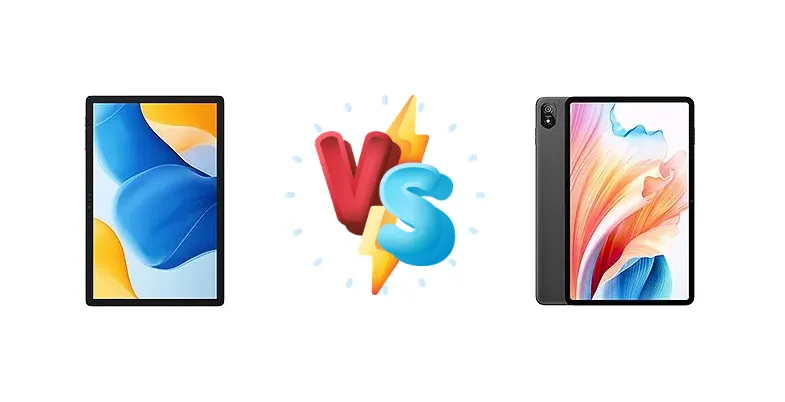
The budget Android tablet market is heating up, with options like the Ulefone Tab A10 Pro and Blackview Tab 18 vying for attention. While both aim to deliver an affordable tablet experience, they take distinctly different approaches to performance and longevity. The Ulefone prioritizes extended battery life, while the Blackview focuses on a more modern and powerful chipset. This comparison will dissect the key differences to help you choose the right tablet for your needs.
🏆 Quick Verdict
For most users, the Blackview Tab 18 emerges as the better choice. Its Mediatek Helio G99 chipset, built on a 6nm process, offers a significant performance uplift over the Ulefone Tab A10 Pro’s MT8786. While the Ulefone boasts impressive battery endurance, the Blackview’s faster 33W charging mitigates any concerns about power depletion, making it the more versatile option.
| Network |
|---|
| 2G bands | GSM 850 / 900 / 1800 / 1900 | GSM 850 / 900 / 1800 / 1900 |
| 3G bands | HSDPA 850 / 900 / 1700(AWS) / 1900 / 2100 | HSDPA 900 / 2100 |
| 4G bands | 1, 2, 3, 4, 5, 7, 8, 12, 13, 17, 20, 26, 28, 34, 38, 39, 40, 41, 66, 71 | 1, 3, 7, 8, 20, 40 |
| Speed | HSPA, LTE | HSPA, LTE |
| Technology | GSM / HSPA / LTE | GSM / HSPA / LTE |
| Launch |
|---|
| Announced | 2024, November | 2023, November |
| Status | Available. Released 2024, November | Available. Released 2023, November |
| Body |
|---|
| Dimensions | 237.7 x 156.5 x 7.8 mm (9.36 x 6.16 x 0.31 in) | 277.6 x 173.2 x 7.9 mm (10.93 x 6.82 x 0.31 in) |
| SIM | Nano-SIM + Nano-SIM | Nano-SIM + Nano-SIM |
| Weight | 446 g (15.73 oz) | 632 g (1.39 lb) |
| Display |
|---|
| Protection | Mohs level 4 | - |
| Resolution | 800 x 1280 pixels, 16:10 ratio (~149 ppi density) | 1200 x 2000 pixels, 5:3 ratio (~194 ppi density) |
| Size | 10.1 inches, 295.8 cm2 (~79.5% screen-to-body ratio) | 12.0 inches, 409.9 cm2 (~85.2% screen-to-body ratio) |
| Type | IPS LCD | IPS LCD, 350 nits |
| Platform |
|---|
| CPU | Octa-core (2x2.0 GHz Cortex-A75 & 6x1.7 GHz Cortex-A55) | Octa-core (2x2.2 GHz Cortex-A76 & 6x2.0 GHz Cortex-A55) |
| Chipset | Mediatek MT8786 (12 nm) | Mediatek Helio G99 (6 nm) |
| GPU | Mali-G52 | Mali-G57 MC2 |
| OS | Android 14 | Android 13, Doke OS_P 4.0 |
| Memory |
|---|
| Card slot | microSDXC (uses shared SIM slot) | microSDXC (uses shared SIM slot) |
| Internal | 128GB 6GB RAM | 256GB 12GB RAM |
| Main Camera |
|---|
| Features | LED flash, HDR, panorama | LED flash |
| Single | 13 MP | 16 MP |
| Video | 1080p@30fps | 1080p@30fps |
| Selfie camera |
|---|
| Single | 5 MP | 8 MP |
| Video | Yes | Yes |
| Sound |
|---|
| 35mm jack | Yes | No |
| Loudspeaker | Yes, with stereo speakers | Yes, with stereo speakers (4 speakers) |
| Comms |
|---|
| Bluetooth | 5.0, A2DP, LE | 5.1, A2DP, LE |
| NFC | No | No |
| Positioning | GPS, GLONASS, GALILEO, BDS | GPS, GLONASS, GALILEO, BDS |
| Radio | FM radio, RDS, recording | FM Radio |
| USB | USB Type-C 2.0, OTG | USB Type-C, OTG |
| WLAN | Wi-Fi 802.11 a/b/g/n/ac, dual-band | Wi-Fi 802.11 a/b/g/n/ac, dual-band |
| Features |
|---|
| Sensors | Accelerometer, proximity (accessories only) | Fingerprint (side-mounted), accelerometer, gyro, proximity, compass |
| Battery |
|---|
| Charging | 18W wired | 33W wired |
| Type | Li-Po 6600 mAh | 8800 mAh |
| Misc |
|---|
| Colors | Gray | Turquoise Green, Glacier Blue, Space Grey |
| EU LABEL |
|---|
| Battery | 67:09h endurance, 1000 cycles | - |
| Energy | Class F | - |
| Free fall | Class D (52 falls) | - |
| Repairability | Class B | - |
Ulefone Tab A10 Pro
- Exceptional battery endurance (67:09h)
- Potentially longer battery lifespan (1000 cycles)
- Lower price point (likely)
- Older, less powerful chipset (MT8786)
- Slower charging speed (18W)
- Less responsive user experience
Blackview Tab 18
- More powerful and efficient chipset (Helio G99)
- Faster charging speed (33W)
- Smoother multitasking and gaming
- Potentially shorter battery life (compared to Ulefone)
- May be slightly more expensive
- Battery health over long term is unknown
Display Comparison
Display specifications are not provided, so a direct comparison is limited. However, given the price points, both tablets likely utilize IPS LCD panels. The Blackview Tab 18’s more modern chipset suggests a potentially higher resolution or refresh rate, though this is speculative. Bezels are likely comparable, focusing on cost optimization. Color accuracy will likely be standard for this segment, prioritizing viewing angles over professional color grading.
Camera Comparison
Camera details are absent, making a detailed comparison impossible. However, based on the market segment, both tablets likely feature modest camera setups focused on basic functionality. Expect a primary sensor for daylight photography and potentially a secondary sensor for depth information. Image processing will likely be software-driven, prioritizing simplicity over advanced features. The absence of detailed specs suggests neither tablet will excel in photography.
Performance
The core difference lies in the chipsets. The Blackview Tab 18’s Mediatek Helio G99 (6nm) represents a substantial leap forward compared to the Ulefone Tab A10 Pro’s Mediatek MT8786 (12nm). The 6nm process node inherently offers better power efficiency and thermal performance, allowing the G99 to sustain higher clock speeds for longer. The CPU architecture also favors the Blackview: Cortex-A76 cores (2x2.2 GHz) in the G99 outperform the Cortex-A75 cores (2x2.0 GHz) in the MT8786. This translates to snappier app launches, smoother multitasking, and improved gaming performance. While both are octa-core designs, the G99’s architecture is demonstrably more capable.
Battery Life
The Ulefone Tab A10 Pro boasts a remarkable 67:09h endurance rating, indicating exceptional battery life. However, the Blackview Tab 18 compensates with significantly faster 33W wired charging. While the exact battery capacity of the Blackview is unknown, the faster charging speed means less downtime. The Ulefone’s 18W charging will take considerably longer to reach a full charge. The 1000 cycle claim for the Ulefone suggests a focus on long-term battery health, but the G99’s efficiency may mitigate battery degradation over time in the Blackview.
Buying Guide
Buy the Ulefone Tab A10 Pro if you absolutely prioritize maximum battery life and are willing to sacrifice some processing power for it. This tablet is ideal for users who primarily consume media, read ebooks, or browse the web for extended periods without access to frequent charging. Buy the Blackview Tab 18 if you value a smoother, more responsive user experience, enjoy occasional gaming, and appreciate the convenience of faster charging. This tablet is better suited for users who multitask, stream high-resolution video, or engage in more demanding applications.
Frequently Asked Questions
❓ Will the Blackview Tab 18’s Helio G99 handle demanding games like PUBG or Genshin Impact?
The Mediatek Helio G99 is a capable chipset for mobile gaming. While it won't deliver flagship-level performance, it should be able to run PUBG and Genshin Impact at medium settings with acceptable frame rates. The 6nm process and improved CPU/GPU architecture provide a noticeable advantage over the Ulefone Tab A10 Pro’s chipset for gaming.
❓ How long will it take to fully charge the Blackview Tab 18 with the 33W charger?
Without knowing the battery capacity of the Blackview Tab 18, a precise charging time is difficult to estimate. However, 33W charging is significantly faster than the Ulefone Tab A10 Pro’s 18W charging. Expect a full charge to take between 1.5 to 2.5 hours, depending on the battery size and current charge level.
❓ Is the Ulefone Tab A10 Pro a good choice for watching a lot of videos on the go?
Absolutely. The Ulefone Tab A10 Pro’s exceptional battery endurance (67:09h) makes it an excellent choice for media consumption. You can expect to watch many hours of video without needing to recharge, making it ideal for long trips or situations where power outlets are scarce.