
Ulefone T2 vs Nokia XR20: A Detailed Comparison of Budget 5G Contenders
| Phones Images | |||||
|---|---|---|---|---|---|
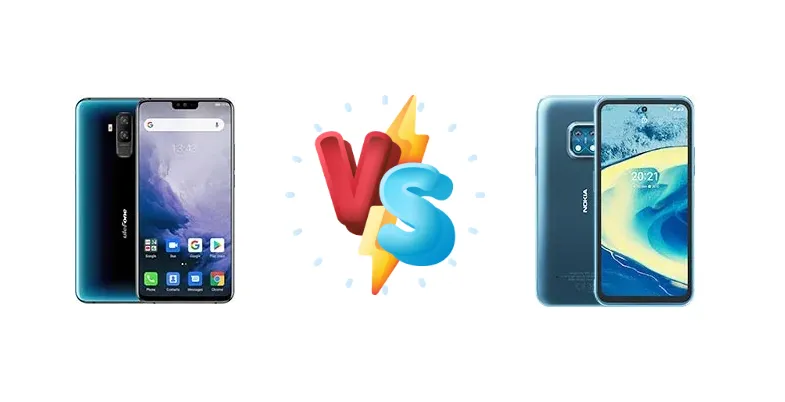
|
🏆 Quick Verdict
For the average user prioritizing 5G connectivity and long-term software support, the Nokia XR20 is the better choice. Its Snapdragon 480 offers superior efficiency and 5G capabilities, despite the Ulefone T2’s slightly faster CPU clock speeds. The XR20’s build quality and Nokia’s software commitment also add significant value.
| PHONES | ||
|---|---|---|
| Phone Names | Ulefone T2 | Nokia XR20 |
| Network | ||
|---|---|---|
| 2G bands | GSM 850 / 900 / 1800 / 1900 | GSM 850 / 900 / 1800 / 1900 |
| 3G bands | HSDPA 850 / 900 / 1700(AWS) / 1900 / 2100 | HSDPA 850 / 900 / 1700(AWS) / 1900 / 2100 |
| 4G bands | 1, 2, 3, 4, 5, 7, 8, 12, 17, 19, 20, 28, 34, 38, 39, 40, 41 | 1, 2, 3, 4, 5, 7, 8, 12, 13, 14, 20, 25, 26, 28, 30, 38, 40, 41, 48, 66, 71 |
| 5G bands | - | 2, 5, 25, 38, 41, 48, 66, 77, 78 SA/NSA |
| Speed | HSPA 42.2/11.5 Mbps, LTE (2CA) Cat7 300/150 Mbps | HSPA, LTE, 5G |
| Technology | GSM / CDMA / HSPA / EVDO / LTE | GSM / CDMA / HSPA / EVDO / LTE / 5G |
| CDMA2000 1xEV-DO | CDMA2000 1xEV-DO | |
| Launch | ||
|---|---|---|
| Announced | 2019, August. Released 2019, August | 2021, July 27 |
| Status | Discontinued | Available. Released 2021, August 04 |
| Body | ||
|---|---|---|
| Dimensions | 167.6 x 80.3 x 8.7 mm (6.60 x 3.16 x 0.34 in) | 171.6 x 81.5 x 10.6 mm (6.76 x 3.21 x 0.42 in) |
| SIM | Nano-SIM + Nano-SIM | · Nano-SIM· Nano-SIM + Nano-SIM |
| Weight | 197.2 g (6.95 oz) | 248 g (8.75 oz) |
| - | IP68 dust/water resistant (up to 1.5m for 60 min) Drop-to-concrete resistance from up to 1.8m MIL-STD-810H compliant | |
| Display | ||
|---|---|---|
| Protection | - | Corning Gorilla Glass Victus |
| Resolution | 1080 x 2280 pixels, 19:9 ratio (~377 ppi density) | 1080 x 2400 pixels, 20:9 ratio (~395 ppi density) |
| Size | 6.7 inches, 112.0 cm2 (~83.3% screen-to-body ratio) | 6.67 inches, 107.4 cm2 (~76.8% screen-to-body ratio) |
| Type | IPS LCD | IPS LCD, 550 nits |
| Platform | ||
|---|---|---|
| CPU | Octa-core (4x2.1 GHz Cortex-A73 & 4x2.1 GHz Cortex-A53) | Octa-core (2x2.0 GHz Kryo 460 & 6x1.8 GHz Kryo 460) |
| Chipset | Mediatek MT6771 Helio P70 (12 nm) | Qualcomm SM4350 Snapdragon 480 5G (8 nm) |
| GPU | Mali-G72 MP3 | Adreno 619 |
| OS | Android 9.0 (Pie) | Android 11, upgradable to Android 13 |
| Memory | ||
|---|---|---|
| Card slot | microSDXC (uses shared SIM slot) | microSDXC (uses shared SIM slot) |
| Internal | 128GB 6GB RAM | 64GB 4GB RAM, 128GB 6GB RAM |
| eMMC 5.1 | - | |
| Main Camera | ||
|---|---|---|
| Dual | - | 48 MP, f/1.8, (wide), 1/2.25", 0.8µm, PDAF 13 MP, f/2.4, 123˚ (ultrawide), 1/3.0", 1.12µm |
| Features | Dual-LED dual-tone flash, HDR, panorama | Zeiss optics, Dual-LED dual-tone flash, second LED flash, HDR, panorama |
| Single | 16 MP, f/1.8, (wide), AF 8 MP | 8 MP, f/2.0 (wide), 1/4.0", 1.12µm |
| Video | 1080p@30fps | 1080p@30fps |
| Selfie camera | ||
|---|---|---|
| Single | 8 MP | 8 MP, f/2.0 (wide), 1/4.0", 1.12µm |
| Video | 1080p@30fps | 1080p@30fps |
| Sound | ||
|---|---|---|
| 3.5mm jack | No | Yes |
| 35mm jack | No | Yes |
| Loudspeaker | Yes | Yes, with stereo speakers |
| Comms | ||
|---|---|---|
| Bluetooth | 4.2, A2DP, LE | 5.1, A2DP, LE, aptX Adaptive |
| NFC | Yes | Yes |
| Positioning | GPS, GLONASS, BDS | GPS (L1+L5), GLONASS, BDS, GALILEO, QZSS, NavIC |
| Radio | Stereo FM radio, RDS, recording | Unspecified |
| USB | USB Type-C 2.0, OTG | USB Type-C 3.0 |
| WLAN | Wi-Fi 802.11 a/b/g/n/ac, dual-band, Wi-Fi Direct | Wi-Fi 802.11 a/b/g/n/ac/6, dual-band, Wi-Fi Direct |
| Features | ||
|---|---|---|
| Sensors | Fingerprint (rear-mounted), accelerometer, gyro, proximity, compass | Fingerprint (side-mounted), accelerometer, gyro, proximity, compass, barometer |
| Battery | ||
|---|---|---|
| Charging | 18W wired 10W wireless | 18W wired 15W wireless |
| Type | Li-Po 4200 mAh | Li-Po 4630 mAh |
| Misc | ||
|---|---|---|
| Colors | Bordeaux Red, Glacier Blue | Ultra Blue, Granite Gray |
| Models | - | TA-1368, TA-1362 |
| Price | - | About 270 EUR |
| SAR EU | - | 1.13 W/kg (head) 1.43 W/kg (body) |
Ulefone T2
- Potentially lower price point
- Faster CPU clock speeds (on paper)
- Wireless charging available
- Older, less efficient chipset
- Likely inferior 5G performance
- Potentially shorter software support
Nokia XR20
- More efficient Snapdragon 480 5G chipset
- 5G connectivity
- Better long-term software support (Nokia's promise)
- Potentially higher price
- Slightly slower CPU clock speeds
- Wireless charging is slower than wired
Display Comparison
Neither device’s display specifications are provided, so a direct comparison is limited. However, given the market positioning, both likely utilize IPS LCD panels. The Ulefone T2, being a more budget-focused device, may have narrower viewing angles and lower peak brightness. The Nokia XR20, benefiting from a slightly higher price point, likely offers better color accuracy and potentially Gorilla Glass protection, enhancing durability. The absence of high refresh rates is expected on both.
Camera Comparison
Without detailed camera specifications, a precise comparison is difficult. Both phones likely feature multi-camera setups, but the quality will heavily depend on sensor size and image processing. It’s reasonable to assume the Nokia XR20 benefits from Qualcomm’s image signal processor (ISP), which generally delivers better dynamic range and noise reduction. The Ulefone T2 may rely on more basic image processing algorithms. The presence of a 2MP macro lens on either device is likely a marketing gimmick, offering limited practical benefit.
Performance
The core difference lies in the chipsets. The Ulefone T2’s Mediatek Helio P70 (12nm) features a Cortex-A73/A53 configuration, offering decent performance for everyday tasks. However, the Nokia XR20’s Qualcomm Snapdragon 480 5G (8nm) utilizes Kryo 460 cores and a more efficient manufacturing process. This 8nm process translates to better thermal management and power efficiency, meaning the XR20 will likely sustain performance for longer periods without throttling. While the T2’s Cortex-A73 cores have a higher clock speed (2.1 GHz vs 2.0 GHz), the Snapdragon 480’s architectural improvements and integrated 5G modem provide a more holistic performance advantage, especially in 5G-enabled areas.
Battery Life
Both devices support 18W wired charging, but the Nokia XR20 adds 15W wireless charging, offering added convenience. While battery capacity isn’t specified, the Snapdragon 480’s superior power efficiency in the XR20 will likely result in longer real-world battery life despite potentially having a similar capacity to the Ulefone T2. The 8nm process allows the XR20 to achieve more work per watt, extending usage between charges. The wireless charging capability of the XR20 is a significant advantage for users who prefer cable-free charging.
Buying Guide
Buy the Ulefone T2 if you need a phone primarily for basic tasks and aren't heavily reliant on 5G. Its lower price point makes it attractive for users on a very tight budget. Buy the Nokia XR20 if you value 5G connectivity, a more durable build, and a cleaner software experience with guaranteed updates – it’s a worthwhile investment for those seeking longevity and reliability.