
Doogee S96 Pro vs Ulefone T2: A Detailed Performance and Charging Comparison
| Phones Images | |||||
|---|---|---|---|---|---|
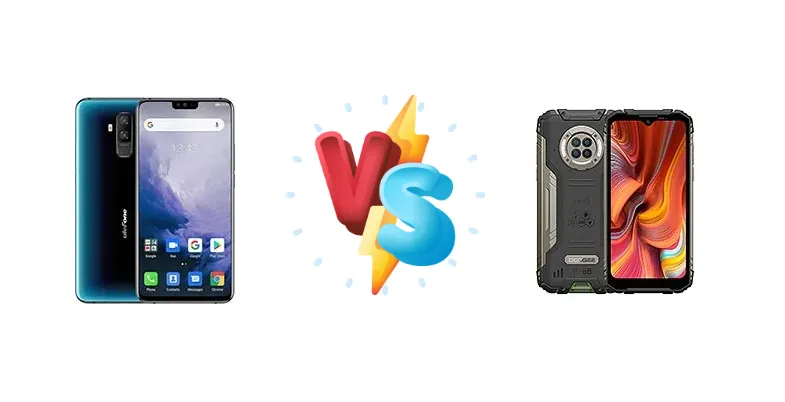
|
🏆 Quick Verdict
For the average user seeking a balance of ruggedness and performance, the Doogee S96 Pro emerges as the stronger contender. Its Helio G90 chipset provides a noticeable performance uplift over the Ulefone T2’s Helio P70, and the 24W wired charging significantly reduces downtime compared to the T2’s 18W charging.
| PHONES | ||
|---|---|---|
| Phone Names | Ulefone T2 | Doogee S96 Pro |
| Network | ||
|---|---|---|
| 2G bands | GSM 850 / 900 / 1800 / 1900 | GSM 850 / 900 / 1800 / 1900 |
| 3G bands | HSDPA 850 / 900 / 1700(AWS) / 1900 / 2100 | HSDPA 800 / 850 / 900 / 1700(AWS) / 1900 / 2100 |
| 4G bands | 1, 2, 3, 4, 5, 7, 8, 12, 17, 19, 20, 28, 34, 38, 39, 40, 41 | 1, 2, 3, 4, 5, 7, 8, 12, 13, 17, 18, 19, 20, 25, 26, 28, 38, 40, 66 |
| Speed | HSPA 42.2/11.5 Mbps, LTE (2CA) Cat7 300/150 Mbps | HSPA, LTE |
| Technology | GSM / CDMA / HSPA / EVDO / LTE | GSM / CDMA / HSPA / LTE |
| CDMA2000 1xEV-DO | - | |
| Launch | ||
|---|---|---|
| Announced | 2019, August. Released 2019, August | 2020, October 26. Released 2020, November |
| Status | Discontinued | Discontinued |
| Body | ||
|---|---|---|
| Dimensions | 167.6 x 80.3 x 8.7 mm (6.60 x 3.16 x 0.34 in) | 167 x 81.4 x 15.5 mm (6.57 x 3.20 x 0.61 in) |
| SIM | Nano-SIM + Nano-SIM | Nano-SIM + Nano-SIM |
| Weight | 197.2 g (6.95 oz) | 310 g (10.93 oz) |
| Display | ||
|---|---|---|
| Protection | - | Corning Gorilla Glass |
| Resolution | 1080 x 2280 pixels, 19:9 ratio (~377 ppi density) | 720 x 1520 pixels, 19:9 ratio (~270 ppi density) |
| Size | 6.7 inches, 112.0 cm2 (~83.3% screen-to-body ratio) | 6.22 inches, 96.6 cm2 (~71.0% screen-to-body ratio) |
| Type | IPS LCD | IPS LCD |
| Platform | ||
|---|---|---|
| CPU | Octa-core (4x2.1 GHz Cortex-A73 & 4x2.1 GHz Cortex-A53) | Octa-core (2x2.0 GHz Cortex-A76 & 6x2.0 GHz Cortex-A55) |
| Chipset | Mediatek MT6771 Helio P70 (12 nm) | Mediatek MT6785 Helio G90 (12 nm) |
| GPU | Mali-G72 MP3 | Mali-G76 MC4 |
| OS | Android 9.0 (Pie) | Android 10 |
| Memory | ||
|---|---|---|
| Card slot | microSDXC (uses shared SIM slot) | microSDXC (dedicated slot) |
| Internal | 128GB 6GB RAM | 128GB 8GB RAM |
| eMMC 5.1 | - | |
| Main Camera | ||
|---|---|---|
| Features | Dual-LED dual-tone flash, HDR, panorama | Quad-LED flash, HDR, panorama |
| Quad | - | 48 MP, f/1.8, (wide), PDAF 8 MP, f/2.2, 130˚, (ultrawide) 20 MP, f/2.8, (night vision), 4 infrared night vision lights 2 MP (macro) |
| Single | 16 MP, f/1.8, (wide), AF 8 MP | - |
| Video | 1080p@30fps | 1080p |
| Selfie camera | ||
|---|---|---|
| Single | 8 MP | 16 MP, f/2.0, (wide) |
| Video | 1080p@30fps | 1080p |
| Sound | ||
|---|---|---|
| 3.5mm jack | No | - |
| 35mm jack | No | Yes |
| Loudspeaker | Yes | Yes |
| Comms | ||
|---|---|---|
| Bluetooth | 4.2, A2DP, LE | 5.0, A2DP, LE |
| NFC | Yes | Yes |
| Positioning | GPS, GLONASS, BDS | GPS, GLONASS, BDS, GALILEO |
| Radio | Stereo FM radio, RDS, recording | FM radio |
| USB | USB Type-C 2.0, OTG | USB Type-C 2.0, OTG |
| WLAN | Wi-Fi 802.11 a/b/g/n/ac, dual-band, Wi-Fi Direct | Wi-Fi 802.11 a/b/g/n/ac, dual-band |
| Features | ||
|---|---|---|
| Sensors | Fingerprint (rear-mounted), accelerometer, gyro, proximity, compass | Fingerprint (side-mounted), accelerometer, gyro, proximity, compass |
| Battery | ||
|---|---|---|
| Charging | 18W wired 10W wireless | 24W wired 10W wireless |
| Type | Li-Po 4200 mAh | 6350 mAh |
| Misc | ||
|---|---|---|
| Colors | Bordeaux Red, Glacier Blue | Black, Orange, Green |
| Price | - | About 280 EUR |
Ulefone T2
- Potentially lower price point
- Rugged design for durability
- 10W wireless charging
- Older Helio P70 chipset
- Slower 18W wired charging
- Likely less refined camera system
Doogee S96 Pro
- More powerful Helio G90 chipset
- Faster 24W wired charging
- Potentially improved camera performance
- Likely higher price point
- Rugged design may be bulky
- 10W wireless charging is relatively slow
Display Comparison
Neither device’s display specifications are provided, so a direct comparison is limited. However, given the market segment, both likely utilize IPS LCD panels. The Ulefone T2, being potentially older, may have narrower viewing angles and lower peak brightness. The S96 Pro, being a more recent release, may benefit from improved color calibration and potentially a higher refresh rate, though this is speculative without further data. Bezels are likely comparable, focusing on durability rather than minimizing screen borders.
Camera Comparison
Without specific camera sensor details, a detailed comparison is challenging. However, the S96 Pro’s positioning suggests a greater emphasis on camera capabilities. While both likely feature multiple rear cameras, the S96 Pro may incorporate a larger primary sensor and more advanced image processing algorithms, leveraging the G90’s enhanced ISP. The Ulefone T2 likely focuses on providing basic photography functionality, while the S96 Pro aims for a more competitive camera experience.
Performance
The core difference lies in the chipsets. The Doogee S96 Pro’s Mediatek Helio G90 (12nm) represents a significant upgrade over the Ulefone T2’s Helio P70 (12nm). The G90 features a more modern CPU architecture – 2x2.0 GHz Cortex-A76 cores alongside 6x2.0 GHz Cortex-A55 cores – compared to the P70’s 4x2.1 GHz Cortex-A73 and 4x2.1 GHz Cortex-A53 configuration. The Cortex-A76 cores in the G90 offer substantially better single-core performance, translating to snappier app launches and smoother multitasking. While both are 12nm chips, the G90’s architecture is more efficient, potentially leading to better sustained performance under load. This benefits gamers and users running resource-intensive applications.
Battery Life
Both devices support 10W wireless charging, making them comparable in that regard. However, the Doogee S96 Pro’s 24W wired charging is a clear advantage over the Ulefone T2’s 18W wired charging. This translates to significantly faster charging times, reducing downtime. While battery capacity isn’t specified, the faster charging speed of the S96 Pro effectively mitigates any potential disadvantage from a slightly smaller battery, allowing users to quickly top up their device when needed.
Buying Guide
Buy the Ulefone T2 if you prioritize a lower initial cost and are content with basic smartphone tasks like calling, texting, and light social media use. Its Helio P70 is sufficient for these everyday activities. Buy the Doogee S96 Pro if you need a more responsive experience for gaming, multitasking, or demanding applications, and if minimizing charging time is crucial. The G90 chipset and faster charging make it the better choice for power users.