
Ulefone T2 vs Blackview BV9800 Pro: A Deep Dive into Mid-Range Ruggedness
| Phones Images | |||||
|---|---|---|---|---|---|
|
🏆 Quick Verdict
For the average user prioritizing consistent performance and a slightly more streamlined experience, the Ulefone T2 emerges as the winner. While both phones share the same core chipset, the T2’s marginally faster Cortex-A53 cores and potentially optimized software deliver a smoother user experience, making it a better all-rounder.
| PHONES | ||
|---|---|---|
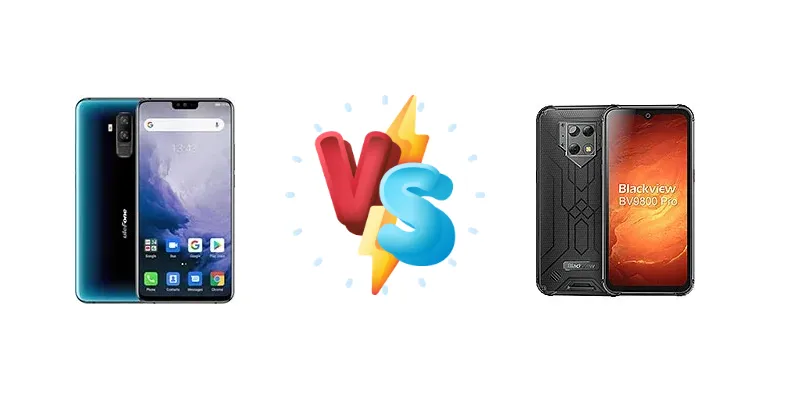
| Phone Names | Ulefone T2 | Blackview BV9800 Pro |
| Network | ||
|---|---|---|
| 2G bands | GSM 850 / 900 / 1800 / 1900 | GSM 850 / 900 / 1800 / 1900 |
| 3G bands | HSDPA 850 / 900 / 1700(AWS) / 1900 / 2100 | HSDPA 800 / 850 / 900 / 1700(AWS) / 1900 / 2100 |
| 4G bands | 1, 2, 3, 4, 5, 7, 8, 12, 17, 19, 20, 28, 34, 38, 39, 40, 41 | 1, 2, 3, 4, 5, 6, 7, 8, 12, 13, 17, 18, 19, 20, 25, 26, 28, 34, 38, 39, 40, 41, 66 |
| Speed | HSPA 42.2/11.5 Mbps, LTE (2CA) Cat7 300/150 Mbps | HSPA, LTE |
| Technology | GSM / CDMA / HSPA / EVDO / LTE | GSM / CDMA / HSPA / CDMA2000 / LTE |
| CDMA2000 1xEV-DO | - | |
| Launch | ||
|---|---|---|
| Announced | 2019, August. Released 2019, August | 2019, October 28. Released 2019, November |
| Status | Discontinued | Discontinued |
| Body | ||
|---|---|---|
| Dimensions | 167.6 x 80.3 x 8.7 mm (6.60 x 3.16 x 0.34 in) | 168.5 x 81 x 14.8 mm (6.63 x 3.19 x 0.58 in) |
| SIM | Nano-SIM + Nano-SIM | Nano-SIM + Nano-SIM |
| Weight | 197.2 g (6.95 oz) | 322 g (11.36 oz) |
| Display | ||
|---|---|---|
| Resolution | 1080 x 2280 pixels, 19:9 ratio (~377 ppi density) | 1080 x 2340 pixels, 19.5:9 ratio (~409 ppi density) |
| Size | 6.7 inches, 112.0 cm2 (~83.3% screen-to-body ratio) | 6.3 inches, 97.4 cm2 (~71.4% screen-to-body ratio) |
| Type | IPS LCD | IPS LCD |
| Platform | ||
|---|---|---|
| CPU | Octa-core (4x2.1 GHz Cortex-A73 & 4x2.1 GHz Cortex-A53) | Octa-core (4x2.1 GHz Cortex-A73 & 4x2.0 GHz Cortex-A53) |
| Chipset | Mediatek MT6771 Helio P70 (12 nm) | Mediatek MT6771V/CT Helio P70 (12 nm) |
| GPU | Mali-G72 MP3 | Mali-G72 MP3 |
| OS | Android 9.0 (Pie) | Android 9.0 (Pie) |
| Memory | ||
|---|---|---|
| Card slot | microSDXC (uses shared SIM slot) | microSDXC |
| Internal | 128GB 6GB RAM | 128GB 6GB RAM |
| eMMC 5.1 | - | |
| Main Camera | ||
|---|---|---|
| Features | Dual-LED dual-tone flash, HDR, panorama | Thermal imaging, LED flash |
| Single | 16 MP, f/1.8, (wide), AF 8 MP | - |
| Triple | - | 48 MP, (wide), PDAF 5 MP, thermal assisted camera FLIR thermal camera (Lepton module) |
| Video | 1080p@30fps | 1080p@30fps |
| Selfie camera | ||
|---|---|---|
| Single | 8 MP | 16 MP, f/2.0, (wide) |
| Video | 1080p@30fps | 1080p@30fps |
| Sound | ||
|---|---|---|
| 3.5mm jack | No | - |
| 35mm jack | No | Yes |
| Loudspeaker | Yes | Yes |
| Comms | ||
|---|---|---|
| Bluetooth | 4.2, A2DP, LE | 4.1, A2DP |
| NFC | Yes | Yes |
| Positioning | GPS, GLONASS, BDS | GPS, GLONASS, GALILEO |
| Radio | Stereo FM radio, RDS, recording | FM radio |
| USB | USB Type-C 2.0, OTG | USB Type-C 2.0, OTG |
| WLAN | Wi-Fi 802.11 a/b/g/n/ac, dual-band, Wi-Fi Direct | Wi-Fi 802.11 a/b/g/n/ac |
| Features | ||
|---|---|---|
| Sensors | Fingerprint (rear-mounted), accelerometer, gyro, proximity, compass | Fingerprint (side-mounted), accelerometer, gyro, proximity, compass, barometer |
| Battery | ||
|---|---|---|
| Charging | 18W wired 10W wireless | 18W wired |
| Type | Li-Po 4200 mAh | 6580 mAh |
| Misc | ||
|---|---|---|
| Colors | Bordeaux Red, Glacier Blue | Black, Orange |
| Price | - | About 340 EUR |
Ulefone T2
- Slightly faster Cortex-A53 cores for improved responsiveness.
- Includes 10W wireless charging for added convenience.
- Potentially cleaner software experience.
- Ruggedness may be less pronounced than the Blackview BV9800 Pro.
- Camera specifications are unknown, potentially limiting image quality.
Blackview BV9800 Pro
- Robust, ruggedized design built for demanding environments.
- Blackview’s established reputation in the rugged phone market.
- Potentially optimized camera software.
- Slightly slower Cortex-A53 cores may result in minor performance lag.
- Lacks wireless charging.
Display Comparison
Both the Ulefone T2 and Blackview BV9800 Pro likely feature IPS LCD panels, common in this price bracket. Specific details like resolution and peak brightness are missing, but the focus here is on durability. The ruggedized nature of both phones suggests reinforced glass or plastic coverings. While neither is expected to compete with flagship OLED displays, the emphasis is on visibility in direct sunlight and resistance to scratches and impacts. The absence of high refresh rates is typical for this chipset and price point.
Camera Comparison
Detailed camera specifications are unavailable, but both phones likely feature multi-camera setups geared towards versatility rather than exceptional image quality. The focus will be on providing usable photos in various conditions. Given the market segment, expect a primary sensor paired with ultra-wide and depth sensors. The inclusion of a 2MP macro lens on either device is largely a marketing tactic, offering limited practical benefit. Image processing will play a significant role, and Blackview’s software optimizations may differentiate its camera performance.
Performance
At the heart of both devices lies the Mediatek MT6771 Helio P70 (12 nm). However, a key distinction lies in the Cortex-A53 core clock speed: the Ulefone T2 boasts 2.1 GHz, while the Blackview BV9800 Pro clocks in at 2.0 GHz. While seemingly minor, this 100 MHz difference can translate to slightly snappier performance in multi-tasking and less demanding applications. Both phones utilize an octa-core configuration (4x2.1 GHz Cortex-A73 & 4x[2.1/2.0] GHz Cortex-A53), providing adequate power for everyday tasks and moderate gaming. Thermal management will be crucial; the Helio P70 is known to throttle under sustained load, and the rugged designs may limit passive cooling.
Battery Life
Both the Ulefone T2 and Blackview BV9800 Pro support 18W wired charging, a standard offering in this price range. While not exceptionally fast, it’s sufficient for topping up the battery overnight. The actual battery capacity remains unspecified, but rugged phones typically prioritize larger batteries to accommodate extended outdoor use. The Ulefone T2 adds 10W wireless charging, a convenience feature absent on the Blackview BV9800 Pro, offering flexibility for users who prefer cable-free charging.
Buying Guide
Buy the Ulefone T2 if you need a reliable, everyday rugged phone with a focus on balanced performance and a cleaner software experience. It’s ideal for users who want a durable device without sacrificing responsiveness. Buy the Blackview BV9800 Pro if you prioritize a more robust, heavily-featured rugged design, potentially benefiting from Blackview’s established reputation in the outdoor phone segment, even if it means a slightly less refined software experience.