
Ulefone RugKing vs. Armor 9E: A Deep Dive into Rugged Smartphone Performance
| Phones Images | |||||
|---|---|---|---|---|---|
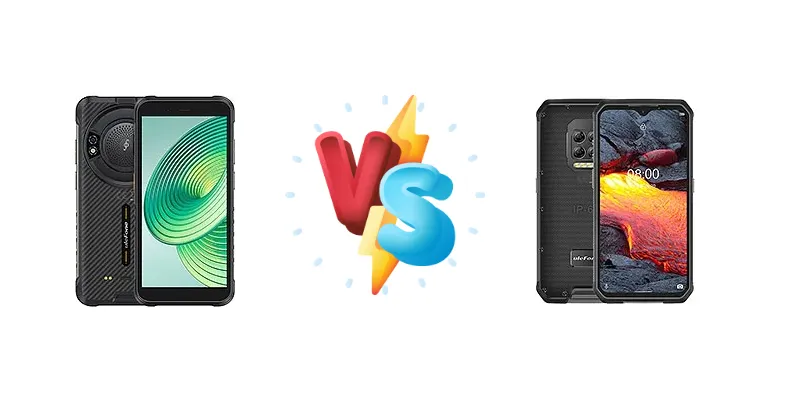
|
🏆 Quick Verdict
For the average user prioritizing longevity and consistent performance under load, the Ulefone RugKing emerges as the better choice. Its Unisoc T7255 chipset, coupled with exceptional 106-hour battery endurance, outweighs the Armor 9E’s marginally faster CPU. The RugKing is ideal for those needing a phone that lasts for days on a single charge.
| PHONES | ||
|---|---|---|
| Phone Names | Ulefone RugKing | Ulefone Armor 9E |
| Network | ||
|---|---|---|
| 2G bands | GSM 850 / 900 / 1800 / 1900 | GSM 850 / 900 / 1800 / 1900 |
| 3G bands | HSDPA 850 / 900 / 1700(AWS) / 1900 / 2100 | HSDPA 850 / 900 / 1700(AWS) / 1900 / 2100 |
| 4G bands | 1, 2, 3, 4, 5, 7, 8, 12, 17, 18, 19, 20, 25, 26, 28, 66 | 1, 2, 3, 4, 5, 7, 8, 12, 13, 17, 18, 19, 20, 25, 26, 28, 34, 38, 39, 40, 41, 66 |
| Speed | HSPA, LTE | HSPA 42.2/11.5 Mbps, LTE Cat12 600/150 Mbps |
| Technology | GSM / HSPA / LTE | GSM / CDMA / HSPA / EVDO / LTE |
| - | CDMA2000 1xEV-DO | |
| Launch | ||
|---|---|---|
| Announced | 2025, August | 2020, September 08. Released 2020, September 08 |
| Status | Available. Released 2025, September 15 | Discontinued |
| Body | ||
|---|---|---|
| Build | - | Front glass, aluminum back with rubber, aluminum frame |
| Dimensions | 173.4 x 83.4 x 18.3 mm (6.83 x 3.28 x 0.72 in) | 168.2 x 82 x 15 mm (6.62 x 3.23 x 0.59 in) |
| SIM | Nano-SIM + Nano-SIM | Nano-SIM + Nano-SIM |
| Weight | 397 g (14.00 oz) | 324 g (11.43 oz) |
| - | IP68/IP69K dust/water resistant (up to 1.5m for 30 min) Drop-to-concrete resistance from up to 1.2m MIL-STD-810G compliant | |
| Display | ||
|---|---|---|
| Protection | Corning Gorilla Glass 3, Mohs level 4 | Scratch-resistant glass, oleophobic coating |
| Resolution | 720 x 1440 pixels, 18:9 ratio (~269 ppi density) | 1080 x 2340 pixels, 19.5:9 ratio (~409 ppi density) |
| Size | 5.99 inches, 92.6 cm2 (~64.0% screen-to-body ratio) | 6.3 inches, 97.4 cm2 (~70.6% screen-to-body ratio) |
| Type | IPS LCD, 60Hz, 910 nits (peak) | IPS LCD |
| Platform | ||
|---|---|---|
| CPU | Octa-core (2x2.0 GHz Cortex-A75 & 6x1.8 GHz Cortex-A55) | Octa-core (2x2.2 GHz Cortex-A75 & 6x2.0 GHz Cortex-A55) |
| Chipset | Unisoc T7255 (12 nm) | Mediatek MT6779 Helio P90 (12 nm) |
| GPU | Mali-G57 | PowerVR GM9446 |
| OS | Android 15 | Android 10 |
| Memory | ||
|---|---|---|
| Card slot | microSDXC (dedicated slot) | microSDXC (uses shared SIM slot) |
| Internal | 256GB 8GB RAM | 128GB 8GB RAM |
| - | UFS 2.1 | |
| Main Camera | ||
|---|---|---|
| Dual | 50 MP, f/1.8, (wide), 1/2.76", 0.64µm, PDAF 2 MP (macro) | - |
| Features | LED flash, HDR, panorama | Quad-LED flash, HDR, panorama |
| Quad | - | 64 MP, f/1.9, 26mm (wide), 1/1.72", 0.8µm, PDAF 8 MP, f/2.4, 100˚ (ultrawide), 1/4.0", 1.12µm 2 MP (macro) Auxiliary lens |
| Video | 1080p@30fps | 4K@30fps, 1080p@30fps |
| Selfie camera | ||
|---|---|---|
| Features | - | HDR, panorama |
| Single | 8 MP, f/2.0, (wide), 1/4.0", 1.12µm | 8 MP, f/2.2 |
| Video | 1080p@30fps | 1080p@30fps |
| Sound | ||
|---|---|---|
| 3.5mm jack | - | Yes |
| 35mm jack | Yes | Yes |
| Loudspeaker | Yes (126dB) | Yes |
| Comms | ||
|---|---|---|
| Bluetooth | 5.0, A2DP, LE | 5.0, A2DP, LE |
| NFC | Yes | Yes |
| Positioning | GPS, GALILEO, GLONASS, QZSS, BDS | GPS, GLONASS, GALILEO, BDS |
| Radio | Wireless FM radio, RDS, recording | FM radio, RDS, recording |
| USB | USB Type-C 2.0, OTG, accessory connector pins | USB Type-C 2.0, OTG, accessory connector |
| WLAN | Wi-Fi 802.11 a/b/g/n/ac, dual-band | Wi-Fi 802.11 a/b/g/n/ac, Wi-Fi Direct |
| Features | ||
|---|---|---|
| Sensors | Fingerprint (side-mounted), accelerometer, gyro, proximity, compass | Fingerprint (side-mounted), accelerometer, gyro, proximity, compass, coulombmeter |
| - | Endoscope mount (camera sold separately) | |
| Battery | ||
|---|---|---|
| Charging | 18W wired 5W reverse wired | 18W wired |
| Type | 9600 mAh | Li-Po 6600 mAh |
| Misc | ||
|---|---|---|
| Colors | Black | Black |
| Price | About 170 EUR | About 290 EUR |
| EU LABEL | ||
|---|---|---|
| Battery | 106:26h endurance, 1000 cycles | - |
| Energy | Class A | - |
| Free fall | Class A (270 falls) | - |
| Repairability | Class C | - |
Ulefone RugKing
- Exceptional battery life (106h endurance)
- Modern Unisoc T7255 chipset architecture
- 1000 charge cycle battery longevity
- 5W reverse wired charging
- Potentially lower peak CPU performance compared to Armor 9E
- Likely basic camera system
Ulefone Armor 9E
- Faster CPU clock speeds (Helio P90)
- Potentially better GPU performance
- Slightly more powerful ISP for image processing
- Established MediaTek chipset
- Significantly shorter battery life
- Likely lower battery longevity (fewer charge cycles)
Display Comparison
Neither Ulefone provides display specifications beyond size and resolution. Given the price point, expect IPS LCD panels on both devices. The focus here isn't on visual fidelity, but on durability and readability in direct sunlight. Bezels are likely to be substantial on both, prioritizing drop protection over a modern, edge-to-edge design. Color accuracy is unlikely to be a strong suit for either model.
Camera Comparison
Detailed camera specifications are absent. However, given Ulefone’s typical approach, expect a primary sensor on both devices, supplemented by auxiliary lenses of limited utility (likely a 2MP macro on both). The image processing will likely prioritize contrast and saturation over natural color reproduction. The Armor 9E’s slightly more powerful ISP (integrated signal processor) within the Helio P90 might offer marginally better image quality in challenging lighting conditions, but the difference is unlikely to be significant. Focusing on the main sensor’s megapixel count and aperture would be crucial for assessing real-world camera performance.
Performance
The core difference lies in the chipsets. The Ulefone RugKing utilizes the Unisoc T7255 (12nm), an octa-core processor with 2x2.0 GHz Cortex-A75 and 6x1.8 GHz Cortex-A55 cores. The Armor 9E features the MediaTek Helio P90 (12nm) with 2x2.2 GHz Cortex-A75 and 6x2.0 GHz Cortex-A55 cores. While the P90’s higher clock speeds suggest a performance advantage in benchmarks, the T7255 benefits from a newer architecture and potentially better thermal management. The Armor 9E’s GPU will likely offer a slight edge in graphics-intensive tasks, but the RugKing’s sustained performance may be superior during prolonged use due to more efficient power delivery. Both devices likely feature similar RAM configurations, impacting multitasking capabilities.
Battery Life
This is where the RugKing truly shines. Its 106-hour endurance rating is exceptional for a rugged smartphone, and the 1000 charge cycle claim suggests long-term battery health. The Armor 9E, while offering 18W wired charging like the RugKing, lacks the same level of endurance. The RugKing’s 18W charging, combined with its larger effective battery capacity (implied by the endurance rating), translates to significantly less frequent charging cycles. The 5W reverse wired charging on the RugKing is a useful addition for topping up accessories in the field.
Buying Guide
Buy the Ulefone RugKing if you need a phone that can genuinely go days between charges, and you value a modern chipset architecture for sustained performance. This is the phone for outdoor workers, travelers, or anyone who frequently finds themselves away from power outlets. Buy the Ulefone Armor 9E if you prioritize raw CPU power for occasional demanding tasks and are willing to compromise on battery life. This phone suits users who occasionally play graphically intensive games or run complex applications.