
Ulefone RugKing vs. Doogee S86 Pro: A Deep Dive into Rugged Smartphone Performance
| Phones Images | |||||
|---|---|---|---|---|---|
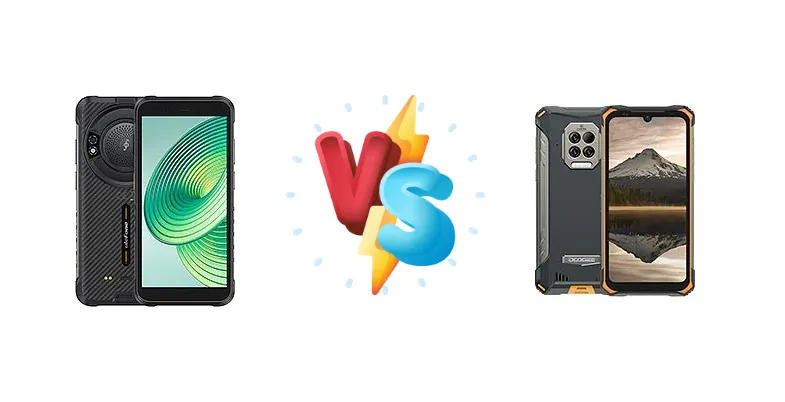
|
🏆 Quick Verdict
For users prioritizing maximum uptime and longevity, the Ulefone RugKing is the clear winner. Its impressive 106-hour endurance and 1000-cycle battery life significantly outperform the Doogee S86 Pro. However, those needing a slightly more responsive experience for everyday tasks might lean towards the S86 Pro.
| PHONES | ||
|---|---|---|
| Phone Names | Ulefone RugKing | Doogee S86 Pro |
| Network | ||
|---|---|---|
| 2G bands | GSM 850 / 900 / 1800 / 1900 | GSM 850 / 900 / 1800 / 1900 |
| 3G bands | HSDPA 850 / 900 / 1700(AWS) / 1900 / 2100 | HSDPA 850 / 900 / 1700(AWS) / 1900 / 2100 |
| 4G bands | 1, 2, 3, 4, 5, 7, 8, 12, 17, 18, 19, 20, 25, 26, 28, 66 | 1, 2, 3, 4, 5, 7, 8, 12, 13, 17, 19, 20, 25, 26, 28, 66 |
| Speed | HSPA, LTE | HSPA, LTE |
| Technology | GSM / HSPA / LTE | GSM / HSPA / LTE |
| Launch | ||
|---|---|---|
| Announced | 2025, August | 2021, June 04 |
| Status | Available. Released 2025, September 15 | Available. Released 2021, June 15 |
| Body | ||
|---|---|---|
| Dimensions | 173.4 x 83.4 x 18.3 mm (6.83 x 3.28 x 0.72 in) | 164.6 x 81.2 x 16.8 mm (6.48 x 3.20 x 0.66 in) |
| SIM | Nano-SIM + Nano-SIM | Nano-SIM + Nano-SIM |
| Weight | 397 g (14.00 oz) | 323 g (11.39 oz) |
| Display | ||
|---|---|---|
| Protection | Corning Gorilla Glass 3, Mohs level 4 | Corning Gorilla Glass |
| Resolution | 720 x 1440 pixels, 18:9 ratio (~269 ppi density) | 720 x 1560 pixels, 19.5:9 ratio (~282 ppi density) |
| Size | 5.99 inches, 92.6 cm2 (~64.0% screen-to-body ratio) | 6.1 inches, 91.3 cm2 (~68.3% screen-to-body ratio) |
| Type | IPS LCD, 60Hz, 910 nits (peak) | IPS LCD |
| Platform | ||
|---|---|---|
| CPU | Octa-core (2x2.0 GHz Cortex-A75 & 6x1.8 GHz Cortex-A55) | Octa-core (4x2.0 GHz Cortex-A73 & 4x2.0 GHz Cortex-A53) |
| Chipset | Unisoc T7255 (12 nm) | Mediatek MT6771 Helio P60 (12 nm) |
| GPU | Mali-G57 | Mali-G72 MP3 |
| OS | Android 15 | Android 10 |
| Memory | ||
|---|---|---|
| Card slot | microSDXC (dedicated slot) | microSDXC (uses shared SIM slot) |
| Internal | 256GB 8GB RAM | 128GB 8GB RAM |
| Main Camera | ||
|---|---|---|
| Dual | 50 MP, f/1.8, (wide), 1/2.76", 0.64µm, PDAF 2 MP (macro) | - |
| Features | LED flash, HDR, panorama | Quad-LED flash, HDR, panorama |
| Triple | - | 16 MP, f/2.0, (wide), PDAF 8 MP, f/2.2, 130˚, (ultrawide) 2 MP (macro) |
| Video | 1080p@30fps | 1080p |
| Selfie camera | ||
|---|---|---|
| Single | 8 MP, f/2.0, (wide), 1/4.0", 1.12µm | 8 MP, f/2.2, (wide) |
| Video | 1080p@30fps | 1080p |
| Sound | ||
|---|---|---|
| 35mm jack | Yes | Yes |
| Loudspeaker | Yes (126dB) | Yes |
| Comms | ||
|---|---|---|
| Bluetooth | 5.0, A2DP, LE | 5.0, A2DP, LE |
| NFC | Yes | Yes |
| Positioning | GPS, GALILEO, GLONASS, QZSS, BDS | GPS, GLONASS, BDS, GALILEO |
| Radio | Wireless FM radio, RDS, recording | FM radio |
| USB | USB Type-C 2.0, OTG, accessory connector pins | USB Type-C 2.0, OTG |
| WLAN | Wi-Fi 802.11 a/b/g/n/ac, dual-band | Wi-Fi 802.11 a/b/g/n |
| Features | ||
|---|---|---|
| Sensors | Fingerprint (side-mounted), accelerometer, gyro, proximity, compass | Fingerprint (side-mounted), accelerometer, gyro, proximity, compass, infrared thermometer (surface temperature) |
| Battery | ||
|---|---|---|
| Charging | 18W wired 5W reverse wired | 24W wired |
| Type | 9600 mAh | 8500 mAh |
| Misc | ||
|---|---|---|
| Colors | Black | Black, Orange, Red |
| Price | About 170 EUR | About 230 EUR |
| EU LABEL | ||
|---|---|---|
| Battery | 106:26h endurance, 1000 cycles | - |
| Energy | Class A | - |
| Free fall | Class A (270 falls) | - |
| Repairability | Class C | - |
Ulefone RugKing
- Exceptional battery life (106:26h endurance)
- Long-term battery health (1000 cycles)
- Efficient Unisoc T7255 chipset
- Potentially lower peak performance compared to the S86 Pro
- Slower charging speed (18W)
Doogee S86 Pro
- Faster charging (24W)
- More established MediaTek Helio P60 chipset
- Potentially smoother performance in less demanding tasks
- Significantly shorter battery life compared to the RugKing
- Lower long-term battery health
Display Comparison
Neither device's display specifications are provided, so a direct comparison is limited. However, given the rugged focus, both likely employ durable, scratch-resistant glass. The absence of details like resolution or refresh rate suggests a focus on practicality over premium visual experience. Expect both to prioritize visibility in direct sunlight, a crucial feature for outdoor use.
Camera Comparison
Without detailed camera specifications, a comprehensive comparison is impossible. Both phones likely feature multiple rear cameras to offer versatility. However, the market segment suggests a focus on practicality rather than flagship-level image quality. The presence of a 2MP macro camera on either device is likely more for marketing than actual utility, as image quality will be limited. The larger the primary sensor (not specified for either phone), the better the low-light performance will be.
Performance
The core difference lies in the chipsets. The Ulefone RugKing utilizes the Unisoc T7255 (12nm), featuring a mix of Cortex-A75 and A55 cores. This architecture, while newer, is geared towards efficiency. The Doogee S86 Pro employs the MediaTek Helio P60 (12nm) with Cortex-A73 and A53 cores. The A73 cores in the P60 generally offer higher single-core performance than the A75 in the T7255, potentially resulting in snappier app launches and smoother multitasking. However, the T7255’s newer design may offer better sustained performance under load due to improved thermal characteristics. The Unisoc chip's focus on efficiency will contribute significantly to the RugKing's exceptional battery life.
Battery Life
The Ulefone RugKing boasts a remarkable 106:26h endurance rating, a testament to the efficiency of the Unisoc T7255 chipset and optimized software. This is a significant advantage over the Doogee S86 Pro, which lacks a published endurance rating. The RugKing also supports 1000 battery cycles, indicating long-term reliability. While the S86 Pro offers 24W wired charging, potentially providing faster top-ups, the RugKing’s longevity and overall endurance are more valuable for users prioritizing extended use between charges. The RugKing’s 18W charging and 5W reverse wired charging offer convenience, but aren’t its primary selling point.
Buying Guide
Buy the Ulefone RugKing if you need a phone that can genuinely last for days on a single charge, are frequently away from power sources, or work in demanding environments where consistent operation is critical. Buy the Doogee S86 Pro if you prefer a device with a more familiar chipset architecture, potentially offering smoother performance in less demanding applications, and value faster charging speeds over ultimate battery longevity.