
Ulefone RugKing vs Blackview BV9900E: A Deep Dive into Rugged Smartphone Performance
| Phones Images | |||||
|---|---|---|---|---|---|
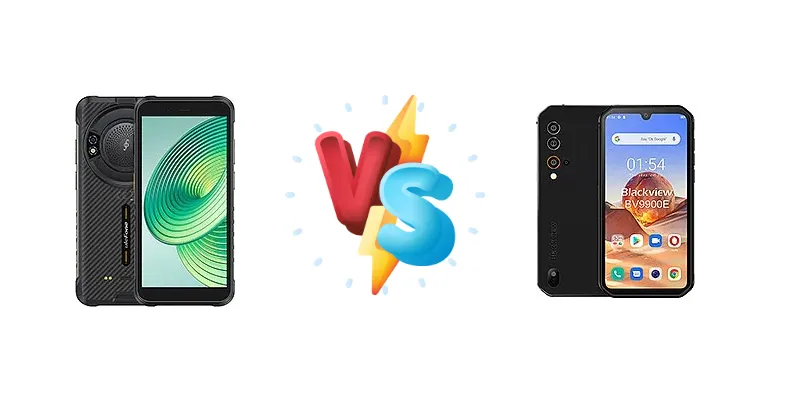
|
🏆 Quick Verdict
For the average user prioritizing longevity and consistent performance, the Ulefone RugKing emerges as the winner. Its superior battery endurance (106:26h) and efficient Unisoc T7255 chipset provide a more reliable experience, especially for extended outdoor use. While the Blackview BV9900E offers wireless charging and a marginally faster CPU, the RugKing’s battery life is a more critical advantage in this category.
| PHONES | ||
|---|---|---|
| Phone Names | Ulefone RugKing | Blackview BV9900E |
| Network | ||
|---|---|---|
| 2G bands | GSM 850 / 900 / 1800 / 1900 | GSM 850 / 900 / 1800 / 1900 |
| 3G bands | HSDPA 850 / 900 / 1700(AWS) / 1900 / 2100 | HSDPA 800 / 850 / 900 / 1700(AWS) / 1900 / 2100 |
| 4G bands | 1, 2, 3, 4, 5, 7, 8, 12, 17, 18, 19, 20, 25, 26, 28, 66 | 1, 2, 3, 4, 5, 7, 8, 12, 13, 17, 18, 19, 20, 25, 26, 28, 34, 38, 39, 40, 41, 66 |
| Speed | HSPA, LTE | HSPA, LTE |
| Technology | GSM / HSPA / LTE | GSM / CDMA / HSPA / CDMA2000 / LTE |
| Launch | ||
|---|---|---|
| Announced | 2025, August | 2020, September 10. Released 2020, September |
| Status | Available. Released 2025, September 15 | Discontinued |
| Body | ||
|---|---|---|
| Dimensions | 173.4 x 83.4 x 18.3 mm (6.83 x 3.28 x 0.72 in) | 156.5 x 78.3 x 14.2 mm (6.16 x 3.08 x 0.56 in) |
| SIM | Nano-SIM + Nano-SIM | Nano-SIM + Nano-SIM |
| Weight | 397 g (14.00 oz) | 273 g (9.63 oz) |
| Display | ||
|---|---|---|
| Protection | Corning Gorilla Glass 3, Mohs level 4 | Corning Gorilla Glass 5 |
| Resolution | 720 x 1440 pixels, 18:9 ratio (~269 ppi density) | 1080 x 2280 pixels, 19:9 ratio (~432 ppi density) |
| Size | 5.99 inches, 92.6 cm2 (~64.0% screen-to-body ratio) | 5.84 inches, 85.1 cm2 (~69.5% screen-to-body ratio) |
| Type | IPS LCD, 60Hz, 910 nits (peak) | IPS LCD |
| Platform | ||
|---|---|---|
| CPU | Octa-core (2x2.0 GHz Cortex-A75 & 6x1.8 GHz Cortex-A55) | Octa-core (2x2.2 GHz Cortex-A75 & 6x2.0 GHz Cortex-A55) |
| Chipset | Unisoc T7255 (12 nm) | Mediatek MT6779V/CE Helio P90 (12 nm) |
| GPU | Mali-G57 | PowerVR GM9446 |
| OS | Android 15 | Android 10 |
| Memory | ||
|---|---|---|
| Card slot | microSDXC (dedicated slot) | microSDXC |
| Internal | 256GB 8GB RAM | 128GB 6GB RAM |
| Main Camera | ||
|---|---|---|
| Dual | 50 MP, f/1.8, (wide), 1/2.76", 0.64µm, PDAF 2 MP (macro) | - |
| Features | LED flash, HDR, panorama | LED flash, HDR, panorama |
| Quad | - | 48 MP, f/1.8, (wide), PDAF 16 MP, 120˚ (ultrawide) 2 MP (macro) Auxiliary lens |
| Video | 1080p@30fps | 4K@30fps, 1080p@60fps |
| Selfie camera | ||
|---|---|---|
| Single | 8 MP, f/2.0, (wide), 1/4.0", 1.12µm | 16 MP, f/2.0, (wide) |
| Video | 1080p@30fps | 1080p@30fps |
| Sound | ||
|---|---|---|
| 35mm jack | Yes | No |
| Loudspeaker | Yes (126dB) | Yes |
| Comms | ||
|---|---|---|
| Bluetooth | 5.0, A2DP, LE | 5.0, A2DP, LE |
| NFC | Yes | Yes |
| Positioning | GPS, GALILEO, GLONASS, QZSS, BDS | GPS, GLONASS, GALILEO, BDS |
| Radio | Wireless FM radio, RDS, recording | FM radio |
| USB | USB Type-C 2.0, OTG, accessory connector pins | USB Type-C 2.0, OTG |
| WLAN | Wi-Fi 802.11 a/b/g/n/ac, dual-band | Wi-Fi 802.11 a/b/g/n/ac |
| Features | ||
|---|---|---|
| Sensors | Fingerprint (side-mounted), accelerometer, gyro, proximity, compass | Fingerprint (side-mounted), accelerometer, gyro, proximity, compass, barometer |
| Battery | ||
|---|---|---|
| Charging | 18W wired 5W reverse wired | 15W wired 18W wireless |
| Type | 9600 mAh | 4380 mAh |
| Misc | ||
|---|---|---|
| Colors | Black | Black, Silver |
| Price | About 170 EUR | About 260 EUR |
| EU LABEL | ||
|---|---|---|
| Battery | 106:26h endurance, 1000 cycles | - |
| Energy | Class A | - |
| Free fall | Class A (270 falls) | - |
| Repairability | Class C | - |
Ulefone RugKing
- Exceptional battery life (106:26h endurance)
- Modern and efficient Unisoc T7255 chipset
- 1000 charge cycle battery rating for longevity
- Potentially less powerful CPU than the BV9900E
- Lacks wireless charging
Blackview BV9900E
- Faster CPU clock speeds (Helio P90)
- Convenient 18W wireless charging
- Reverse wired charging
- Significantly shorter battery life compared to RugKing
- Older chipset architecture
Display Comparison
Neither device’s display specifications are provided, so a direct comparison is limited. However, given the price point and rugged focus, we can assume both utilize IPS LCD panels. The BV9900E’s inclusion of wireless charging suggests a glass or plastic back, potentially allowing for a slightly more vibrant display than the RugKing, which may prioritize a more robust, textured back for grip. Bezels are likely to be substantial on both to contribute to drop protection.
Camera Comparison
Without detailed camera specifications, a comprehensive comparison is impossible. However, the rugged phone segment often prioritizes durability over camera quality. Both devices likely feature a multi-camera setup, but image processing and sensor size will be key differentiators. We can assume both will include a standard, wide, and potentially a macro lens, though the usefulness of a 2MP macro lens is questionable on both devices. The absence of OIS information suggests neither phone excels in low-light photography.
Performance
The Blackview BV9900E’s MediaTek Helio P90 (2x2.2 GHz Cortex-A75 & 6x2.0 GHz Cortex-A55) holds a slight clock speed advantage over the Ulefone RugKing’s Unisoc T7255 (2x2.0 GHz Cortex-A75 & 6x1.8 GHz Cortex-A55). Both chipsets are built on a 12nm process, but the P90’s higher clock speeds suggest a marginal performance edge in CPU-intensive tasks. However, the Unisoc T7255 is a newer architecture, potentially offering better power efficiency and sustained performance under load. The RugKing’s efficiency is further bolstered by its focus on endurance, suggesting software optimizations to complement the chipset.
Battery Life
This is where the Ulefone RugKing truly shines. Its reported 106:26h endurance significantly surpasses what we’d expect from a phone with a comparable battery capacity to the BV9900E (capacity not specified). The RugKing’s Unisoc T7255 chipset is clearly more power-efficient. While the BV9900E offers 15W wired and 18W wireless charging, the RugKing counters with 18W wired and 5W reverse wired charging. The RugKing’s 1000 charge cycle rating also suggests a longer lifespan for the battery itself, a crucial factor for long-term durability.
Buying Guide
Buy the Ulefone RugKing if you need a phone that can genuinely last for days on a single charge, and you value a modern chipset optimized for efficiency. This is ideal for travelers, construction workers, or anyone frequently away from power outlets. Buy the Blackview BV9900E if you prefer the convenience of wireless charging and prioritize slightly faster processing speeds for demanding applications, accepting a trade-off in overall battery life. This phone is better suited for users who have regular access to charging and occasionally engage in more intensive tasks.