
Ulefone RugKing vs Blackview BV9800 Pro: A Deep Dive into Rugged Performance
| Phones Images | |||||
|---|---|---|---|---|---|
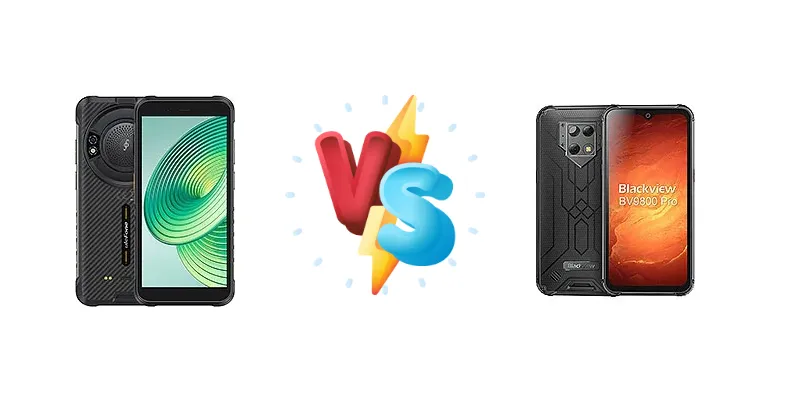
|
🏆 Quick Verdict
For the average user prioritizing long-term battery life and sustained performance under load, the Ulefone RugKing is the better choice. Its Unisoc T7255 chipset, coupled with exceptional endurance (106:26h), provides a more reliable experience than the Blackview BV9800 Pro’s older Helio P70.
| PHONES | ||
|---|---|---|
| Phone Names | Ulefone RugKing | Blackview BV9800 Pro |
| Network | ||
|---|---|---|
| 2G bands | GSM 850 / 900 / 1800 / 1900 | GSM 850 / 900 / 1800 / 1900 |
| 3G bands | HSDPA 850 / 900 / 1700(AWS) / 1900 / 2100 | HSDPA 800 / 850 / 900 / 1700(AWS) / 1900 / 2100 |
| 4G bands | 1, 2, 3, 4, 5, 7, 8, 12, 17, 18, 19, 20, 25, 26, 28, 66 | 1, 2, 3, 4, 5, 6, 7, 8, 12, 13, 17, 18, 19, 20, 25, 26, 28, 34, 38, 39, 40, 41, 66 |
| Speed | HSPA, LTE | HSPA, LTE |
| Technology | GSM / HSPA / LTE | GSM / CDMA / HSPA / CDMA2000 / LTE |
| Launch | ||
|---|---|---|
| Announced | 2025, August | 2019, October 28. Released 2019, November |
| Status | Available. Released 2025, September 15 | Discontinued |
| Body | ||
|---|---|---|
| Dimensions | 173.4 x 83.4 x 18.3 mm (6.83 x 3.28 x 0.72 in) | 168.5 x 81 x 14.8 mm (6.63 x 3.19 x 0.58 in) |
| SIM | Nano-SIM + Nano-SIM | Nano-SIM + Nano-SIM |
| Weight | 397 g (14.00 oz) | 322 g (11.36 oz) |
| Display | ||
|---|---|---|
| Protection | Corning Gorilla Glass 3, Mohs level 4 | - |
| Resolution | 720 x 1440 pixels, 18:9 ratio (~269 ppi density) | 1080 x 2340 pixels, 19.5:9 ratio (~409 ppi density) |
| Size | 5.99 inches, 92.6 cm2 (~64.0% screen-to-body ratio) | 6.3 inches, 97.4 cm2 (~71.4% screen-to-body ratio) |
| Type | IPS LCD, 60Hz, 910 nits (peak) | IPS LCD |
| Platform | ||
|---|---|---|
| CPU | Octa-core (2x2.0 GHz Cortex-A75 & 6x1.8 GHz Cortex-A55) | Octa-core (4x2.1 GHz Cortex-A73 & 4x2.0 GHz Cortex-A53) |
| Chipset | Unisoc T7255 (12 nm) | Mediatek MT6771V/CT Helio P70 (12 nm) |
| GPU | Mali-G57 | Mali-G72 MP3 |
| OS | Android 15 | Android 9.0 (Pie) |
| Memory | ||
|---|---|---|
| Card slot | microSDXC (dedicated slot) | microSDXC |
| Internal | 256GB 8GB RAM | 128GB 6GB RAM |
| Main Camera | ||
|---|---|---|
| Dual | 50 MP, f/1.8, (wide), 1/2.76", 0.64µm, PDAF 2 MP (macro) | - |
| Features | LED flash, HDR, panorama | Thermal imaging, LED flash |
| Triple | - | 48 MP, (wide), PDAF 5 MP, thermal assisted camera FLIR thermal camera (Lepton module) |
| Video | 1080p@30fps | 1080p@30fps |
| Selfie camera | ||
|---|---|---|
| Single | 8 MP, f/2.0, (wide), 1/4.0", 1.12µm | 16 MP, f/2.0, (wide) |
| Video | 1080p@30fps | 1080p@30fps |
| Sound | ||
|---|---|---|
| 35mm jack | Yes | Yes |
| Loudspeaker | Yes (126dB) | Yes |
| Comms | ||
|---|---|---|
| Bluetooth | 5.0, A2DP, LE | 4.1, A2DP |
| NFC | Yes | Yes |
| Positioning | GPS, GALILEO, GLONASS, QZSS, BDS | GPS, GLONASS, GALILEO |
| Radio | Wireless FM radio, RDS, recording | FM radio |
| USB | USB Type-C 2.0, OTG, accessory connector pins | USB Type-C 2.0, OTG |
| WLAN | Wi-Fi 802.11 a/b/g/n/ac, dual-band | Wi-Fi 802.11 a/b/g/n/ac |
| Features | ||
|---|---|---|
| Sensors | Fingerprint (side-mounted), accelerometer, gyro, proximity, compass | Fingerprint (side-mounted), accelerometer, gyro, proximity, compass, barometer |
| Battery | ||
|---|---|---|
| Charging | 18W wired 5W reverse wired | 18W wired |
| Type | 9600 mAh | 6580 mAh |
| Misc | ||
|---|---|---|
| Colors | Black | Black, Orange |
| Price | About 170 EUR | About 340 EUR |
| EU LABEL | ||
|---|---|---|
| Battery | 106:26h endurance, 1000 cycles | - |
| Energy | Class A | - |
| Free fall | Class A (270 falls) | - |
| Repairability | Class C | - |
Ulefone RugKing
- Exceptional battery life (106:26h endurance)
- Modern CPU architecture (Unisoc T7255)
- 5W reverse wired charging for emergency power
- Limited brand recognition compared to Blackview
- Display specifications are unknown
Blackview BV9800 Pro
- Established brand in the rugged phone market
- Potentially wider accessory availability
- Slightly higher CPU clock speed (A73 cores)
- Older CPU architecture (Helio P70)
- Likely shorter battery life
- No reverse charging
Display Comparison
Neither device’s display specifications are provided, so a direct comparison is limited. However, given the price point and rugged focus, both likely utilize IPS LCD panels. The absence of details like resolution or refresh rate suggests neither prioritizes a premium visual experience. Users should expect functional clarity rather than vibrant colors or smooth scrolling. Bezels are likely substantial on both to contribute to drop protection.
Camera Comparison
Without detailed camera specifications, a comprehensive comparison is impossible. However, the rugged phone segment often prioritizes durability over camera quality. Both devices likely feature a multi-camera setup, but image processing and sensor size will be key differentiators. The absence of information suggests neither phone will compete with flagship camera performance. Users should expect acceptable photos in good lighting conditions, but struggle in low-light scenarios. The inclusion of a 2MP macro lens on either device is likely a marketing gimmick with limited practical value.
Performance
The Ulefone RugKing’s Unisoc T7255 (12nm) and the Blackview BV9800 Pro’s MediaTek Helio P70 (12nm) are both mid-range chipsets, but their architectures differ significantly. The RugKing utilizes Cortex-A75 cores (2x2.0 GHz) alongside A55 cores (6x1.8 GHz), offering a more modern and efficient design than the BV9800 Pro’s Cortex-A73 (4x2.1 GHz) and A53 (4x2.0 GHz) configuration. While the BV9800 Pro’s A73 cores have a slightly higher clock speed, the A75 cores in the RugKing generally provide better sustained performance and power efficiency. This translates to smoother multitasking and potentially less throttling during prolonged use. The 12nm process node is shared, meaning thermal performance will be similar, but the architectural advantage favors Ulefone.
Battery Life
This is where the Ulefone RugKing truly shines. Its 106:26h endurance rating is exceptional for a rugged phone, and the 1000 cycle lifespan suggests long-term battery health. The 18W wired charging is standard, but the 5W reverse wired charging adds a useful convenience feature. The Blackview BV9800 Pro, lacking endurance data, likely offers significantly less battery life. While both support 18W charging, the RugKing’s superior capacity and efficiency mean it will spend less time plugged in and offer more usable power throughout the day.
Buying Guide
Buy the Ulefone RugKing if you need a phone that can genuinely last for days on a single charge, and you frequently use your device for extended periods outdoors or in demanding work environments. Buy the Blackview BV9800 Pro if you prioritize a slightly more established brand in the rugged space and are willing to trade some battery life for potentially wider accessory availability, though the performance difference is minimal.