
Ulefone Power Armor X11 vs Nokia XR20: A Head-to-Head Rugged Phone Showdown
| Phones Images | |||||
|---|---|---|---|---|---|
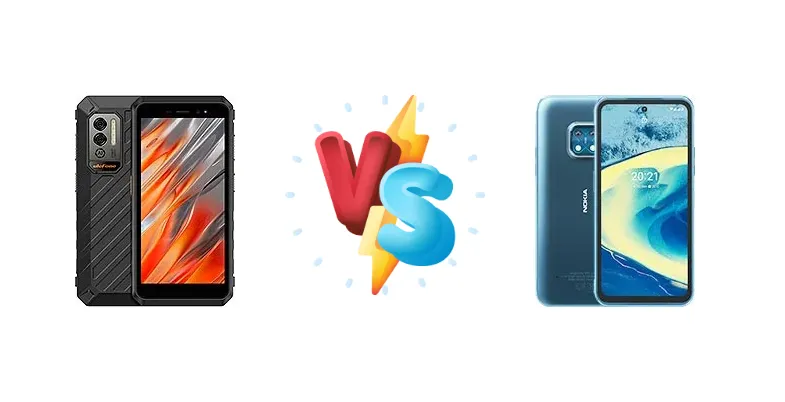
|
🏆 Quick Verdict
For the average user prioritizing future-proofing and smoother performance, the Nokia XR20 is the clear winner. Its Snapdragon 480 5G chipset offers a significant leap in processing power and connectivity compared to the Ulefone X11’s Helio A22, justifying the price difference for those who demand more from their device.
| PHONES | ||
|---|---|---|
| Phone Names | Ulefone Power Armor X11 | Nokia XR20 |
| Network | ||
|---|---|---|
| 2G bands | GSM 850 / 900 / 1800 / 1900 | GSM 850 / 900 / 1800 / 1900 |
| 3G bands | HSDPA 850 / 900 / 1700(AWS) / 1900 / 2100 | HSDPA 850 / 900 / 1700(AWS) / 1900 / 2100 |
| 4G bands | 1, 2, 3, 4, 5, 7, 8, 12, 13, 17, 18, 19, 20, 25, 26, 28 | 1, 2, 3, 4, 5, 7, 8, 12, 13, 14, 20, 25, 26, 28, 30, 38, 40, 41, 48, 66, 71 |
| 5G bands | - | 2, 5, 25, 38, 41, 48, 66, 77, 78 SA/NSA |
| Speed | HSPA, LTE | HSPA, LTE, 5G |
| Technology | GSM / HSPA / LTE | GSM / CDMA / HSPA / EVDO / LTE / 5G |
| - | CDMA2000 1xEV-DO | |
| Launch | ||
|---|---|---|
| Announced | 2023, June 18 | 2021, July 27 |
| Status | Available. Released 2023, June 18 | Available. Released 2021, August 04 |
| Body | ||
|---|---|---|
| Dimensions | 158.2 x 76.7 x 19.3 mm (6.23 x 3.02 x 0.76 in) | 171.6 x 81.5 x 10.6 mm (6.76 x 3.21 x 0.42 in) |
| SIM | Nano-SIM + Nano-SIM | · Nano-SIM· Nano-SIM + Nano-SIM |
| Weight | 330 g (11.64 oz) | 248 g (8.75 oz) |
| - | IP68 dust/water resistant (up to 1.5m for 60 min) Drop-to-concrete resistance from up to 1.8m MIL-STD-810H compliant | |
| Display | ||
|---|---|---|
| Protection | - | Corning Gorilla Glass Victus |
| Resolution | 720 x 1440 pixels, 18:9 ratio (~295 ppi density) | 1080 x 2400 pixels, 20:9 ratio (~395 ppi density) |
| Size | 5.45 inches, 76.7 cm2 (~63.2% screen-to-body ratio) | 6.67 inches, 107.4 cm2 (~76.8% screen-to-body ratio) |
| Type | IPS LCD | IPS LCD, 550 nits |
| Platform | ||
|---|---|---|
| CPU | Quad-core 2.0 GHz Cortex-A53 | Octa-core (2x2.0 GHz Kryo 460 & 6x1.8 GHz Kryo 460) |
| Chipset | Mediatek MT6761 Helio A22 (12 nm) | Qualcomm SM4350 Snapdragon 480 5G (8 nm) |
| GPU | PowerVR GE8320 | Adreno 619 |
| OS | Android 13 | Android 11, upgradable to Android 13 |
| Memory | ||
|---|---|---|
| Card slot | microSDXC (dedicated slot) | microSDXC (uses shared SIM slot) |
| Internal | 32GB 4GB RAM | 64GB 4GB RAM, 128GB 6GB RAM |
| Main Camera | ||
|---|---|---|
| Dual | 16 MP, f/1.8, (wide), 1.12µm, PDAF Auxiliary lens | 48 MP, f/1.8, (wide), 1/2.25", 0.8µm, PDAF 13 MP, f/2.4, 123˚ (ultrawide), 1/3.0", 1.12µm |
| Features | Quad-LED flash, HDR, panorama | Zeiss optics, Dual-LED dual-tone flash, second LED flash, HDR, panorama |
| Single | - | 8 MP, f/2.0 (wide), 1/4.0", 1.12µm |
| Video | 1080p@30fps | 1080p@30fps |
| Selfie camera | ||
|---|---|---|
| Single | 5 MP, f/2.2 | 8 MP, f/2.0 (wide), 1/4.0", 1.12µm |
| Video | 1080p@30fps | 1080p@30fps |
| Sound | ||
|---|---|---|
| 3.5mm jack | - | Yes |
| 35mm jack | Yes | Yes |
| Loudspeaker | Yes, with dual speakers | Yes, with stereo speakers |
| Comms | ||
|---|---|---|
| Bluetooth | 5.0, A2DP, LE | 5.1, A2DP, LE, aptX Adaptive |
| NFC | Yes | Yes |
| Positioning | GPS, GLONASS, GALILEO, BDS | GPS (L1+L5), GLONASS, BDS, GALILEO, QZSS, NavIC |
| Radio | Wireless FM radio, RDS, recording | Unspecified |
| USB | USB Type-C 2.0, OTG | USB Type-C 3.0 |
| WLAN | Wi-Fi 802.11 a/b/g/n/ac, dual-band | Wi-Fi 802.11 a/b/g/n/ac/6, dual-band, Wi-Fi Direct |
| Features | ||
|---|---|---|
| Sensors | Accelerometer, proximity, compass | Fingerprint (side-mounted), accelerometer, gyro, proximity, compass, barometer |
| Battery | ||
|---|---|---|
| Charging | 10W | 18W wired 15W wireless |
| Type | Li-Po 8150 mAh | Li-Po 4630 mAh |
| Misc | ||
|---|---|---|
| Colors | Black | Ultra Blue, Granite Gray |
| Models | - | TA-1368, TA-1362 |
| Price | About 140 EUR | About 270 EUR |
| SAR EU | - | 1.13 W/kg (head) 1.43 W/kg (body) |
Ulefone Power Armor X11
- Extremely affordable price point
- Rugged build quality for basic protection
- Simple and easy-to-use interface
- Outdated and slow processor
- Limited app performance
- Slow 10W charging
- No 5G connectivity
Nokia XR20
- 5G connectivity for faster data speeds
- Significantly faster processor for smooth performance
- 18W wired and 15W wireless charging
- More advanced camera capabilities
- Higher price compared to the Ulefone X11
- May still struggle with very demanding games
- Rugged design may add bulk
Display Comparison
Neither Ulefone nor Nokia provide detailed display specs beyond size. However, the core difference lies elsewhere. The XR20’s chipset has an ISP capable of handling higher resolution displays and faster refresh rates, suggesting a potentially sharper and more responsive visual experience. While both likely utilize IPS LCD panels, the XR20’s processing power allows for more sophisticated image processing, potentially leading to better color accuracy and contrast. The X11, constrained by its Helio A22, will likely offer a more basic display experience.
Camera Comparison
Detailed camera specs are unavailable, but the chipset difference heavily influences camera capabilities. The Snapdragon 480 in the XR20 includes a more advanced image signal processor (ISP) capable of faster image processing, better noise reduction, and improved dynamic range. While both phones likely feature similar megapixel counts in their primary sensors, the XR20’s ISP will deliver superior image quality, especially in challenging lighting conditions. The X11’s Helio A22 will struggle to keep up with complex image processing tasks, resulting in softer images and less detail.
Performance
The performance gap between these two devices is substantial. The Ulefone X11’s MediaTek Helio A22, a quad-core processor built on a 12nm process, is designed for entry-level smartphones. It will struggle with demanding applications and multitasking. Conversely, the Nokia XR20 boasts the Qualcomm Snapdragon 480 5G, an octa-core processor fabricated on a more efficient 8nm node. This translates to significantly faster processing speeds, smoother app performance, and the ability to handle 5G networks. The XR20’s CPU architecture (Kryo 460) is also more modern and efficient than the Cortex-A53 cores in the X11, resulting in better overall responsiveness.
Battery Life
While battery capacity isn't specified, the charging capabilities highlight a key difference. The Ulefone X11 supports only 10W charging, meaning a full charge will take a considerable amount of time. The Nokia XR20, with its 18W wired and 15W wireless charging, offers significantly faster and more convenient charging options. The 8nm process of the Snapdragon 480 also contributes to better power efficiency, potentially offsetting any capacity difference between the two devices. The XR20’s wireless charging is a significant convenience feature absent on the X11.
Buying Guide
Buy the Ulefone Power Armor X11 if you need an extremely budget-friendly, genuinely rugged phone for basic tasks like calls, texts, and occasional navigation where performance isn't critical. Buy the Nokia XR20 if you prefer a more capable device with 5G connectivity, faster processing for apps and multitasking, and the convenience of wireless charging, even if it comes at a higher cost.