
Ulefone Power Armor X11 vs. Blackview BL5000: A Rugged Performance Showdown
| Phones Images | |||||
|---|---|---|---|---|---|
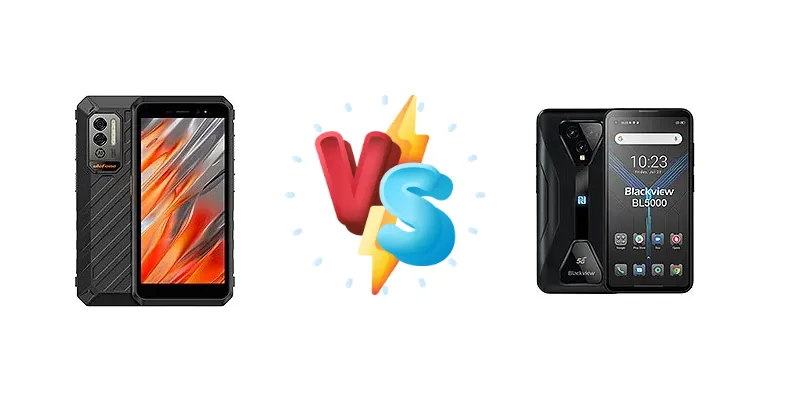
|
🏆 Quick Verdict
For the average user prioritizing responsiveness and future-proofing, the Blackview BL5000 is the clear winner. Its Dimensity 700 chipset delivers a substantial performance uplift over the Ulefone X11’s Helio A22, making it suitable for more demanding tasks and 5G connectivity. While the X11 offers a lower entry price, the BL5000’s speed justifies the cost difference.
| PHONES | ||
|---|---|---|
| Phone Names | Ulefone Power Armor X11 | Blackview BL5000 |
| Network | ||
|---|---|---|
| 2G bands | GSM 850 / 900 / 1800 / 1900 | GSM 850 / 900 / 1800 / 1900 |
| 3G bands | HSDPA 850 / 900 / 1700(AWS) / 1900 / 2100 | HSDPA 800 / 850 / 900 / 1700(AWS) / 1900 / 2100 |
| 4G bands | 1, 2, 3, 4, 5, 7, 8, 12, 13, 17, 18, 19, 20, 25, 26, 28 | 1, 2, 3, 4, 5, 7, 8, 12, 13, 17, 18, 19, 20, 25, 26, 28, 34, 38, 39, 40, 41, 66 |
| 5G bands | - | 1, 3, 5, 7, 8, 20, 28, 38, 40, 41, 77, 78, 79 SA/NSA |
| Speed | HSPA, LTE | HSPA, LTE, 5G |
| Technology | GSM / HSPA / LTE | GSM / CDMA / HSPA / CDMA2000 / LTE / 5G |
| - | CDMA2000 1x | |
| Launch | ||
|---|---|---|
| Announced | 2023, June 18 | 2021, July 29 |
| Status | Available. Released 2023, June 18 | Available. Released 2021, August |
| Body | ||
|---|---|---|
| Dimensions | 158.2 x 76.7 x 19.3 mm (6.23 x 3.02 x 0.76 in) | 164 x 80.4 x 12.8 mm (6.46 x 3.17 x 0.50 in) |
| SIM | Nano-SIM + Nano-SIM | Nano-SIM + Nano-SIM |
| Weight | 330 g (11.64 oz) | 273 g (9.63 oz) |
| - | IP68/IP69K dust/water resistant (up to 1.5m for 30 min) Drop-to-concrete resistance from up to 1.5m MIL-STD-810G compliant | |
| Display | ||
|---|---|---|
| Protection | - | Corning Gorilla Glass 5 |
| Resolution | 720 x 1440 pixels, 18:9 ratio (~295 ppi density) | 1080 x 2300 pixels (~400 ppi density) |
| Size | 5.45 inches, 76.7 cm2 (~63.2% screen-to-body ratio) | 6.36 inches, 100.4 cm2 (~76.1% screen-to-body ratio) |
| Type | IPS LCD | IPS LCD |
| Platform | ||
|---|---|---|
| CPU | Quad-core 2.0 GHz Cortex-A53 | Octa-core (2x2.2 GHz Cortex-A76 & 6x2.0 GHz Cortex-A55) |
| Chipset | Mediatek MT6761 Helio A22 (12 nm) | Mediatek Dimensity 700 (7 nm) |
| GPU | PowerVR GE8320 | Mali-G57 MC2 |
| OS | Android 13 | Android 11 |
| Memory | ||
|---|---|---|
| Card slot | microSDXC (dedicated slot) | No |
| Internal | 32GB 4GB RAM | 128GB 8GB RAM |
| - | UFS 2.2 | |
| Main Camera | ||
|---|---|---|
| Dual | 16 MP, f/1.8, (wide), 1.12µm, PDAF Auxiliary lens | 12 MP, f/1.8, (wide), PDAF 16 MP, 125˚ (ultrawide) |
| Features | Quad-LED flash, HDR, panorama | LED flash, HDR, panorama |
| Single | - | 16 MP, f/2.0, (wide) |
| Video | 1080p@30fps | 1440p@30fps |
| Selfie camera | ||
|---|---|---|
| Single | 5 MP, f/2.2 | 16 MP, f/2.0, (wide) |
| Video | 1080p@30fps | 1080p@30fps |
| Sound | ||
|---|---|---|
| 3.5mm jack | - | No |
| 35mm jack | Yes | No |
| Loudspeaker | Yes, with dual speakers | Yes |
| Comms | ||
|---|---|---|
| Bluetooth | 5.0, A2DP, LE | 5.2, A2DP, LE |
| NFC | Yes | Yes |
| Positioning | GPS, GLONASS, GALILEO, BDS | GPS, GLONASS, GALILEO, BDS |
| Radio | Wireless FM radio, RDS, recording | FM radio |
| USB | USB Type-C 2.0, OTG | USB Type-C 2.0, OTG |
| WLAN | Wi-Fi 802.11 a/b/g/n/ac, dual-band | Wi-Fi 802.11 a/b/g/n/ac |
| Features | ||
|---|---|---|
| Sensors | Accelerometer, proximity, compass | Fingerprint (side-mounted), accelerometer, gyro, proximity, compass, barometer |
| Battery | ||
|---|---|---|
| Charging | 10W | 30W wired |
| Type | Li-Po 8150 mAh | 4980 mAh |
| Misc | ||
|---|---|---|
| Colors | Black | Black, Orange, Green |
| Price | About 140 EUR | About 260 EUR |
Ulefone Power Armor X11
- Lowest possible price point for a rugged phone.
- Potentially longer battery life due to less power-hungry chipset.
- Durable build quality expected from the Power Armor series.
- Extremely slow performance for modern apps.
- Slow 10W charging.
- Limited future-proofing.
Blackview BL5000
- Significantly faster performance thanks to the Dimensity 700.
- 5G connectivity for faster data speeds.
- 30W fast charging for quicker top-ups.
- Higher price compared to the Ulefone X11.
- Potentially shorter battery life under heavy load (though mitigated by efficiency).
- Rugged design may add bulk.
Display Comparison
Neither device’s display specifications are provided, so we must infer. Given the price point of the X11, it likely features a 720p LCD panel. The BL5000, positioned higher, may have a 1080p LCD. The key difference isn’t resolution, but the chipset’s ability to drive a higher refresh rate display if one were present. The Dimensity 700’s GPU is far more capable of handling higher resolutions and refresh rates, offering a smoother visual experience. Bezels are likely substantial on both, typical of rugged designs prioritizing protection.
Camera Comparison
Without detailed camera specs, a direct comparison is difficult. However, the chipset plays a role. The Dimensity 700 includes a more powerful image signal processor (ISP) than the Helio A22, enabling better noise reduction, dynamic range, and faster image processing. This doesn’t guarantee better photos, but it provides the *potential* for superior image quality. Both phones likely feature multiple cameras, but the X11’s image processing will be significantly slower and less sophisticated. Expect the BL5000 to handle video recording with greater stability and detail.
Performance
The performance gap is the defining characteristic of this comparison. The Ulefone X11’s Mediatek Helio A22, a quad-core 2.0 GHz Cortex-A53 processor built on a 12nm process, is designed for basic smartphone functions. The Blackview BL5000’s Mediatek Dimensity 700, an octa-core (2x2.2 GHz Cortex-A76 & 6x2.0 GHz Cortex-A55) processor fabricated on a more efficient 7nm node, represents a significant leap in processing power. The Dimensity 700’s Cortex-A76 cores provide substantially higher single-core performance, crucial for app responsiveness, while the additional cores and improved efficiency handle multitasking with ease. This translates to faster app loading times, smoother scrolling, and the ability to run more demanding applications on the BL5000.
Battery Life
Battery capacity isn’t specified, but the charging wattage reveals a key difference. The Ulefone X11’s 10W charging is slow by modern standards, requiring several hours for a full charge. The Blackview BL5000’s 30W wired charging significantly reduces charging times, offering a more convenient user experience. While the X11 might have a slightly larger battery, the BL5000’s more efficient chipset and faster charging mitigate any potential endurance disadvantage.
Buying Guide
Buy the Ulefone Power Armor X11 if you need an extremely affordable, basic rugged phone for essential communication and light tasks like calls, texts, and simple navigation. It’s ideal for users on a tight budget or those who prioritize maximum battery life over speed. Buy the Blackview BL5000 if you prefer a smoother, more responsive experience, require 5G connectivity, and anticipate using your phone for more than just basic functions – including occasional gaming or demanding apps. The BL5000 is for users who want a rugged phone that doesn’t feel like a compromise.