
Ulefone Power Armor X11 Pro vs. Armor 10 5G: A Deep Dive into Rugged Performance
| Phones Images | |||||
|---|---|---|---|---|---|
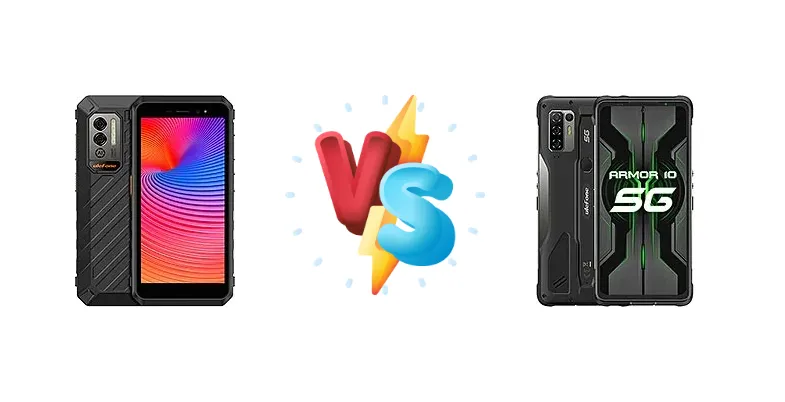
|
🏆 Quick Verdict
For most users, the Ulefone Armor 10 5G is the superior choice. The Dimensity 800 chipset delivers a significantly faster and more responsive experience, alongside the benefit of 5G connectivity. While the X11 Pro offers longer potential battery life due to its less demanding processor, the performance gap is too large to ignore for all but the most frugal users.
| PHONES | ||
|---|---|---|
| Phone Names | Ulefone Power Armor X11 Pro | Ulefone Armor 10 5G |
| Network | ||
|---|---|---|
| 2G bands | GSM 850 / 900 / 1800 / 1900 | GSM 850 / 900 / 1800 / 1900 |
| 3G bands | HSDPA 850 / 900 / 1700(AWS) / 1900 / 2100 | HSDPA 850 / 900 / 1700(AWS) / 1900 / 2100 |
| 4G bands | 1, 2, 3, 4, 5, 7, 8, 12, 13, 17, 18, 19, 20, 25, 26, 28 | 1, 2, 3, 4, 5, 7, 8, 12, 13, 17, 18, 19, 20, 25, 26, 28, 34, 38, 39, 40, 41, 66 |
| 5G bands | - | 1, 3, 41, 77, 78, 79 SA/NSA |
| Speed | HSPA, LTE | HSPA, LTE, 5G |
| Technology | GSM / HSPA / LTE | GSM / CDMA / HSPA / EVDO / LTE / 5G |
| eMMC 5.1 | CDMA2000 1xEV-DO | |
| Launch | ||
|---|---|---|
| Announced | 2022, September 16 | 2020, November 17. Released 2020, December 07 |
| Status | Available. Released 2022, September 16 | Discontinued |
| Body | ||
|---|---|---|
| Build | - | Front glass, aluminum back with rubber, aluminum frame |
| Dimensions | 158.2 x 76.7 x 19.3 mm (6.23 x 3.02 x 0.76 in) | 176.5 x 82.8 x 14.6 mm (6.95 x 3.26 x 0.57 in) |
| SIM | Nano-SIM + Nano-SIM | Nano-SIM + Nano-SIM |
| Weight | 330 g (11.64 oz) | 328 g (11.57 oz) |
| IP68 dust/water resistant (up to 1.5m for 30 min) Drop-to-concrete resistance from up to 1.5m MIL-STD-810G compliant | IP68 dust/water resistant (up to 1.5m for 30 min) Drop-to-concrete resistance from up to 1.2m MIL-STD-810G compliant | |
| Display | ||
|---|---|---|
| Protection | - | Scratch-resistant glass, oleophobic coating |
| Resolution | 720 x 1440 pixels, 18:9 ratio (~295 ppi density) | 1080 x 2400 pixels, 20:9 ratio (~395 ppi density) |
| Size | 5.45 inches, 76.7 cm2 (~63.2% screen-to-body ratio) | 6.67 inches, 107.4 cm2 (~73.5% screen-to-body ratio) |
| Type | IPS LCD | IPS LCD |
| Platform | ||
|---|---|---|
| CPU | Octa-core (4x2.0 GHz Cortex-A53 & 4x1.5 GHz Cortex-A53) | Octa-core (4x2.0 GHz Cortex-A76 & 4x2.0 GHz Cortex-A55) |
| Chipset | Mediatek MT6762G Helio G25 (12 nm) | Mediatek Dimensity 800 (7 nm) |
| GPU | PowerVR GE8320 | Mali-G57 MP4 |
| OS | Android 12 | Android 10, planned upgrade to Android 11 |
| Memory | ||
|---|---|---|
| Card slot | microSDXC (dedicated slot) | microSDXC (uses shared SIM slot) |
| Internal | 64GB 4GB RAM | 128GB 8GB RAM |
| Main Camera | ||
|---|---|---|
| Dual | 16 MP, f/1.8, (wide), 1.12µm, PDAF Auxiliary lens | - |
| Features | Dual-LED flash, HDR, panorama | LED flash, Panorama, HDR |
| Quad | - | 64 MP, f/1.9, 26mm (wide), 1/1.72", 0.8µm, PDAF 8 MP, f/2.2, 119˚ (ultrawide) 5 MP (macro) Auxiliary lens |
| Single | 5 MP, f/2.2 | - |
| Video | 1080p@30fps | 4K@30fps, 1080p@30fps |
| Selfie camera | ||
|---|---|---|
| Single | 5 MP, f/2.2 | 16 MP, f/2.2 |
| Video | 1080p@30fps | 1080p@30fps |
| Sound | ||
|---|---|---|
| 3.5mm jack | Yes | Yes |
| 35mm jack | Yes | Yes |
| Loudspeaker | Yes | Yes |
| Comms | ||
|---|---|---|
| Bluetooth | 5.0, A2DP, LE | 5.2, A2DP, LE |
| NFC | Yes | Yes |
| Positioning | GPS, GLONASS, GALILEO, BDS | GPS, GLONASS, GALILEO, BDS |
| Radio | FM radio, RDS, recording | FM radio, RDS, recording |
| USB | USB Type-C 2.0, OTG | USB Type-C 2.0, OTG |
| WLAN | Wi-Fi 802.11 a/b/g/n/ac, dual-band | Wi-Fi 802.11 a/b/g/n/ac, Wi-Fi Direct |
| Features | ||
|---|---|---|
| Sensors | Accelerometer, proximity, compass | Fingerprint (side-mounted), accelerometer, gyro, proximity, compass, baroceptor, coulombmeter |
| Battery | ||
|---|---|---|
| Charging | - | 15W wired 15W wireless |
| Type | Li-Po 8150 mAh | Li-Po 5800 mAh |
| Misc | ||
|---|---|---|
| Colors | Black | Black |
| Price | About 170 EUR | About 420 EUR |
Ulefone Power Armor X11 Pro
- Potentially longer battery life due to less demanding chipset.
- More affordable price point.
- Rugged design for durability.
- Significantly slower performance.
- Lacks 5G connectivity.
- Limited multitasking capabilities.
Ulefone Armor 10 5G
- Much faster performance with the Dimensity 800.
- 5G connectivity for faster data speeds.
- Faster charging (wired and wireless).
- Potentially shorter battery life compared to the X11 Pro.
- Higher price point.
- May experience more heat under heavy load.
Display Comparison
Neither Ulefone provides detailed display specifications beyond size. However, the core difference lies in the processing power driving the UI. A faster chipset, like the Dimensity 800 in the Armor 10 5G, will translate to smoother animations and faster app loading times, enhancing the perceived display quality. While both likely utilize IPS LCD panels, the Armor 10 5G’s superior processing capabilities will make the display feel more responsive.
Camera Comparison
Without detailed camera specs, a direct comparison is difficult. However, Ulefone’s marketing often focuses on megapixel count rather than sensor size or image processing quality. It’s reasonable to assume both phones feature similar image sensors, but the Armor 10 5G’s more powerful ISP (Image Signal Processor) within the Dimensity 800 chipset will likely result in better image processing, particularly in low-light conditions. Expect improved noise reduction and dynamic range on the Armor 10 5G. The presence of a dedicated ISP is a key advantage.
Performance
The performance disparity is the most significant factor. The Ulefone Armor 10 5G’s Mediatek Dimensity 800 (7nm) is a substantial upgrade over the Power Armor X11 Pro’s Helio G25 (12nm). The Dimensity 800 features Cortex-A76 cores, offering significantly higher single-core performance compared to the X11 Pro’s Cortex-A53 cores. This translates to faster app launches, smoother multitasking, and a more enjoyable gaming experience. The 7nm process also contributes to better thermal efficiency, reducing throttling under sustained load. The X11 Pro’s G25 is adequate for basic tasks, but will struggle with demanding applications.
Battery Life
The Power Armor X11 Pro, with its less power-hungry Helio G25, will likely achieve longer battery life under similar usage scenarios. However, the Armor 10 5G’s 15W wired and 15W wireless charging capabilities offer greater convenience. While the Armor 10 5G’s battery capacity isn’t specified, the Dimensity 800’s efficiency gains partially offset the increased power draw. The X11 Pro will likely require less frequent charging, but the Armor 10 5G’s faster charging speeds minimize downtime.
Buying Guide
Buy the Ulefone Power Armor X11 Pro if you prioritize maximum battery life and are primarily focused on basic smartphone tasks like calls, texts, and light social media use. You'll appreciate its lower price point. Buy the Ulefone Armor 10 5G if you need faster performance for multitasking, gaming, or demanding applications, and if 5G connectivity is a priority. The improved processing power justifies the higher cost for power users.