
Ulefone Power Armor X11 Pro vs. Doogee S98 Pro: A Deep Dive into Rugged Performance
| Phones Images | |||||
|---|---|---|---|---|---|
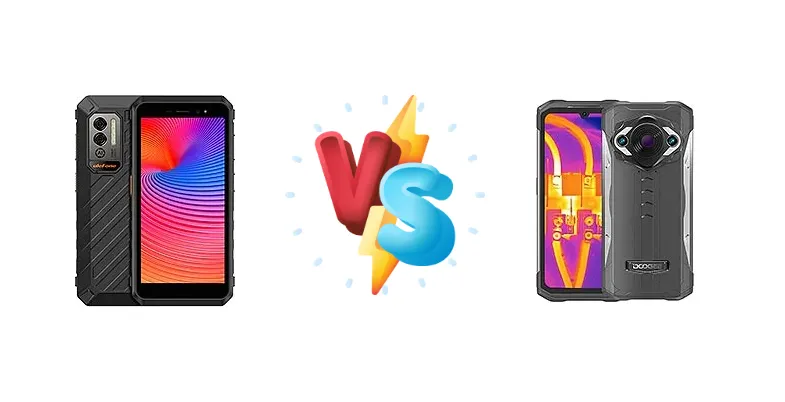
|
🏆 Quick Verdict
For the average user prioritizing responsiveness and future-proofing, the Doogee S98 Pro is the clear winner. Its Helio G96 chipset provides a substantial performance uplift over the Ulefone X11 Pro’s Helio G25, making it better suited for multitasking, gaming, and demanding applications. While the X11 Pro offers a lower entry price, the S98 Pro’s added power justifies the cost for most.
| PHONES | ||
|---|---|---|
| Phone Names | Ulefone Power Armor X11 Pro | Doogee S98 Pro |
| Network | ||
|---|---|---|
| 2G bands | GSM 850 / 900 / 1800 / 1900 | GSM 850 / 900 / 1800 / 1900 |
| 3G bands | HSDPA 850 / 900 / 1700(AWS) / 1900 / 2100 | HSDPA 800 / 850 / 900 / 1700(AWS) / 1900 / 2100 |
| 4G bands | 1, 2, 3, 4, 5, 7, 8, 12, 13, 17, 18, 19, 20, 25, 26, 28 | 1, 2, 3, 4, 5, 7, 8, 12, 13, 17, 18, 19, 20, 25, 26, 28, 34, 38, 39, 40, 41, 66 |
| Speed | HSPA, LTE | HSPA, LTE |
| Technology | GSM / HSPA / LTE | GSM / CDMA / HSPA / LTE |
| eMMC 5.1 | - | |
| Launch | ||
|---|---|---|
| Announced | 2022, September 16 | 2022, May 27 |
| Status | Available. Released 2022, September 16 | Available. Released 2022, June 06 |
| Body | ||
|---|---|---|
| Dimensions | 158.2 x 76.7 x 19.3 mm (6.23 x 3.02 x 0.76 in) | 172 x 82 x 15.5 mm (6.77 x 3.23 x 0.61 in) |
| SIM | Nano-SIM + Nano-SIM | Nano-SIM + Nano-SIM |
| Weight | 330 g (11.64 oz) | 320 g (11.29 oz) |
| IP68 dust/water resistant (up to 1.5m for 30 min) Drop-to-concrete resistance from up to 1.5m MIL-STD-810G compliant | - | |
| Display | ||
|---|---|---|
| Protection | - | Corning Gorilla Glass |
| Resolution | 720 x 1440 pixels, 18:9 ratio (~295 ppi density) | 1080 x 2340 pixels, 19.5:9 ratio (~409 ppi density) |
| Size | 5.45 inches, 76.7 cm2 (~63.2% screen-to-body ratio) | 6.3 inches, 97.4 cm2 (~69.1% screen-to-body ratio) |
| Type | IPS LCD | IPS LCD, 500 nits (peak) |
| Platform | ||
|---|---|---|
| CPU | Octa-core (4x2.0 GHz Cortex-A53 & 4x1.5 GHz Cortex-A53) | Octa-core (2x2.05 GHz Cortex-A76 & 6x2.0 GHz Cortex-A55) |
| Chipset | Mediatek MT6762G Helio G25 (12 nm) | Mediatek MT6781 Helio G96 (12 nm) |
| GPU | PowerVR GE8320 | Mali-G57 MC2 |
| OS | Android 12 | Android 12 |
| Memory | ||
|---|---|---|
| Card slot | microSDXC (dedicated slot) | microSDXC (dedicated slot) |
| Internal | 64GB 4GB RAM | 256GB 8GB RAM |
| Main Camera | ||
|---|---|---|
| Dual | 16 MP, f/1.8, (wide), 1.12µm, PDAF Auxiliary lens | - |
| Features | Dual-LED flash, HDR, panorama | Dual-LED flash, HDR, panorama |
| Single | 5 MP, f/2.2 | - |
| Triple | - | 48 MP, f/1.8, (wide), PDAF 20 MP, f/1.8, (night vision), 2 infrared night vision lights Thermal imaging camera |
| Video | 1080p@30fps | 1440p, 1080p |
| Selfie camera | ||
|---|---|---|
| Single | 5 MP, f/2.2 | 16 MP, f/2.0, (wide) |
| Video | 1080p@30fps | 1080p |
| Sound | ||
|---|---|---|
| 3.5mm jack | Yes | - |
| 35mm jack | Yes | Unspecified |
| Loudspeaker | Yes | Yes |
| Comms | ||
|---|---|---|
| Bluetooth | 5.0, A2DP, LE | 5.1, A2DP, LE |
| NFC | Yes | Yes |
| Positioning | GPS, GLONASS, GALILEO, BDS | GPS, GLONASS, BDS, GALILEO |
| Radio | FM radio, RDS, recording | FM radio |
| USB | USB Type-C 2.0, OTG | USB Type-C 2.0, OTG |
| WLAN | Wi-Fi 802.11 a/b/g/n/ac, dual-band | Wi-Fi 802.11 a/b/g/n/ac, dual-band |
| Features | ||
|---|---|---|
| Sensors | Accelerometer, proximity, compass | Fingerprint (side-mounted), accelerometer, gyro, proximity, compass |
| Battery | ||
|---|---|---|
| Charging | - | 33W wired 15W wireless |
| Type | Li-Po 8150 mAh | 6000 mAh |
| Misc | ||
|---|---|---|
| Colors | Black | Black |
| Price | About 170 EUR | About 470 EUR |
Ulefone Power Armor X11 Pro
- More affordable price point
- Rugged design for durability
- Potentially longer battery life with conservative usage
- Significantly slower performance
- Likely lower-quality display
- Slower charging speeds
Doogee S98 Pro
- Faster and more responsive performance
- 33W wired and 15W wireless charging
- Likely better camera system
- Higher price tag
- Potentially shorter battery life under heavy load
- May be slightly bulkier due to larger battery/features
Display Comparison
Neither device’s display specifications are provided, so a direct comparison is limited. However, given the price point of the X11 Pro, it likely utilizes a lower-quality panel with lower peak brightness and narrower color gamut compared to the S98 Pro. The S98 Pro, positioned as a more premium offering, likely benefits from a more refined display experience, potentially with better outdoor visibility. Bezels are expected to be larger on the X11 Pro due to cost constraints.
Camera Comparison
Without detailed camera specifications, a precise comparison is difficult. However, the S98 Pro’s higher overall price suggests a more capable camera system. While both phones likely feature multiple rear cameras, the S98 Pro is more likely to include a larger main sensor with optical image stabilization (OIS), resulting in better low-light performance and sharper images. The X11 Pro likely relies on smaller sensors and digital image stabilization, compromising image quality in challenging conditions. The inclusion of a 2MP macro camera on either device is largely a marketing tactic, offering limited practical benefit.
Performance
The core difference lies in the chipsets. The Ulefone X11 Pro’s MediaTek Helio G25 is an entry-level processor built on a 12nm process, featuring an octa-core configuration with Cortex-A53 cores clocked up to 2.0 GHz. This is adequate for basic tasks but will struggle with demanding applications. Conversely, the Doogee S98 Pro boasts the Helio G96, also on a 12nm process, but with a significantly more powerful CPU configuration: two Cortex-A76 cores at 2.05 GHz and six Cortex-A55 cores at 2.0 GHz. The A76 cores represent a substantial architectural improvement over the A53, delivering significantly better single-core and multi-core performance. This translates to faster app loading times, smoother multitasking, and a more enjoyable gaming experience on the S98 Pro.
Battery Life
Battery capacity isn’t specified for the X11 Pro, but rugged phones typically prioritize large batteries. The Doogee S98 Pro’s 33W wired and 15W wireless charging capabilities provide significant convenience. The X11 Pro likely offers slower charging speeds. While a larger battery capacity on the X11 Pro might offset the S98 Pro’s more power-hungry chipset, the S98 Pro’s faster charging allows for quicker top-ups, minimizing downtime. The wireless charging on the S98 Pro is a significant convenience feature absent on the X11 Pro.
Buying Guide
Buy the Ulefone Power Armor X11 Pro if you need a highly affordable, basic rugged phone for essential communication and light tasks, prioritizing longevity over speed. Buy the Doogee S98 Pro if you prefer a more responsive and capable device for everyday use, including moderate gaming, photography, and running multiple apps simultaneously, and value the convenience of wireless charging.