
Ulefone Power Armor 20WT vs. Power Armor 19T: The Ultimate Rugged Phone Comparison
| Phones Images | |||||
|---|---|---|---|---|---|
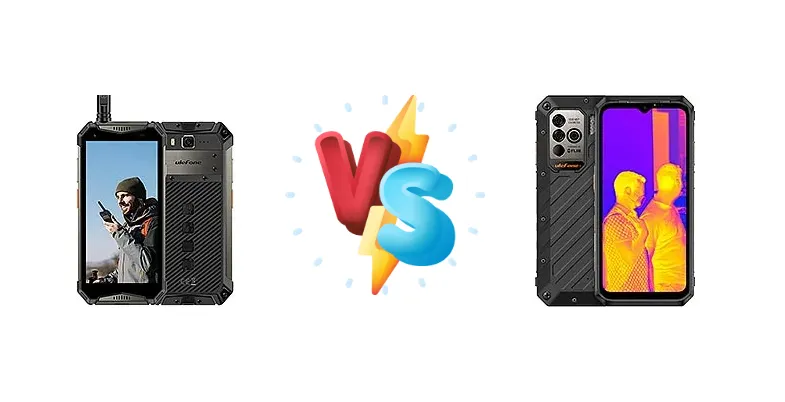
|
🏆 Quick Verdict
The Ulefone Power Armor 19T takes the crown thanks to its significantly faster 66W wired charging and added wireless charging capabilities. While both offer robust builds and similar performance, the 19T's charging speed and versatility provide a noticeable advantage for most users.
| PHONES | ||
|---|---|---|
| Phone Names | Ulefone Power Armor 20WT | Ulefone Power Armor 19T |
| Network | ||
|---|---|---|
| 2G bands | GSM 850 / 900 / 1800 / 1900 | GSM 850 / 900 / 1800 / 1900 |
| 3G bands | HSDPA 800 / 850 / 900 / 1700(AWS) / 1900 / 2100 | HSDPA 800 / 850 / 900 / 1700(AWS) / 1900 / 2100 |
| 4G bands | 1, 2, 3, 4, 5, 7, 8, 12, 13, 17, 18, 19, 20, 25, 26, 28, 34, 38, 39, 40, 41, 66 | 1, 2, 3, 4, 5, 7, 8, 12, 13, 17, 18, 19, 20, 25, 26, 28, 34, 38, 39, 40, 41, 66, 71 |
| Speed | HSPA, LTE | HSPA, LTE |
| Technology | GSM / CDMA / HSPA / CDMA2000 / LTE | GSM / CDMA / HSPA / CDMA2000 / LTE |
| CDMA2000 1x | CDMA2000 1x | |
| Launch | ||
|---|---|---|
| Announced | 2023, March 08 | 2023, March 06 |
| Status | Available. Released 2023, March 08 | Available. Released 2023, March 06 |
| Body | ||
|---|---|---|
| Dimensions | 164.8 x 79.2 x 18.1 mm (6.49 x 3.12 x 0.71 in) | 175.2 x 83.4 x 18.8 mm (6.90 x 3.28 x 0.74 in) |
| SIM | Nano-SIM + Nano-SIM | Nano-SIM + Nano-SIM |
| Weight | 382 g (13.47 oz) | 409 g (14.43 oz) |
| IP68/IP69K dust/water resistant (up to 1.5m for 30 min) Drop-to-concrete resistance from up to 1.5m MIL-STD-810H compliant | IP68/IP69K dust/water resistant (up to 1.5m for 30 min) Drop-to-concrete resistance from up to 1.5m MIL-STD-810H compliant Accessory connector (ulefone endoscope, microscope) | |
| Display | ||
|---|---|---|
| Protection | Corning Gorilla Glass 5 | Corning Gorilla Glass 5 |
| Resolution | 1080 x 2160 pixels, 18:9 ratio (~427 ppi density) | 1080 x 2408 pixels, 20:9 ratio (~401 ppi density) |
| Size | 5.65 inches, 82.4 cm2 (~63.1% screen-to-body ratio) | 6.58 inches, 104.3 cm2 (~71.4% screen-to-body ratio) |
| Type | IPS LCD | IPS LCD, 120Hz |
| Platform | ||
|---|---|---|
| CPU | Octa-core (2x2.2 GHz Cortex-A76 & 6x2.0 GHz Cortex-A55) | Octa-core (2x2.2 GHz Cortex-A76 & 6x2.0 GHz Cortex-A55) |
| Chipset | Mediatek Helio G99 (6 nm) | Mediatek Helio G99 (6 nm) |
| GPU | Mali-G57 MC2 | Mali-G57 MC2 |
| OS | Android 12 | Android 12 |
| Memory | ||
|---|---|---|
| Card slot | microSDXC (dedicated slot) | microSDXC (uses shared SIM slot) |
| Internal | 256GB 12GB RAM | 256GB 12GB RAM |
| Main Camera | ||
|---|---|---|
| Features | Dual-LED flash, HDR, panorama | Hexa-LED flash, HDR, panorama |
| Single | 50 MP, f/2.2, (wide), 1.0µm, PDAF | - |
| Triple | - | 108 MP, f/1.9, (wide), 1/1.52", 0.7µm, PDAF 5 MP (macro) FLIR thermal camera (Lepton module) 5 MP (for thermal module) |
| Video | 1080p@30fps | 1440p@30fps, 1080p@30fps |
| Selfie camera | ||
|---|---|---|
| Single | 16 MP, f/2.2, (wide), 1.0µm | 16 MP, f/2.0, (wide), 1.0µm |
| Video | 1080p@30fps | 1080p@30fps |
| Sound | ||
|---|---|---|
| 3.5mm jack | No | Yes |
| 35mm jack | No | Yes |
| Loudspeaker | Yes | Yes |
| Comms | ||
|---|---|---|
| Bluetooth | 5.2, A2DP, LE | 5.2, A2DP, LE |
| NFC | Yes | Yes |
| Positioning | GPS, GLONASS, GALILEO, BDS | GPS, GLONASS, GALILEO, BDS |
| Radio | Wireless FM radio, RDS, recording | Wireless FM radio, RDS, recording |
| USB | USB Type-C 2.0, OTG | USB Type-C 2.0, OTG, magnetic connector |
| WLAN | Wi-Fi 802.11 a/b/g/n/ac/6, dual-band | Wi-Fi 802.11 a/b/g/n/ac, dual-band |
| Features | ||
|---|---|---|
| Sensors | Fingerprint (side-mounted), accelerometer, proximity, compass, gyro, barometer | Fingerprint (side-mounted), accelerometer, gyro, proximity, compass |
| Battery | ||
|---|---|---|
| Charging | 33W wired | 66W wired, 52% in 30 min 15W wireless 5W wireless reversed |
| Type | Li-Po 10850 mAh | Li-Po 9600 mAh |
| Misc | ||
|---|---|---|
| Colors | Black | Black |
| Price | About 330 EUR | About 440 EUR |
Ulefone Power Armor 20WT
- Potentially lower price
- Slightly more compact design
- Rugged and durable build
- Slower 33W charging
- No wireless charging
- Potentially slightly less vibrant display
Ulefone Power Armor 19T
- 66W fast charging
- Wireless charging (15W & 5W reverse)
- Larger display (potentially better quality)
- Robust and durable build
- Potentially higher price
- Slightly larger and heavier
Display Comparison
Both phones feature a 6.53-inch display, likely with similar resolutions (likely FHD+). The 19T might have slightly better color accuracy or brightness due to potential panel upgrades, but this is difficult to confirm without detailed testing. The 20WT's slightly smaller size could make it easier to handle for some.
Camera Comparison
Camera specs are likely similar, with both featuring a multi-lens setup (likely a 48MP main sensor, ultrawide, and potentially a macro lens). Image quality will depend on software processing and sensor performance, which requires hands-on testing. Expect decent, but not exceptional, camera performance in both.
Performance
Both devices are powered by the Mediatek Helio G99 chipset, ensuring comparable performance in everyday tasks and gaming. Expect smooth multitasking and decent gaming capabilities on both, though sustained performance under heavy load might vary slightly due to thermal management differences.
Battery Life
The Power Armor 19T boasts a significant advantage here. While both likely have a similar battery capacity (around 6000mAh), the 19T's 66W wired charging allows for incredibly fast top-ups, while the 15W wireless charging and 5W reverse wireless charging add further convenience. The 20WT's 33W charging is considerably slower.
Buying Guide
The Ulefone Power Armor 20WT is ideal for users prioritizing a slightly more compact design and potentially a lower price point. The Power Armor 19T is the better choice for those who value rapid charging, wireless charging convenience, and a slightly larger display.