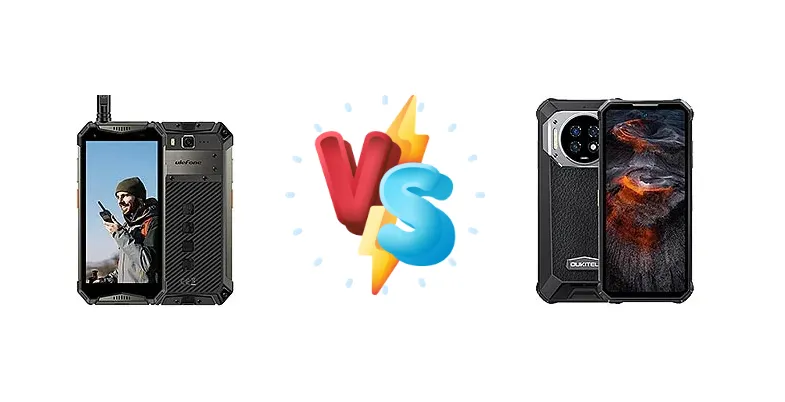
The rugged smartphone market is heating up, with both Ulefone and Oukitel offering compelling options. We pit the Ulefone Power Armor 20WT, powered by the newer MediaTek Helio G99, against the Oukitel WP19, featuring the Helio G95, to determine which device delivers the best balance of performance, durability, and value for demanding users.
🏆 Quick Verdict
For most users, the Ulefone Power Armor 20WT emerges as the better choice. Its Helio G99 chipset, built on a 6nm process, offers a noticeable efficiency advantage over the Oukitel WP19’s 12nm Helio G95, translating to potentially better sustained performance and thermal management during intensive tasks.
| Network |
|---|
| 2G bands | GSM 850 / 900 / 1800 / 1900 | GSM 850 / 900 / 1800 / 1900 |
| 3G bands | HSDPA 800 / 850 / 900 / 1700(AWS) / 1900 / 2100 | HSDPA 850 / 900 / 1700(AWS) / 1900 / 2100 |
| 4G bands | 1, 2, 3, 4, 5, 7, 8, 12, 13, 17, 18, 19, 20, 25, 26, 28, 34, 38, 39, 40, 41, 66 | LTE |
| Speed | HSPA, LTE | HSPA, LTE |
| Technology | GSM / CDMA / HSPA / CDMA2000 / LTE | GSM / HSPA / LTE |
| | CDMA2000 1x | - |
| Launch |
|---|
| Announced | 2023, March 08 | 2022, June |
| Status | Available. Released 2023, March 08 | Available. Released 2022, July |
| Body |
|---|
| Dimensions | 164.8 x 79.2 x 18.1 mm (6.49 x 3.12 x 0.71 in) | - |
| SIM | Nano-SIM + Nano-SIM | Nano-SIM + Nano-SIM |
| Weight | 382 g (13.47 oz) | - |
| | IP68/IP69K dust/water resistant (up to 1.5m for 30 min)
Drop-to-concrete resistance from up to 1.5m
MIL-STD-810H compliant | - |
| Display |
|---|
| Protection | Corning Gorilla Glass 5 | - |
| Resolution | 1080 x 2160 pixels, 18:9 ratio (~427 ppi density) | 1080 x 2460 pixels (~396 ppi density) |
| Size | 5.65 inches, 82.4 cm2 (~63.1% screen-to-body ratio) | 6.78 inches, 109.2 cm2 |
| Type | IPS LCD | IPS LCD, 90Hz |
| Platform |
|---|
| CPU | Octa-core (2x2.2 GHz Cortex-A76 & 6x2.0 GHz Cortex-A55) | Octa-core (2x2.05 GHz Cortex-A76 & 6x2.0 GHz Cortex-A55) |
| Chipset | Mediatek Helio G99 (6 nm) | Mediatek MT6785V/CD Helio G95 (12 nm) |
| GPU | Mali-G57 MC2 | Mali-G76 MC4 |
| OS | Android 12 | Android 12 |
| Memory |
|---|
| Card slot | microSDXC (dedicated slot) | microSDXC (dedicated slot) |
| Internal | 256GB 12GB RAM | 256GB 8GB RAM |
| Main Camera |
|---|
| Features | Dual-LED flash, HDR, panorama | LED flash, panorama |
| Single | 50 MP, f/2.2, (wide), 1.0µm, PDAF | - |
| Triple | - | 64 MP, f/1.8, (wide), PDAF
20 MP, f/2.0, (night vision), 4 infrared night vision lights
2 MP (macro) |
| Video | 1080p@30fps | 4K@30fps, 1080p@30fps |
| Selfie camera |
|---|
| Single | 16 MP, f/2.2, (wide), 1.0µm | 16 MP |
| Video | 1080p@30fps | Yes |
| Sound |
|---|
| 3.5mm jack | No | - |
| 35mm jack | No | Unspecified |
| Loudspeaker | Yes | Yes |
| Comms |
|---|
| Bluetooth | 5.2, A2DP, LE | Yes |
| NFC | Yes | Yes |
| Positioning | GPS, GLONASS, GALILEO, BDS | GPS, GLONASS, GALILEO, BDS |
| Radio | Wireless FM radio, RDS, recording | Unspecified |
| USB | USB Type-C 2.0, OTG | USB Type-C 2.0, OTG |
| WLAN | Wi-Fi 802.11 a/b/g/n/ac/6, dual-band | Yes |
| Features |
|---|
| Sensors | Fingerprint (side-mounted), accelerometer, proximity, compass, gyro, barometer | Unspecified |
| Battery |
|---|
| Charging | 33W wired | 33W wired |
| Type | Li-Po 10850 mAh | Li-Po 21000 mAh |
| Misc |
|---|
| Colors | Black | Blue, Camo, Camouflage |
| Price | About 330 EUR | About 380 EUR |
Ulefone Power Armor 20WT
- More efficient Helio G99 chipset
- Potentially better sustained performance
- Likely improved thermal management
- May be slightly more expensive
- No specified display improvements
Oukitel WP19
- Potentially lower price point
- 33W fast charging
- Rugged design for durability
- Less efficient Helio G95 chipset
- Potential for thermal throttling under load
Display Comparison
Neither device's display specifications are provided, so a direct comparison is limited. However, given the target market, both likely utilize IPS LCD panels prioritizing durability over cutting-edge technology. Expect similar color accuracy and viewing angles. The absence of high refresh rates is typical for this segment, focusing instead on power efficiency and ruggedness. Bezels are likely to be substantial on both to provide structural integrity.
Camera Comparison
Without detailed camera specifications, a comprehensive comparison is impossible. However, the rugged phone market often prioritizes durability over camera quality. Both devices likely feature a multi-camera setup, but image processing and sensor size will be key differentiators. We can assume both will include a primary sensor, an ultrawide, and potentially a macro lens. The absence of information regarding OIS or sensor size makes it difficult to assess which device will deliver superior image quality in challenging conditions. The 2MP macro lenses commonly found on these devices offer limited practical benefit.
Performance
The core difference lies in the chipsets. The Ulefone Power Armor 20WT’s MediaTek Helio G99 (6nm) boasts a clear architectural advantage over the Oukitel WP19’s Helio G95 (12nm). The 6nm process allows for higher transistor density and improved power efficiency. While both CPUs feature the same core configuration – 2x2.2 GHz Cortex-A76 and 6x2.0 GHz Cortex-A55 – the G99’s smaller node translates to less heat generation under load. This means the 20WT is more likely to maintain peak performance for longer periods, particularly during gaming. The G99 also benefits from newer CPU and GPU microarchitectures, offering incremental performance gains.
Battery Life
Both devices feature 33W wired charging, suggesting similar charging speeds from 0-100%. The actual battery capacity isn't specified, but the G99's superior efficiency in the Ulefone Power Armor 20WT could translate to longer real-world battery life, even with a similar capacity battery. The 6nm process reduces power consumption during both active use and standby, giving the 20WT an edge in longevity. Users prioritizing all-day battery life will likely benefit from the Ulefone's more efficient chipset.
Buying Guide
Buy the Ulefone Power Armor 20WT if you prioritize sustained performance for gaming or demanding applications, and appreciate the benefits of a more modern, efficient chipset. Buy the Oukitel WP19 if you are seeking a more budget-friendly rugged option and your usage primarily consists of everyday tasks like communication, navigation, and light media consumption. The WP19 represents a strong value proposition for those less concerned with peak performance.
Frequently Asked Questions
❓ Will the Ulefone Power Armor 20WT run demanding games like Genshin Impact smoothly?
The Helio G99 in the 20WT is capable of running Genshin Impact, but expect to make compromises on graphics settings. The 6nm process and improved GPU architecture will provide a more stable frame rate compared to the WP19, but it won't deliver a flagship-level gaming experience. Lowering graphics settings to medium or low is recommended for optimal performance.
❓ Is the Oukitel WP19 a good choice for someone who primarily uses their phone for calls, texts, and basic navigation?
Absolutely. The Oukitel WP19 is well-suited for users with basic smartphone needs. The Helio G95 is perfectly adequate for everyday tasks, and the rugged design provides peace of mind. The 33W charging ensures relatively quick top-ups, and the focus on durability makes it a reliable companion for outdoor activities.
❓ How does the 6nm process of the Helio G99 impact long-term performance compared to the 12nm Helio G95?
The 6nm process allows for a higher transistor density and reduced heat generation. Over time, this translates to less thermal throttling, meaning the Ulefone Power Armor 20WT will be able to maintain peak performance for longer periods during sustained tasks like gaming or video recording. The Oukitel WP19's 12nm chip is more prone to throttling, potentially leading to performance drops after extended use.