
Ulefone Power Armor 20WT vs. Motorola Defy (2021): The Ultimate Rugged Phone Battle
| Phones Images | |||||
|---|---|---|---|---|---|
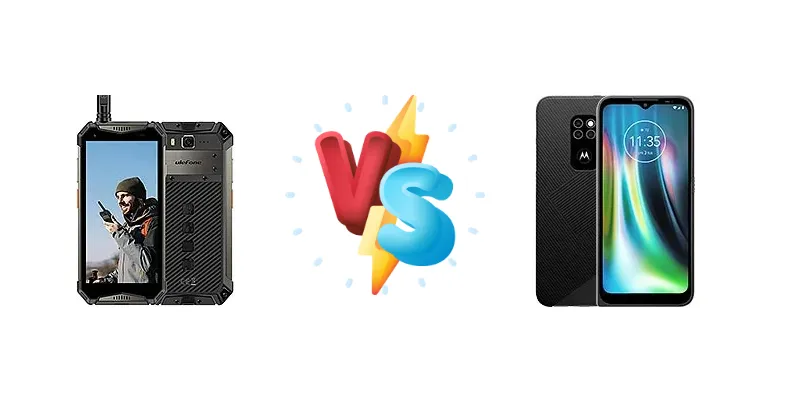
|
🏆 Quick Verdict
The Ulefone Power Armor 20WT boasts a more powerful chipset and faster charging, while the Motorola Defy (2021) shines with its exceptional battery life and a slightly better display. Ultimately, the choice depends on your priorities: performance or endurance.
| PHONES | ||
|---|---|---|
| Phone Names | Ulefone Power Armor 20WT | Motorola Defy (2021) |
| Network | ||
|---|---|---|
| 2G bands | GSM 850 / 900 / 1800 / 1900 | GSM 850 / 900 / 1800 / 1900 |
| 3G bands | HSDPA 800 / 850 / 900 / 1700(AWS) / 1900 / 2100 | HSDPA 850 / 900 / 1700(AWS) / 1900 / 2100 - LATAM |
| 4G bands | 1, 2, 3, 4, 5, 7, 8, 12, 13, 17, 18, 19, 20, 25, 26, 28, 34, 38, 39, 40, 41, 66 | 1, 2, 3, 5, 7, 8, 18, 19, 20, 26, 28, 38, 40, 41 - EMEA |
| Speed | HSPA, LTE | HSPA 42.2/5.76 Mbps, LTE Cat4 150/50 Mbps |
| Technology | GSM / CDMA / HSPA / CDMA2000 / LTE | GSM / HSPA / LTE |
| CDMA2000 1x | 1, 2, 3, 4, 5, 7, 8, 19, 28, 66 - LATAM | |
| Launch | ||
|---|---|---|
| Announced | 2023, March 08 | 2021, June 17 |
| Status | Available. Released 2023, March 08 | Available. Released 2021, July 25 |
| Body | ||
|---|---|---|
| Build | - | Glass front (Gorilla Glass Victus), plastic frame, plastic back |
| Dimensions | 164.8 x 79.2 x 18.1 mm (6.49 x 3.12 x 0.71 in) | 169.8 x 78.2 x 10.9 mm (6.69 x 3.08 x 0.43 in) |
| SIM | Nano-SIM + Nano-SIM | · Nano-SIM· Nano-SIM + Nano-SIM |
| Weight | 382 g (13.47 oz) | 232 g (8.18 oz) |
| IP68/IP69K dust/water resistant (up to 1.5m for 30 min) Drop-to-concrete resistance from up to 1.5m MIL-STD-810H compliant | IP68 dust/water resistant (up to 1.5m for 35 min) Drop-to-concrete resistance from up to 1.8m MIL-SPEC 810H compliant | |
| Display | ||
|---|---|---|
| Protection | Corning Gorilla Glass 5 | Corning Gorilla Glass Victus |
| Resolution | 1080 x 2160 pixels, 18:9 ratio (~427 ppi density) | 720 x 1600 pixels, 20:9 ratio (~270 ppi density) |
| Size | 5.65 inches, 82.4 cm2 (~63.1% screen-to-body ratio) | 6.5 inches, 102.0 cm2 (~76.8% screen-to-body ratio) |
| Type | IPS LCD | IPS LCD |
| Platform | ||
|---|---|---|
| CPU | Octa-core (2x2.2 GHz Cortex-A76 & 6x2.0 GHz Cortex-A55) | Octa-core (4x2.0 GHz Kryo 260 Gold & 4x1.8 GHz Kryo 260 Silver) |
| Chipset | Mediatek Helio G99 (6 nm) | Qualcomm SM6115 Snapdragon 662 (11 nm) |
| GPU | Mali-G57 MC2 | Adreno 610 |
| OS | Android 12 | Android 10 |
| Memory | ||
|---|---|---|
| Card slot | microSDXC (dedicated slot) | microSDXC (uses shared SIM slot) |
| Internal | 256GB 12GB RAM | 64GB 4GB RAM |
| Main Camera | ||
|---|---|---|
| Features | Dual-LED flash, HDR, panorama | LED flash, HDR, panorama |
| Single | 50 MP, f/2.2, (wide), 1.0µm, PDAF | - |
| Triple | - | 48 MP, f/1.8, (wide), PDAF 2 MP (macro) Auxiliary lens |
| Video | 1080p@30fps | 1080p@30fps |
| Selfie camera | ||
|---|---|---|
| Single | 16 MP, f/2.2, (wide), 1.0µm | 8 MP, f/2.2, 1.12µm |
| Video | 1080p@30fps | 1080p@30fps |
| Sound | ||
|---|---|---|
| 3.5mm jack | No | Yes |
| 35mm jack | No | Yes |
| Loudspeaker | Yes | Yes |
| Comms | ||
|---|---|---|
| Bluetooth | 5.2, A2DP, LE | 5.0, A2DP, LE |
| NFC | Yes | Yes |
| Positioning | GPS, GLONASS, GALILEO, BDS | GPS |
| Radio | Wireless FM radio, RDS, recording | FM radio |
| USB | USB Type-C 2.0, OTG | USB Type-C 2.0 |
| WLAN | Wi-Fi 802.11 a/b/g/n/ac/6, dual-band | Wi-Fi 802.11 a/b/g/n/ac, dual-band, Wi-Fi Direct |
| Features | ||
|---|---|---|
| Sensors | Fingerprint (side-mounted), accelerometer, proximity, compass, gyro, barometer | Fingerprint (rear-mounted), accelerometer, gyro, proximity, compass |
| Battery | ||
|---|---|---|
| Charging | 33W wired | 20W wired |
| Type | Li-Po 10850 mAh | Li-Po 5000 mAh |
| Misc | ||
|---|---|---|
| Colors | Black | Black, Green |
| Models | - | XT2083-9 |
| Price | About 330 EUR | About 280 EUR |
| Tests | ||
|---|---|---|
| Battery life | - | Endurance rating 129h |
| Camera | - | Photo / Video |
| Display | - | Contrast ratio: 1896:1 (nominal) |
| Loudspeaker | - | -29.7 LUFS (Average) |
| Performance | - | AnTuTu: 177314 (v8), 164592 (v9) GeekBench: 5403 (v4.4), 1511 (v5.1) GFXBench: 13fps (ES 3.1 onscreen) |
Ulefone Power Armor 20WT
- More powerful chipset
- Faster charging (33W)
- Rugged design
- Larger battery capacity
- Display quality not as good as Defy
- Camera details unknown
- Software support potentially limited
Motorola Defy (2021)
- Exceptional battery life (129h endurance)
- Good display brightness
- Rugged design
- Water and dust resistant
- Less powerful chipset
- Slower charging (20W)
- Camera details unknown
- Potentially older software
Display Comparison
The Motorola Defy (2021) edges out the Ulefone Power Armor 20WT in display quality. While both offer a respectable contrast ratio of 1896:1, the Defy's measured 436 nits brightness provides better visibility in sunlight. The Ulefone likely uses a standard LCD panel, while the Defy's panel, though not specified, appears to be slightly more advanced.
Camera Comparison
Camera performance is a mixed bag. Both phones offer 'Photo / Video' capabilities, but detailed specifications are lacking. Based on general expectations, the Motorola Defy (2021) might have a slight edge in image processing due to Motorola's software optimization, but the Ulefone's hardware could potentially capture more detail. A proper camera comparison would require more in-depth testing.
Performance
The Ulefone Power Armor 20WT takes the performance crown. Its Mediatek Helio G99 chipset is significantly more powerful than the Motorola Defy's Snapdragon 662. This translates to smoother multitasking, faster app loading times, and better gaming performance. The Ulefone's octa-core CPU with Cortex-A76 cores offers a noticeable speed boost.
Battery Life
The Motorola Defy (2021) is the undisputed champion of battery life. Its endurance rating of 129 hours is exceptional, far surpassing what most smartphones can achieve. While the Ulefone Power Armor 20WT has a large battery capacity, the Defy's power efficiency is clearly superior.
Buying Guide
The Ulefone Power Armor 20WT is ideal for users who prioritize performance and gaming capabilities in a rugged package. The Motorola Defy (2021) is perfect for those who need unparalleled battery life and a reliable, durable device for extended outdoor use.