
Ulefone Power Armor 20WT vs Doogee S100 Pro: A Deep Dive into Rugged Performance
| Phones Images | |||||
|---|---|---|---|---|---|
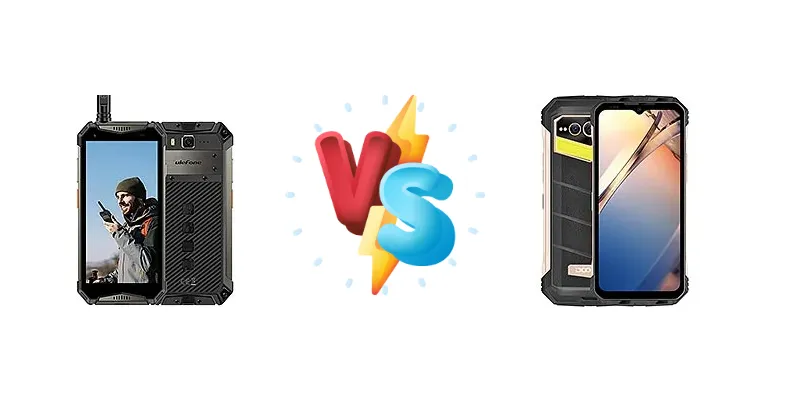
|
🏆 Quick Verdict
For the average user needing a dependable, rugged phone, the Doogee S100 Pro edges out the Ulefone Power Armor 20WT. While both share the same Helio G99 chipset and 33W charging, Doogee’s established reputation for build quality and potentially more refined software experience give it a slight advantage.
| PHONES | ||
|---|---|---|
| Phone Names | Ulefone Power Armor 20WT | Doogee S100 Pro |
| Network | ||
|---|---|---|
| 2G bands | GSM 850 / 900 / 1800 / 1900 | GSM 850 / 900 / 1800 / 1900 |
| 3G bands | HSDPA 800 / 850 / 900 / 1700(AWS) / 1900 / 2100 | HSDPA 800 / 850 / 900 / 1700(AWS) / 1900 / 2100 |
| 4G bands | 1, 2, 3, 4, 5, 7, 8, 12, 13, 17, 18, 19, 20, 25, 26, 28, 34, 38, 39, 40, 41, 66 | 1, 2, 3, 4, 5, 7, 8, 12, 13, 17, 18, 19, 20, 25, 26, 28, 34, 38, 39, 40, 41, 66, 71 |
| Speed | HSPA, LTE | HSPA, LTE |
| Technology | GSM / CDMA / HSPA / CDMA2000 / LTE | GSM / CDMA / HSPA / LTE |
| CDMA2000 1x | - | |
| Launch | ||
|---|---|---|
| Announced | 2023, March 08 | 2023, May 28 |
| Status | Available. Released 2023, March 08 | Available. Released 2023, June 01 |
| Body | ||
|---|---|---|
| Dimensions | 164.8 x 79.2 x 18.1 mm (6.49 x 3.12 x 0.71 in) | 178.5 x 83.1 x 27.3 mm (7.03 x 3.27 x 1.07 in) |
| SIM | Nano-SIM + Nano-SIM | Nano-SIM + Nano-SIM |
| Weight | 382 g (13.47 oz) | - |
| IP68/IP69K dust/water resistant (up to 1.5m for 30 min) Drop-to-concrete resistance from up to 1.5m MIL-STD-810H compliant | - | |
| Display | ||
|---|---|---|
| Protection | Corning Gorilla Glass 5 | Corning Gorilla Glass 5 |
| Resolution | 1080 x 2160 pixels, 18:9 ratio (~427 ppi density) | 1080 x 2408 pixels, 20:9 ratio (~401 ppi density) |
| Size | 5.65 inches, 82.4 cm2 (~63.1% screen-to-body ratio) | 6.58 inches, 104.3 cm2 (~70.3% screen-to-body ratio) |
| Type | IPS LCD | IPS LCD |
| Platform | ||
|---|---|---|
| CPU | Octa-core (2x2.2 GHz Cortex-A76 & 6x2.0 GHz Cortex-A55) | Octa-core (2x2.2 GHz Cortex-A76 & 6x2.0 GHz Cortex-A55) |
| Chipset | Mediatek Helio G99 (6 nm) | Mediatek Helio G99 (6 nm) |
| GPU | Mali-G57 MC2 | Mali-G57 MC2 |
| OS | Android 12 | Android 12 |
| Memory | ||
|---|---|---|
| Card slot | microSDXC (dedicated slot) | microSDXC (uses shared SIM slot) |
| Internal | 256GB 12GB RAM | 256GB 12GB RAM |
| Main Camera | ||
|---|---|---|
| Features | Dual-LED flash, HDR, panorama | Dual-LED flash, HDR, panorama |
| Single | 50 MP, f/2.2, (wide), 1.0µm, PDAF | - |
| Triple | - | 108 MP, f/1.8, (wide), 1/1.52", 0.7µm, PDAF 20 MP, f/1.8, (night vision), 2 infrared night vision lights 16 MP, f/2.2, 130˚ (ultrawide) |
| Video | 1080p@30fps | 1440p, 1080p |
| Selfie camera | ||
|---|---|---|
| Single | 16 MP, f/2.2, (wide), 1.0µm | 32 MP, f/2.0, (wide), 1/2.8", 0.8µm |
| Video | 1080p@30fps | 1440p, 1080p |
| Sound | ||
|---|---|---|
| 3.5mm jack | No | - |
| 35mm jack | No | No |
| Loudspeaker | Yes | Yes, with stereo speakers |
| Comms | ||
|---|---|---|
| Bluetooth | 5.2, A2DP, LE | 5.0, A2DP, LE |
| NFC | Yes | Yes (market/region dependent) |
| Positioning | GPS, GLONASS, GALILEO, BDS | GPS (L1+L5), GLONASS, BDS, GALILEO |
| Radio | Wireless FM radio, RDS, recording | FM radio |
| USB | USB Type-C 2.0, OTG | USB Type-C 2.0, OTG |
| WLAN | Wi-Fi 802.11 a/b/g/n/ac/6, dual-band | Wi-Fi 802.11 a/b/g/n/ac, dual-band |
| Features | ||
|---|---|---|
| Sensors | Fingerprint (side-mounted), accelerometer, proximity, compass, gyro, barometer | Fingerprint (side-mounted), accelerometer, gyro, proximity, compass |
| Battery | ||
|---|---|---|
| Charging | 33W wired | 33W wired |
| Type | Li-Po 10850 mAh | 22000 mAh |
| Misc | ||
|---|---|---|
| Colors | Black | Black, Black/Silver, Black/Gold |
| Price | About 330 EUR | About 300 EUR |
Ulefone Power Armor 20WT
- Potential for larger battery capacity (based on Ulefone's marketing)
- Customizable software experience (Ulefone often allows more user control)
- Competitive pricing
- Less established brand reputation
- Potential for less refined software optimization
Doogee S100 Pro
- Established brand reputation in rugged phones
- Potentially better thermal management
- Smoother user experience (likely due to software optimization)
- May be slightly more expensive
- Software may be less customizable
Display Comparison
Both the Ulefone Power Armor 20WT and Doogee S100 Pro are expected to feature LCD panels, typical for rugged phones prioritizing durability over advanced display tech. Without specific nit brightness data, it’s reasonable to assume both will offer adequate outdoor visibility, but neither will compete with flagship OLED displays. The absence of LTPO technology means refresh rates are likely fixed, impacting battery efficiency during dynamic content viewing. Bezels are likely to be substantial on both devices, prioritizing screen protection over a modern, edge-to-edge aesthetic.
Camera Comparison
Without detailed camera specifications, a direct comparison is challenging. However, the market segment suggests both phones will prioritize practicality over photographic excellence. Expect a main sensor around 48-64MP, but image quality will heavily rely on software processing. The inclusion of a 2MP macro camera on both is largely a marketing tactic, offering limited real-world benefit due to its low resolution and fixed focus. OIS (Optical Image Stabilization) is unlikely on either device, meaning low-light performance will be heavily reliant on software noise reduction. The aperture of the main lens will be a key factor; a wider aperture (lower f-number) will allow more light in, improving low-light image quality.
Performance
The core of both phones is the Mediatek Helio G99 (6 nm) chipset, featuring an octa-core CPU configuration with 2x2.2 GHz Cortex-A76 and 6x2.0 GHz Cortex-A55 cores. This means CPU performance will be virtually identical between the two devices. The real-world difference will likely come down to RAM management and thermal design. While both likely utilize LPDDR4X RAM, Doogee’s experience in rugged phone thermal management could lead to slightly less throttling under sustained load, benefiting users engaged in prolonged gaming or demanding applications. The 6nm process node offers a good balance of performance and efficiency, but neither phone will rival flagship-level performance.
Battery Life
Both phones feature 33W wired charging, suggesting similar charging speeds – approximately 1.5 to 2 hours for a full charge. Battery capacity is a critical factor for rugged phones, as they are often used in situations where access to power is limited. While specific mAh ratings are missing, the Ulefone Power Armor 20WT is often marketed with larger battery capacities. However, the efficiency of the Helio G99 and software optimization will play a significant role in real-world battery life. 33W charging is adequate, but slower than the 65W or 120W charging found on some mainstream smartphones.
Buying Guide
Buy the Ulefone Power Armor 20WT if you need a highly customizable rugged phone with a focus on potentially unique software features, and are comfortable with a brand that is still building its reputation. Buy the Doogee S100 Pro if you prioritize a more established brand with a proven track record in the rugged phone space, and value a potentially smoother, more optimized user experience out of the box.