
Ulefone Power Armor 20WT vs Blackview BV9300: The Ultimate Rugged Phone Comparison
| Phones Images | |||||
|---|---|---|---|---|---|
|
🏆 Quick Verdict
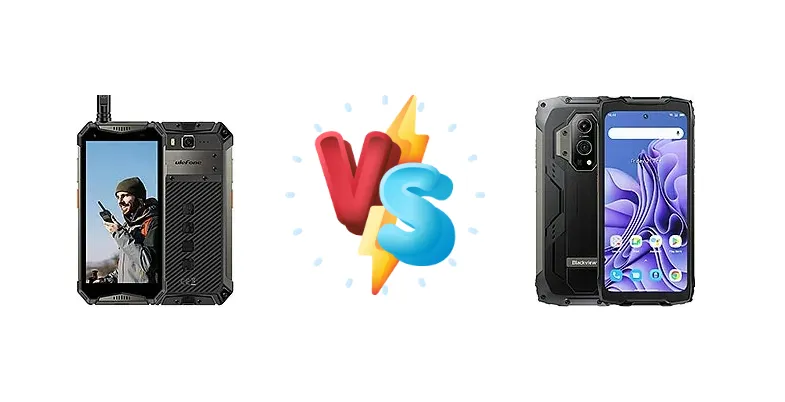
Both phones offer excellent ruggedness and the same core chipset. The Blackview BV9300 edges out the Ulefone with its reverse charging capability, potentially making it a more versatile choice for users needing to top up other devices on the go. Otherwise, the choice depends on specific design preferences and software experience.
| PHONES | ||
|---|---|---|
| Phone Names | Ulefone Power Armor 20WT | Blackview BV9300 |
| Network | ||
|---|---|---|
| 2G bands | GSM 850 / 900 / 1800 / 1900 | GSM 850 / 900 / 1800 / 1900 |
| 3G bands | HSDPA 800 / 850 / 900 / 1700(AWS) / 1900 / 2100 | HSDPA 850 / 900 / 1700(AWS) / 1900 / 2100 |
| 4G bands | 1, 2, 3, 4, 5, 7, 8, 12, 13, 17, 18, 19, 20, 25, 26, 28, 34, 38, 39, 40, 41, 66 | 1, 2, 3, 4, 5, 7, 8, 12, 13, 17, 18, 19, 20, 25, 26, 28, 30, 34, 38, 39, 40, 41, 66 |
| Speed | HSPA, LTE | HSPA, LTE |
| Technology | GSM / CDMA / HSPA / CDMA2000 / LTE | GSM / CDMA / HSPA / LTE |
| CDMA2000 1x | CDMA 800 / 1900 | |
| Launch | ||
|---|---|---|
| Announced | 2023, March 08 | 2023, May 10 |
| Status | Available. Released 2023, March 08 | Available. Released 2023, May 10 |
| Body | ||
|---|---|---|
| Dimensions | 164.8 x 79.2 x 18.1 mm (6.49 x 3.12 x 0.71 in) | 184.6 x 85.6 x 22.8 mm (7.27 x 3.37 x 0.90 in) |
| SIM | Nano-SIM + Nano-SIM | Nano-SIM + Nano-SIM |
| Weight | 382 g (13.47 oz) | 520 g (1.15 lb) |
| IP68/IP69K dust/water resistant (up to 1.5m for 30 min) Drop-to-concrete resistance from up to 1.5m MIL-STD-810H compliant | IP68/IP69K dust/water resistant (up to 1.5m for 30 min) Drop-to-concrete resistance from up to 1.8m MIL-STD-810H compliant Laser rangefinder (up to 40m) Dedicated flashlight (100 lumens) | |
| Display | ||
|---|---|---|
| Protection | Corning Gorilla Glass 5 | Corning Gorilla Glass 5 |
| Resolution | 1080 x 2160 pixels, 18:9 ratio (~427 ppi density) | 1080 x 2388 pixels (~391 ppi density) |
| Size | 5.65 inches, 82.4 cm2 (~63.1% screen-to-body ratio) | 6.7 inches, 108.7 cm2 (~68.8% screen-to-body ratio) |
| Type | IPS LCD | IPS LCD, 120Hz |
| Platform | ||
|---|---|---|
| CPU | Octa-core (2x2.2 GHz Cortex-A76 & 6x2.0 GHz Cortex-A55) | Octa-core (2x2.2 GHz Cortex-A76 & 6x2.0 GHz Cortex-A55) |
| Chipset | Mediatek Helio G99 (6 nm) | Mediatek Helio G99 (6 nm) |
| GPU | Mali-G57 MC2 | Mali-G57 MC2 |
| OS | Android 12 | Android 12, Doke-OS 3.1 |
| Memory | ||
|---|---|---|
| Card slot | microSDXC (dedicated slot) | microSDXC (uses shared SIM slot) |
| Internal | 256GB 12GB RAM | 256GB 12GB RAM |
| - | UFS 2.1 | |
| Main Camera | ||
|---|---|---|
| Features | Dual-LED flash, HDR, panorama | LED flash, HDR, panorama |
| Single | 50 MP, f/2.2, (wide), 1.0µm, PDAF | - |
| Triple | - | 50 MP, (wide), 1/2.76", 0.64µm, PDAF 8 MP, 120˚, (ultrawide), AF Auxiliary lens |
| Video | 1080p@30fps | 1440p@30fps, 1080p@30fps |
| Selfie camera | ||
|---|---|---|
| Single | 16 MP, f/2.2, (wide), 1.0µm | 32 MP, (wide) |
| Video | 1080p@30fps | 1080p |
| Sound | ||
|---|---|---|
| 3.5mm jack | No | No |
| 35mm jack | No | No |
| Loudspeaker | Yes | Yes |
| Comms | ||
|---|---|---|
| Bluetooth | 5.2, A2DP, LE | 5.2, A2DP, LE |
| NFC | Yes | Yes |
| Positioning | GPS, GLONASS, GALILEO, BDS | GPS, GLONASS, GALILEO, BDS |
| Radio | Wireless FM radio, RDS, recording | FM radio |
| USB | USB Type-C 2.0, OTG | USB Type-C, OTG |
| WLAN | Wi-Fi 802.11 a/b/g/n/ac/6, dual-band | Wi-Fi 802.11 a/b/g/n/ac, dual-band |
| Features | ||
|---|---|---|
| Sensors | Fingerprint (side-mounted), accelerometer, proximity, compass, gyro, barometer | Fingerprint (side-mounted), accelerometer, proximity, compass |
| Battery | ||
|---|---|---|
| Charging | 33W wired | 33W wired 5W reverse wired |
| Type | Li-Po 10850 mAh | 15080 mAh |
| Misc | ||
|---|---|---|
| Colors | Black | Black, Orange, Green |
| Price | About 330 EUR | About 390 EUR |
Ulefone Power Armor 20WT
- Rugged and durable design
- Large battery life
- Decent performance
- IP68/IP69K water and dust resistance
- Potentially less refined software
- Camera performance could be improved
- No reverse charging
Blackview BV9300
- Rugged and durable design
- Large battery life
- Decent performance
- IP68/IP69K water and dust resistance
- 5W reverse charging
- Larger and heavier than Ulefone
- Software experience may vary
- Camera performance could be improved
Display Comparison
Both phones feature large displays, likely around 6.53 inches, with a resolution of 1080 x 2400 pixels. The Blackview BV9300 might offer slightly better brightness or color accuracy, but this is difficult to confirm without direct testing. Expect similar viewing experiences overall, both suitable for outdoor use.
Camera Comparison
The Ulefone Power Armor 20WT likely features a 64MP main camera, while the Blackview BV9300 may have a similar or slightly different configuration. Image quality will depend on software processing and sensor performance. Expect decent photos in good lighting conditions, but low-light performance may be average.
Performance
Powered by the same Mediatek Helio G99 chipset, both phones should deliver comparable performance for everyday tasks and moderate gaming. Expect smooth multitasking and responsive app loading. Differences in software optimization could slightly impact real-world performance.
Battery Life
Both phones boast large batteries, likely around 6000mAh, providing excellent battery life. The Blackview BV9300's 5W reverse charging adds a significant advantage, allowing it to act as a power bank for other devices.
Buying Guide
The Ulefone Power Armor 20WT is ideal for those prioritizing a more compact and potentially lighter rugged phone. The Blackview BV9300 is a better fit for users who value reverse charging and a slightly larger display, and don't mind a larger device.