
Ulefone Power Armor 20WT vs. Blackview BV9200: A Rugged Smartphone Showdown
| Phones Images | |||||
|---|---|---|---|---|---|
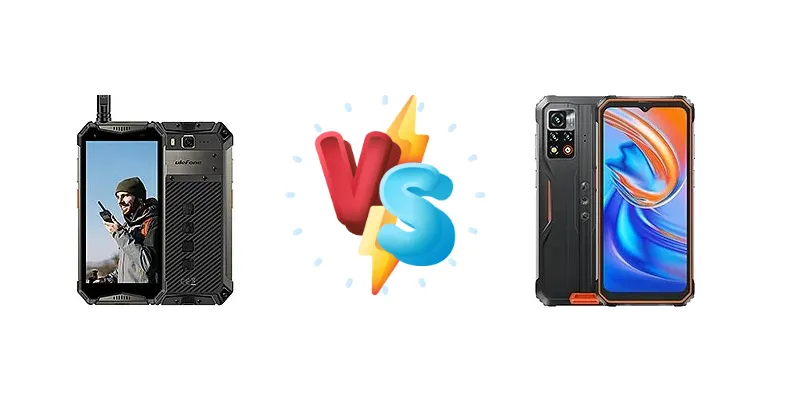
|
🏆 Quick Verdict
For most users, the Blackview BV9200 emerges as the stronger choice. Its 66W wired and 30W wireless charging capabilities significantly reduce downtime, and the brighter 481-nit display enhances usability in direct sunlight. While the Ulefone 20WT boasts a newer chipset, the performance difference isn't substantial enough to offset the BV9200's charging and display advantages.
| PHONES | ||
|---|---|---|
| Phone Names | Ulefone Power Armor 20WT | Blackview BV9200 |
| Network | ||
|---|---|---|
| 2G bands | GSM 850 / 900 / 1800 / 1900 | GSM 850 / 900 / 1800 / 1900 |
| 3G bands | HSDPA 800 / 850 / 900 / 1700(AWS) / 1900 / 2100 | HSDPA 850 / 900 / 1700(AWS) / 1900 / 2100 |
| 4G bands | 1, 2, 3, 4, 5, 7, 8, 12, 13, 17, 18, 19, 20, 25, 26, 28, 34, 38, 39, 40, 41, 66 | 1, 2, 3, 4, 5, 7, 8, 12, 13, 17, 18, 19, 20, 25, 26, 28, 34, 38, 39, 40, 41, 66 |
| Speed | HSPA, LTE | HSPA, LTE |
| Technology | GSM / CDMA / HSPA / CDMA2000 / LTE | GSM / CDMA / HSPA / LTE |
| CDMA2000 1x | CDMA 800 / 1900 | |
| Launch | ||
|---|---|---|
| Announced | 2023, March 08 | 2022, December 28 |
| Status | Available. Released 2023, March 08 | Available. Released 2023, January 09 |
| Body | ||
|---|---|---|
| Dimensions | 164.8 x 79.2 x 18.1 mm (6.49 x 3.12 x 0.71 in) | 174.5 x 81.8 x 13.6 mm (6.87 x 3.22 x 0.54 in) |
| SIM | Nano-SIM + Nano-SIM | Nano-SIM + Nano-SIM |
| Weight | 382 g (13.47 oz) | 310 g (10.93 oz) |
| IP68/IP69K dust/water resistant (up to 1.5m for 30 min) Drop-to-concrete resistance from up to 1.5m MIL-STD-810H compliant | IP68/IP69K dust/water resistant (up to 1.5m for 30 min) Drop-to-concrete resistance from up to 1.8m MIL-STD-810H compliant | |
| Display | ||
|---|---|---|
| Protection | Corning Gorilla Glass 5 | Corning Gorilla Glass 5 |
| Resolution | 1080 x 2160 pixels, 18:9 ratio (~427 ppi density) | 1080 x 2408 pixels, 20:9 ratio (~400 ppi density) |
| Size | 5.65 inches, 82.4 cm2 (~63.1% screen-to-body ratio) | 6.6 inches, 104.9 cm2 (~73.5% screen-to-body ratio) |
| Type | IPS LCD | IPS LCD, 120Hz |
| Platform | ||
|---|---|---|
| CPU | Octa-core (2x2.2 GHz Cortex-A76 & 6x2.0 GHz Cortex-A55) | Octa-core (2x2.05 GHz Cortex-A76 & 6x2.0 GHz Cortex-A55) |
| Chipset | Mediatek Helio G99 (6 nm) | Mediatek MT6781 Helio G96 (12 nm) |
| GPU | Mali-G57 MC2 | Mali-G52 MC2 |
| OS | Android 12 | Android 12, Doke-OS 3.1 |
| Memory | ||
|---|---|---|
| Card slot | microSDXC (dedicated slot) | microSDXC (dedicated slot) |
| Internal | 256GB 12GB RAM | 256GB 8GB RAM |
| - | UFS 2.1 | |
| Main Camera | ||
|---|---|---|
| Features | Dual-LED flash, HDR, panorama | LED flash, HDR, panorama |
| Single | 50 MP, f/2.2, (wide), 1.0µm, PDAF | 16 MP, (wide), 1/3", 1.0µm |
| Triple | - | 50 MP, f/1.8, (wide), 1/2.76", 0.64µm, PDAF 8 MP, f/1.8, 120˚, (ultrawide), AF Auxiliary lens |
| Video | 1080p@30fps | 1440p@30fps, 1080p@30fps |
| Selfie camera | ||
|---|---|---|
| Single | 16 MP, f/2.2, (wide), 1.0µm | 16 MP, f/2.0, (wide), 1/3", 1.0µm |
| Video | 1080p@30fps | 1080p |
| Sound | ||
|---|---|---|
| 3.5mm jack | No | No |
| 35mm jack | No | No |
| Loudspeaker | Yes | Yes, with dual speakers |
| Comms | ||
|---|---|---|
| Bluetooth | 5.2, A2DP, LE | 5.2, A2DP, LE |
| NFC | Yes | Yes |
| Positioning | GPS, GLONASS, GALILEO, BDS | GPS, GLONASS, GALILEO, BDS |
| Radio | Wireless FM radio, RDS, recording | FM radio |
| USB | USB Type-C 2.0, OTG | USB Type-C, OTG |
| WLAN | Wi-Fi 802.11 a/b/g/n/ac/6, dual-band | Wi-Fi 802.11 a/b/g/n/ac, dual-band |
| Features | ||
|---|---|---|
| Sensors | Fingerprint (side-mounted), accelerometer, proximity, compass, gyro, barometer | Fingerprint (side-mounted), accelerometer, gyro, proximity, compass, barometer |
| Battery | ||
|---|---|---|
| Charging | 33W wired | 66W wired 30W wireless |
| Type | Li-Po 10850 mAh | 5000 mAh |
| Misc | ||
|---|---|---|
| Colors | Black | Black, Orange, Green |
| Price | About 330 EUR | About 200 EUR |
Ulefone Power Armor 20WT
- Newer Mediatek Helio G99 chipset for potentially better efficiency.
- 6nm process may result in less thermal throttling.
- Rugged design for durability in harsh environments.
- Slower 33W wired charging.
- Display specifications are unknown, potentially lacking brightness.
- No wireless charging support.
Blackview BV9200
- 66W wired and 30W wireless charging for rapid replenishment.
- Brighter 481-nit display for outdoor visibility.
- High 1423:1 contrast ratio for vibrant colors.
- Older Mediatek Helio G96 chipset.
- 12nm process may be less power efficient.
- Potentially more thermal throttling under sustained load.
Display Comparison
The Blackview BV9200 boasts a clear advantage in display quality, achieving a measured peak brightness of 481 nits. This is crucial for outdoor visibility, a key requirement for rugged phones. While the Ulefone 20WT’s display specs are not provided, the BV9200’s 1423:1 contrast ratio ensures deeper blacks and more vibrant colors. The lack of detailed display information for the Ulefone makes a direct comparison difficult, but the BV9200’s measured performance sets a high bar.
Camera Comparison
Without detailed camera specifications for either device, a comprehensive comparison is limited. However, the rugged phone market often prioritizes durability over cutting-edge camera technology. It’s reasonable to assume both phones will feature capable main sensors for outdoor photography, but image processing quality and low-light performance will likely be the differentiating factors. The presence of a 2MP macro lens on either device is unlikely to significantly impact image quality, serving primarily as a marketing feature.
Performance
Both phones utilize Mediatek Helio G series chipsets, but differ in generation and manufacturing process. The Ulefone Power Armor 20WT features the Helio G99 (6nm), while the Blackview BV9200 uses the Helio G96 (12nm). The 6nm process of the G99 generally translates to improved power efficiency and potentially lower thermal throttling under sustained load. However, the CPU clock speeds are similar – 2.2 GHz vs 2.05 GHz Cortex-A76 cores – suggesting the real-world performance difference will be modest. The G99’s architectural improvements will be most noticeable in graphically intensive tasks, but the BV9200’s larger battery could offset some of the G99’s efficiency gains.
Battery Life
The Blackview BV9200’s charging capabilities are a standout feature, offering 66W wired charging and 30W wireless charging. This dramatically reduces charging times compared to the Ulefone Power Armor 20WT’s 33W wired charging. While battery capacity isn’t specified for either device, the BV9200’s faster charging speeds are a significant advantage for users who need to quickly replenish their battery in the field. The addition of wireless charging further enhances convenience.
Buying Guide
Buy the Ulefone Power Armor 20WT if you prioritize the latest processor generation and anticipate sustained, demanding tasks where the Helio G99’s 6nm process might offer a slight thermal advantage. Buy the Blackview BV9200 if you value rapid charging – both wired and wireless – and need a display that remains visible in bright outdoor conditions. The BV9200 is ideal for users who frequently work or play outdoors and can’t afford lengthy charging interruptions.