
Ulefone Power Armor 19 vs. Doogee S99: A Head-to-Head Rugged Smartphone Showdown
| Phones Images | |||||
|---|---|---|---|---|---|
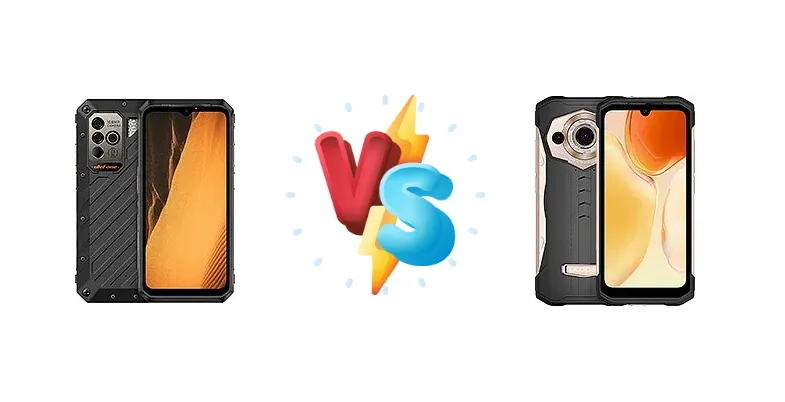
|
🏆 Quick Verdict
For most users prioritizing performance and faster charging, the Ulefone Power Armor 19 emerges as the winner. Its newer Mediatek Helio G99 chipset, built on a 6nm process, provides a noticeable efficiency and speed advantage over the Doogee S99’s 12nm Helio G96, coupled with significantly faster 66W charging.
| PHONES | ||
|---|---|---|
| Phone Names | Ulefone Power Armor 19 | Doogee S99 |
| Network | ||
|---|---|---|
| 2G bands | GSM 850 / 900 / 1800 / 1900 | GSM 850 / 900 / 1800 / 1900 |
| 3G bands | HSDPA 800 / 850 / 900 / 1700(AWS) / 1900 / 2100 | HSDPA 800 / 850 / 900 / 1700(AWS) / 1900 / 2100 |
| 4G bands | 1, 2, 3, 4, 5, 7, 8, 12, 13, 17, 18, 19, 20, 25, 26, 28, 34, 38, 39, 40, 41, 66, 71 | 1, 2, 3, 4, 5, 7, 8, 12, 13, 17, 18, 19, 20, 25, 26, 28, 34, 38, 39, 40, 41, 66 |
| Speed | HSPA, LTE | HSPA, LTE |
| Technology | GSM / CDMA / HSPA / CDMA2000 / LTE | GSM / CDMA / HSPA / LTE |
| CDMA2000 1x | - | |
| Launch | ||
|---|---|---|
| Announced | 2022, December 27 | 2022, December 05 |
| Status | Available. Released 2022, December 27 | Available. Released 2022, December 05 |
| Body | ||
|---|---|---|
| Dimensions | 175.2 x 83.4 x 18.8 mm (6.90 x 3.28 x 0.74 in) | 172 x 82 x 15.5 mm (6.77 x 3.23 x 0.61 in) |
| SIM | Nano-SIM + Nano-SIM | Nano-SIM + Nano-SIM |
| Weight | 409 g (14.43 oz) | - |
| IP68/IP69K dust/water resistant (up to 1.5m for 30 min) Drop-to-concrete resistance from up to 1.5m MIL-STD-810H compliant Accessory connector (ulefone endoscope, microscope) | - | |
| Display | ||
|---|---|---|
| Protection | Corning Gorilla Glass 5 | Corning Gorilla Glass |
| Resolution | 1080 x 2408 pixels, 20:9 ratio (~401 ppi density) | 1080 x 2340 pixels, 19.5:9 ratio (~409 ppi density) |
| Size | 6.58 inches, 104.3 cm2 (~71.4% screen-to-body ratio) | 6.3 inches, 97.4 cm2 (~69.1% screen-to-body ratio) |
| Type | IPS LCD, 120Hz | IPS LCD |
| Platform | ||
|---|---|---|
| CPU | Octa-core (2x2.2 GHz Cortex-A76 & 6x2.0 GHz Cortex-A55) | Octa-core (2x2.05 GHz Cortex-A76 & 6x2.0 GHz Cortex-A55) |
| Chipset | Mediatek Helio G99 (6 nm) | Mediatek MT6781 Helio G96 (12 nm) |
| GPU | Mali-G57 MC2 | Mali-G57 MC2 |
| OS | Android 12 | Android 12 |
| Memory | ||
|---|---|---|
| Card slot | microSDXC (uses shared SIM slot) | microSDXC (dedicated slot) |
| Internal | 256GB 12GB RAM | 128GB 8GB RAM |
| Main Camera | ||
|---|---|---|
| Features | Hexa-LED flash, HDR, panorama | Dual-LED flash, HDR, panorama |
| Single | 16 MP, f/2.0, (wide), 1.0µm | - |
| Triple | 108 MP, f/1.9, (wide), 1/1.52”, 0.7µm, PDAF 8 MP, f/2.2, (ultrawide), 1/4.0", 1.12µm 5 MP (macro) | 108 MP, f/1.9, (wide), 1/1.52", 0.7µm, PDAF 64 MP, f/1.8, (night vision), 2 infrared night vision lights 16 MP, f/1.8, 130˚ (ultrawide) |
| Video | 1440p@30fps | 1440p@30fps, 1080p@30fps |
| Selfie camera | ||
|---|---|---|
| Single | 16 MP, f/2.0, (wide), 1.0µm | 32 MP, f/2.0, (wide), 1/2.8", 0.8µm |
| Video | 1080p@30fps | 1080p@30fps |
| Sound | ||
|---|---|---|
| 3.5mm jack | Yes | - |
| 35mm jack | Yes | No |
| Loudspeaker | Yes | Yes |
| Comms | ||
|---|---|---|
| Bluetooth | 5.2, A2DP, LE | 5.1, A2DP, LE |
| NFC | Yes | Yes (market/region dependent) |
| Positioning | GPS, GLONASS, GALILEO, BDS | GPS, GLONASS, GALILEO, BDS |
| Radio | Wireless FM radio, RDS, recording | FM radio |
| USB | USB Type-C 2.0, OTG, magnetic connector | USB Type-C 2.0, OTG |
| WLAN | Wi-Fi 802.11 a/b/g/n/ac/6, dual-band | Wi-Fi 802.11 a/b/g/n/ac, dual-band |
| Features | ||
|---|---|---|
| Sensors | Fingerprint (side-mounted), accelerometer, gyro, proximity, compass, barometer, thermometer | Fingerprint (side-mounted), accelerometer, gyro, proximity, compass |
| Battery | ||
|---|---|---|
| Charging | 66W wired, 52% in 30 min 15W wireless 5W wireless reversed | 33W wired, 45% in 30 min 15W wireless Reverse wired |
| Type | Li-Po 9600 mAh | 6000 mAh |
| Misc | ||
|---|---|---|
| Colors | Black | Gold, Black |
| Price | About 400 EUR | About 250 EUR |
Ulefone Power Armor 19
- Faster 66W wired charging significantly reduces downtime.
- More efficient Mediatek Helio G99 chipset for better performance and battery life.
- Potentially smoother user experience due to the G99's processing power.
- Price may be higher than the Doogee S99.
- Detailed display specifications are unavailable.
Doogee S99
- Potentially more affordable price point.
- Robust build quality expected from Doogee's rugged phone lineup.
- Offers 15W wireless charging for convenient power-ups.
- Slower 33W wired charging.
- Less efficient Mediatek Helio G96 chipset.
- Potentially lower performance in demanding applications.
Display Comparison
Neither Ulefone nor Doogee provide display specifications beyond the basic panel type. However, the chipset difference hints at potential display capabilities. The G99 in the Power Armor 19 is more capable of driving a higher refresh rate panel, though neither phone explicitly advertises this. The absence of detailed display specs makes a direct comparison difficult, but the G99’s processing power suggests a smoother user experience if both phones were equipped with similar panels.
Camera Comparison
Detailed camera specifications are absent from the provided data. However, given the market positioning of these phones, it’s likely both feature a multi-camera setup with a primary sensor. The performance will heavily rely on image processing algorithms, which are not specified. Without sensor size or aperture information, it’s impossible to definitively declare a winner. The G99’s ISP (Image Signal Processor) in the Ulefone Power Armor 19 *may* offer slightly faster processing and improved noise reduction, but this is speculative.
Performance
The Ulefone Power Armor 19’s Mediatek Helio G99 (6nm) represents a significant architectural leap over the Doogee S99’s Helio G96 (12nm). The 6nm process inherently offers better power efficiency, translating to less heat generation under load and potentially sustained performance. While both CPUs feature the same core configuration (2x2.2 GHz Cortex-A76 & 6x2.0 GHz Cortex-A55), the G99’s improved manufacturing process and slightly higher clock speeds will result in faster application loading times and smoother multitasking. This benefits users who frequently engage in resource-intensive activities like gaming or video editing.
Battery Life
Both phones offer 15W wireless charging, but the wired charging speeds are drastically different. The Ulefone Power Armor 19 boasts 66W wired charging, achieving 52% charge in 30 minutes, while the Doogee S99 manages only 45% in the same timeframe with its 33W charging. This difference is substantial for users who need to quickly top up their battery. While battery capacity isn’t specified, the G99’s improved efficiency could translate to longer real-world battery life despite potentially having a similar capacity to the S99.
Buying Guide
Buy the Ulefone Power Armor 19 if you need a rugged phone that can handle demanding tasks like mobile gaming or running multiple apps simultaneously, and if minimizing charging downtime is crucial. Buy the Doogee S99 if you prioritize a potentially lower price point and are willing to trade some processing power and charging speed for a robust, reliable device suitable for basic outdoor use and communication.