
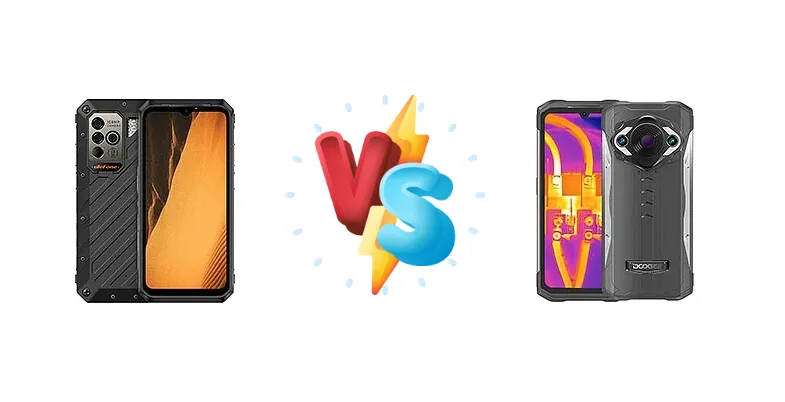
Ulefone Power Armor 19 vs Doogee S98 Pro: A Deep Dive into Rugged Performance
| Phones Images | |||||
|---|---|---|---|---|---|
|
🏆 Quick Verdict
For the average user prioritizing faster charging and a more modern chipset, the Ulefone Power Armor 19 emerges as the winner. Its 66W charging significantly reduces downtime, and the Helio G99’s 6nm process offers a slight efficiency advantage over the Doogee’s older 12nm Helio G96. However, the S98 Pro remains a strong contender for those less concerned with peak charging speed.
| PHONES | ||
|---|---|---|
| Phone Names | Ulefone Power Armor 19 | Doogee S98 Pro |
| Network | ||
|---|---|---|
| 2G bands | GSM 850 / 900 / 1800 / 1900 | GSM 850 / 900 / 1800 / 1900 |
| 3G bands | HSDPA 800 / 850 / 900 / 1700(AWS) / 1900 / 2100 | HSDPA 800 / 850 / 900 / 1700(AWS) / 1900 / 2100 |
| 4G bands | 1, 2, 3, 4, 5, 7, 8, 12, 13, 17, 18, 19, 20, 25, 26, 28, 34, 38, 39, 40, 41, 66, 71 | 1, 2, 3, 4, 5, 7, 8, 12, 13, 17, 18, 19, 20, 25, 26, 28, 34, 38, 39, 40, 41, 66 |
| Speed | HSPA, LTE | HSPA, LTE |
| Technology | GSM / CDMA / HSPA / CDMA2000 / LTE | GSM / CDMA / HSPA / LTE |
| CDMA2000 1x | - | |
| Launch | ||
|---|---|---|
| Announced | 2022, December 27 | 2022, May 27 |
| Status | Available. Released 2022, December 27 | Available. Released 2022, June 06 |
| Body | ||
|---|---|---|
| Dimensions | 175.2 x 83.4 x 18.8 mm (6.90 x 3.28 x 0.74 in) | 172 x 82 x 15.5 mm (6.77 x 3.23 x 0.61 in) |
| SIM | Nano-SIM + Nano-SIM | Nano-SIM + Nano-SIM |
| Weight | 409 g (14.43 oz) | 320 g (11.29 oz) |
| IP68/IP69K dust/water resistant (up to 1.5m for 30 min) Drop-to-concrete resistance from up to 1.5m MIL-STD-810H compliant Accessory connector (ulefone endoscope, microscope) | - | |
| Display | ||
|---|---|---|
| Protection | Corning Gorilla Glass 5 | Corning Gorilla Glass |
| Resolution | 1080 x 2408 pixels, 20:9 ratio (~401 ppi density) | 1080 x 2340 pixels, 19.5:9 ratio (~409 ppi density) |
| Size | 6.58 inches, 104.3 cm2 (~71.4% screen-to-body ratio) | 6.3 inches, 97.4 cm2 (~69.1% screen-to-body ratio) |
| Type | IPS LCD, 120Hz | IPS LCD, 500 nits (peak) |
| Platform | ||
|---|---|---|
| CPU | Octa-core (2x2.2 GHz Cortex-A76 & 6x2.0 GHz Cortex-A55) | Octa-core (2x2.05 GHz Cortex-A76 & 6x2.0 GHz Cortex-A55) |
| Chipset | Mediatek Helio G99 (6 nm) | Mediatek MT6781 Helio G96 (12 nm) |
| GPU | Mali-G57 MC2 | Mali-G57 MC2 |
| OS | Android 12 | Android 12 |
| Memory | ||
|---|---|---|
| Card slot | microSDXC (uses shared SIM slot) | microSDXC (dedicated slot) |
| Internal | 256GB 12GB RAM | 256GB 8GB RAM |
| Main Camera | ||
|---|---|---|
| Features | Hexa-LED flash, HDR, panorama | Dual-LED flash, HDR, panorama |
| Single | 16 MP, f/2.0, (wide), 1.0µm | - |
| Triple | 108 MP, f/1.9, (wide), 1/1.52”, 0.7µm, PDAF 8 MP, f/2.2, (ultrawide), 1/4.0", 1.12µm 5 MP (macro) | 48 MP, f/1.8, (wide), PDAF 20 MP, f/1.8, (night vision), 2 infrared night vision lights Thermal imaging camera |
| Video | 1440p@30fps | 1440p, 1080p |
| Selfie camera | ||
|---|---|---|
| Single | 16 MP, f/2.0, (wide), 1.0µm | 16 MP, f/2.0, (wide) |
| Video | 1080p@30fps | 1080p |
| Sound | ||
|---|---|---|
| 3.5mm jack | Yes | - |
| 35mm jack | Yes | Unspecified |
| Loudspeaker | Yes | Yes |
| Comms | ||
|---|---|---|
| Bluetooth | 5.2, A2DP, LE | 5.1, A2DP, LE |
| NFC | Yes | Yes |
| Positioning | GPS, GLONASS, GALILEO, BDS | GPS, GLONASS, BDS, GALILEO |
| Radio | Wireless FM radio, RDS, recording | FM radio |
| USB | USB Type-C 2.0, OTG, magnetic connector | USB Type-C 2.0, OTG |
| WLAN | Wi-Fi 802.11 a/b/g/n/ac/6, dual-band | Wi-Fi 802.11 a/b/g/n/ac, dual-band |
| Features | ||
|---|---|---|
| Sensors | Fingerprint (side-mounted), accelerometer, gyro, proximity, compass, barometer, thermometer | Fingerprint (side-mounted), accelerometer, gyro, proximity, compass |
| Battery | ||
|---|---|---|
| Charging | 66W wired, 52% in 30 min 15W wireless 5W wireless reversed | 33W wired 15W wireless |
| Type | Li-Po 9600 mAh | 6000 mAh |
| Misc | ||
|---|---|---|
| Colors | Black | Black |
| Price | About 400 EUR | About 470 EUR |
Ulefone Power Armor 19
- Faster 66W wired charging for minimal downtime.
- More efficient Mediatek Helio G99 (6nm) chipset.
- 5W reverse wireless charging for accessories.
- Specific battery capacity is unknown.
- Rugged design may add bulk.
Doogee S98 Pro
- Potentially lower price point.
- Rugged design for durability.
- 15W wireless charging support.
- Slower 33W wired charging.
- Older Mediatek Helio G96 (12nm) chipset.
Display Comparison
Neither device’s display specifications are provided, so a direct comparison is limited. However, given the market segment, both likely utilize IPS LCD panels prioritizing durability over cutting-edge features like LTPO. Bezels are expected to be relatively substantial on both to enhance drop protection. Color accuracy will likely be adequate for outdoor visibility, but not geared towards professional content creation.
Camera Comparison
Without detailed camera specifications beyond the chipsets, a precise comparison is difficult. However, the focus in this segment is typically on durability and practicality rather than photographic excellence. Both phones likely feature a multi-camera setup, but image processing quality will be more dependent on software optimization than raw sensor size. The absence of information regarding OIS or lens apertures suggests neither phone is targeting serious mobile photography enthusiasts.
Performance
The Ulefone Power Armor 19’s Mediatek Helio G99 (6nm) represents a clear architectural advantage over the Doogee S98 Pro’s Helio G96 (12nm). The smaller 6nm node generally translates to improved power efficiency and thermal performance, meaning the Ulefone is less likely to throttle under sustained load. While both CPUs feature the same core configuration (2x2.2 GHz Cortex-A76 & 6x2.0 GHz Cortex-A55), the G99’s higher clock speed and more efficient process give it an edge in demanding tasks like gaming and video editing. Users who frequently engage in resource-intensive applications will likely notice a smoother experience on the Ulefone.
Battery Life
While battery capacity isn’t specified, the Ulefone Power Armor 19’s 66W wired charging is a significant differentiator. This allows for a 52% charge in just 30 minutes, drastically reducing downtime compared to the Doogee S98 Pro’s 33W charging. Both support 15W wireless charging, offering a convenient alternative, and the Ulefone adds 5W reverse wireless charging for topping up accessories. The faster charging speed of the Ulefone effectively mitigates any potential disadvantage from a slightly smaller battery capacity, making it the more practical choice for users who need to quickly replenish their power.
Buying Guide
Buy the Ulefone Power Armor 19 if you need rapid recharging capabilities and want a phone built on a more recent chipset architecture for potentially better long-term performance and efficiency. Buy the Doogee S98 Pro if you prioritize a potentially lower price point and are comfortable with a slightly older, but still capable, processor and slower charging speeds. Both excel in ruggedness, so the decision hinges on your performance and charging expectations.