
Ulefone Power Armor 19 vs. Blackview BV9800 Pro: A Rugged Smartphone Showdown
| Phones Images | |||||
|---|---|---|---|---|---|
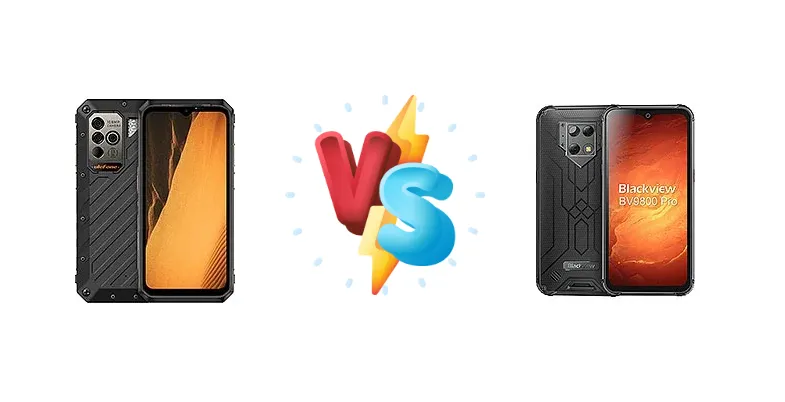
|
🏆 Quick Verdict
For most users, the Ulefone Power Armor 19 is the superior choice. Its Helio G99 chipset offers a significant performance uplift over the BV9800 Pro’s Helio P70, and the 66W charging dramatically reduces downtime. While the BV9800 Pro remains a capable device, the Power Armor 19 provides a more future-proof and responsive user experience.
| PHONES | ||
|---|---|---|
| Phone Names | Ulefone Power Armor 19 | Blackview BV9800 Pro |
| Network | ||
|---|---|---|
| 2G bands | GSM 850 / 900 / 1800 / 1900 | GSM 850 / 900 / 1800 / 1900 |
| 3G bands | HSDPA 800 / 850 / 900 / 1700(AWS) / 1900 / 2100 | HSDPA 800 / 850 / 900 / 1700(AWS) / 1900 / 2100 |
| 4G bands | 1, 2, 3, 4, 5, 7, 8, 12, 13, 17, 18, 19, 20, 25, 26, 28, 34, 38, 39, 40, 41, 66, 71 | 1, 2, 3, 4, 5, 6, 7, 8, 12, 13, 17, 18, 19, 20, 25, 26, 28, 34, 38, 39, 40, 41, 66 |
| Speed | HSPA, LTE | HSPA, LTE |
| Technology | GSM / CDMA / HSPA / CDMA2000 / LTE | GSM / CDMA / HSPA / CDMA2000 / LTE |
| CDMA2000 1x | - | |
| Launch | ||
|---|---|---|
| Announced | 2022, December 27 | 2019, October 28. Released 2019, November |
| Status | Available. Released 2022, December 27 | Discontinued |
| Body | ||
|---|---|---|
| Dimensions | 175.2 x 83.4 x 18.8 mm (6.90 x 3.28 x 0.74 in) | 168.5 x 81 x 14.8 mm (6.63 x 3.19 x 0.58 in) |
| SIM | Nano-SIM + Nano-SIM | Nano-SIM + Nano-SIM |
| Weight | 409 g (14.43 oz) | 322 g (11.36 oz) |
| IP68/IP69K dust/water resistant (up to 1.5m for 30 min) Drop-to-concrete resistance from up to 1.5m MIL-STD-810H compliant Accessory connector (ulefone endoscope, microscope) | - | |
| Display | ||
|---|---|---|
| Protection | Corning Gorilla Glass 5 | - |
| Resolution | 1080 x 2408 pixels, 20:9 ratio (~401 ppi density) | 1080 x 2340 pixels, 19.5:9 ratio (~409 ppi density) |
| Size | 6.58 inches, 104.3 cm2 (~71.4% screen-to-body ratio) | 6.3 inches, 97.4 cm2 (~71.4% screen-to-body ratio) |
| Type | IPS LCD, 120Hz | IPS LCD |
| Platform | ||
|---|---|---|
| CPU | Octa-core (2x2.2 GHz Cortex-A76 & 6x2.0 GHz Cortex-A55) | Octa-core (4x2.1 GHz Cortex-A73 & 4x2.0 GHz Cortex-A53) |
| Chipset | Mediatek Helio G99 (6 nm) | Mediatek MT6771V/CT Helio P70 (12 nm) |
| GPU | Mali-G57 MC2 | Mali-G72 MP3 |
| OS | Android 12 | Android 9.0 (Pie) |
| Memory | ||
|---|---|---|
| Card slot | microSDXC (uses shared SIM slot) | microSDXC |
| Internal | 256GB 12GB RAM | 128GB 6GB RAM |
| Main Camera | ||
|---|---|---|
| Features | Hexa-LED flash, HDR, panorama | Thermal imaging, LED flash |
| Single | 16 MP, f/2.0, (wide), 1.0µm | - |
| Triple | 108 MP, f/1.9, (wide), 1/1.52”, 0.7µm, PDAF 8 MP, f/2.2, (ultrawide), 1/4.0", 1.12µm 5 MP (macro) | 48 MP, (wide), PDAF 5 MP, thermal assisted camera FLIR thermal camera (Lepton module) |
| Video | 1440p@30fps | 1080p@30fps |
| Selfie camera | ||
|---|---|---|
| Single | 16 MP, f/2.0, (wide), 1.0µm | 16 MP, f/2.0, (wide) |
| Video | 1080p@30fps | 1080p@30fps |
| Sound | ||
|---|---|---|
| 3.5mm jack | Yes | - |
| 35mm jack | Yes | Yes |
| Loudspeaker | Yes | Yes |
| Comms | ||
|---|---|---|
| Bluetooth | 5.2, A2DP, LE | 4.1, A2DP |
| NFC | Yes | Yes |
| Positioning | GPS, GLONASS, GALILEO, BDS | GPS, GLONASS, GALILEO |
| Radio | Wireless FM radio, RDS, recording | FM radio |
| USB | USB Type-C 2.0, OTG, magnetic connector | USB Type-C 2.0, OTG |
| WLAN | Wi-Fi 802.11 a/b/g/n/ac/6, dual-band | Wi-Fi 802.11 a/b/g/n/ac |
| Features | ||
|---|---|---|
| Sensors | Fingerprint (side-mounted), accelerometer, gyro, proximity, compass, barometer, thermometer | Fingerprint (side-mounted), accelerometer, gyro, proximity, compass, barometer |
| Battery | ||
|---|---|---|
| Charging | 66W wired, 52% in 30 min 15W wireless 5W wireless reversed | 18W wired |
| Type | Li-Po 9600 mAh | 6580 mAh |
| Misc | ||
|---|---|---|
| Colors | Black | Black, Orange |
| Price | About 400 EUR | About 340 EUR |
Ulefone Power Armor 19
- Significantly faster charging (66W)
- More powerful and efficient processor (Helio G99)
- Wireless charging capabilities
- Potentially higher price point
- Ruggedness certification details not provided
Blackview BV9800 Pro
- Proven ruggedness and durability
- Potentially lower price point
- Established user base
- Outdated processor (Helio P70)
- Slow charging (18W)
- Lacks wireless charging
Display Comparison
Neither device’s display specifications are provided, so a direct comparison is limited. However, given the Power Armor 19’s newer chipset, it’s reasonable to expect a more modern panel with potentially higher brightness and color accuracy. The BV9800 Pro, being an older model, likely utilizes a standard LCD panel. Users prioritizing outdoor visibility should investigate independent display tests for both devices, as peak brightness is crucial in direct sunlight.
Camera Comparison
Without detailed camera specifications beyond the chipsets, a precise comparison is difficult. However, the newer chipset in the Ulefone Power Armor 19 likely supports more advanced image signal processing (ISP) capabilities, potentially leading to better image quality, especially in low-light conditions. The BV9800 Pro’s older ISP will likely produce images with less dynamic range and detail. It’s important to note that the presence of a 2MP macro camera on either device is unlikely to significantly impact overall camera performance; these sensors are often included for marketing purposes but rarely deliver usable results.
Performance
The Ulefone Power Armor 19’s Mediatek Helio G99 (6nm) represents a substantial leap forward compared to the Blackview BV9800 Pro’s Helio P70 (12nm). The G99’s newer architecture – featuring 2x2.2 GHz Cortex-A76 cores and 6x2.0 GHz Cortex-A55 cores – delivers significantly improved CPU performance. The P70’s 4x2.1 GHz Cortex-A73 and 4x2.0 GHz Cortex-A53 configuration, while adequate for basic tasks, will struggle with more demanding applications. The 6nm process node of the G99 also translates to better power efficiency and reduced thermal throttling, benefiting sustained performance during gaming or prolonged use. This means the Power Armor 19 will feel noticeably snappier and more responsive in everyday use.
Battery Life
While battery capacity isn’t specified, the Ulefone Power Armor 19’s 66W wired charging is a game-changer. It can reportedly reach 52% charge in just 30 minutes, drastically reducing downtime compared to the Blackview BV9800 Pro’s 18W charging. The Power Armor 19 also includes 15W wireless and 5W reverse wireless charging, features absent on the BV9800 Pro. Even if the BV9800 Pro has a slightly larger battery capacity, the Power Armor 19’s faster charging will likely result in a more convenient user experience, especially for those who frequently use their phone throughout the day.
Buying Guide
Buy the Ulefone Power Armor 19 if you need a rugged phone that can handle demanding tasks like gaming or video editing, and if minimizing charging time is a priority. Buy the Blackview BV9800 Pro if you prioritize a proven track record of ruggedness and are on a tighter budget, accepting a performance trade-off for a potentially lower price point.