
Ulefone Power Armor 18T vs. Armor 15: A Deep Dive into Rugged Performance
| Phones Images | |||||
|---|---|---|---|---|---|
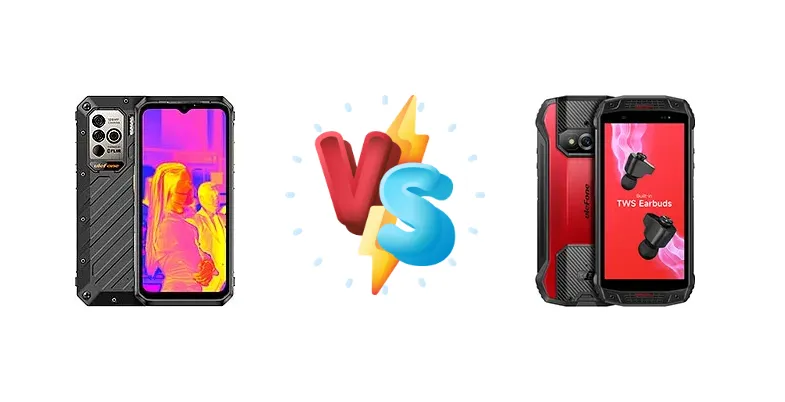
|
🏆 Quick Verdict
For users prioritizing performance and fast charging, the Ulefone Power Armor 18T is the clear winner. Its Dimensity 900 chipset offers a substantial leap over the Armor 15’s Helio G35, making it suitable for gaming and demanding applications. However, the Armor 15 remains a viable option for those on a tighter budget who need basic rugged functionality.
| PHONES | ||
|---|---|---|
| Phone Names | Ulefone Power Armor 18T | Ulefone Armor 15 |
| Network | ||
|---|---|---|
| 2G bands | GSM 850 / 900 / 1800 / 1900 | GSM 850 / 900 / 1800 / 1900 |
| 3G bands | HSDPA 800 / 850 / 900 / 1700(AWS) / 1900 / 2100 | HSDPA 850 / 900 / 1700(AWS) / 1900 / 2100 |
| 4G bands | 1, 2, 3, 4, 5, 7, 8, 12, 13, 17, 18, 19, 20, 25, 26, 28, 34, 38, 39, 40, 41, 66, 71 | 1, 2, 3, 4, 5, 7, 8, 12, 13, 17, 18, 19, 20, 25, 26, 28, 38, 39, 40, 41, 66 |
| 5G bands | 1, 2, 3, 5, 7, 8, 20, 25, 28, 38, 41, 66, 77, 78, 79 SA/NSA/Sub6 | - |
| Speed | HSPA, LTE, 5G | HSPA, LTE Cat13 300/150 Mbps |
| Technology | GSM / CDMA / HSPA / CDMA2000 / LTE / 5G | GSM / HSPA / LTE |
| CDMA2000 1x | - | |
| Launch | ||
|---|---|---|
| Announced | 2022, October 31 | 2022, July 27 |
| Status | Available. Released 2022, October 31 | Available. Released 2022, August 10 |
| Body | ||
|---|---|---|
| Dimensions | 175.2 x 83.4 x 18.8 mm (6.90 x 3.28 x 0.74 in) | 170.2 x 79.6 x 18.2 mm (6.70 x 3.13 x 0.72 in) |
| SIM | Nano-SIM + Nano-SIM | Nano-SIM + Nano-SIM |
| Weight | 409 g (14.43 oz) | 346 g (12.20 oz) |
| IP68/IP69K dust/water resistant (up to 1.5m for 30 min) Drop-to-concrete resistance from up to 1.5m MIL-STD-810G compliant Accessory connector (ulefone endoscope, microscope) | IP68 dust/water resistant (up to 1.5m for 30 min) Drop-to-concrete resistance from up to 1.5m MIL-STD-810G compliant Built-in wireless earbuds housed inside the top side of the phone; charging | |
| Display | ||
|---|---|---|
| Protection | Corning Gorilla Glass 5 | - |
| Resolution | 1080 x 2408 pixels, 20:9 ratio (~401 ppi density) | 720 x 1440 pixels, 18:9 ratio (~295 ppi density) |
| Size | 6.58 inches, 104.3 cm2 (~71.4% screen-to-body ratio) | 5.45 inches, 76.7 cm2 (~56.6% screen-to-body ratio) |
| Type | IPS LCD, 120Hz | IPS LCD |
| Platform | ||
|---|---|---|
| CPU | Octa-core (2x2.4 GHz Cortex-A78 & 6x2.0 GHz Cortex-A55) | Octa-core (4x2.3 GHz Cortex-A53 & 4x1.8 GHz Cortex-A53) |
| Chipset | Mediatek Dimensity 900 (6 nm) | Mediatek MT6765G Helio G35 (12 nm) |
| GPU | Mali-G68 MC4 | PowerVR GE8320 |
| OS | Android 12 | Android 12 |
| Memory | ||
|---|---|---|
| Card slot | microSDXC (uses shared SIM slot) | microSDXC (dedicated slot) |
| Internal | 256GB 12GB RAM | 128GB 6GB RAM |
| Main Camera | ||
|---|---|---|
| Dual | - | 12 MP, f/1.8, (wide), 1.4μm 13 MP, f/2.4, 106˚ (ultrawide) |
| Features | Hexa-LED flash, HDR, panorama | LED flash, HDR, panorama |
| Single | 32 MP, f/2.0, (wide), 1.2µm | 16 MP, f/2.4, (wide), 1.0μm |
| Triple | 108 MP, f/1.9, (wide), 1/1.52", 0.7µm, PDAF 5 MP (macro) FLIR thermal camera (Lepton module) 5 MP (for thermal module) | - |
| Video | 4K@30fps, 1080p@30fps | 1080p@30fps |
| Selfie camera | ||
|---|---|---|
| Single | 32 MP, f/2.0, (wide), 1.2µm | 16 MP, f/2.4, (wide), 1.0μm |
| Video | 1080p@30fps | 1080p@30fps |
| Sound | ||
|---|---|---|
| 3.5mm jack | Yes | No |
| 35mm jack | Yes | No |
| Loudspeaker | Yes | Yes |
| Comms | ||
|---|---|---|
| Bluetooth | 5.0, A2DP, LE | 5.0, A2DP |
| NFC | Yes | Yes |
| Positioning | GPS (L1+L5), GLONASS, GALILEO, BDS, NavIC | GPS, GLONASS, BDS, GALILEO |
| Radio | Wireless FM radio, RDS, recording | Stereo FM radio, RDS, recording |
| USB | USB Type-C 2.0, OTG, magnetic connector | USB Type-C 2.0, OTG |
| WLAN | Wi-Fi 802.11 a/b/g/n/ac/6, dual-band | Wi-Fi 802.11 a/b/g/n/ac, dual-band |
| Features | ||
|---|---|---|
| Sensors | Fingerprint (side-mounted), accelerometer, gyro, proximity, compass, barometer | Fingerprint (side-mounted), accelerometer, proximity, gyro, compass |
| Battery | ||
|---|---|---|
| Charging | 66W wired, 52% in 30 min 15W wireless 5W wireless reversed | 18W wired |
| Type | Li-Po 9600 mAh | Li-Po 6600 mAh |
| Misc | ||
|---|---|---|
| Colors | Black | Meteorite Black, Tech Blue, Sport Red |
| Price | About 640 EUR | About 300 EUR |
Ulefone Power Armor 18T
- Significantly faster processor for gaming and multitasking
- 66W fast charging dramatically reduces charging times
- Wireless charging capabilities (15W & 5W reverse)
- Likely higher price point
- Potentially larger and heavier due to more advanced components
Ulefone Armor 15
- More affordable price
- Rugged design for durability
- Sufficient for basic smartphone tasks
- Slow 18W charging
- Limited performance for demanding applications
- No wireless charging
Display Comparison
While both phones likely feature durable displays given their rugged nature, specific details like panel type (IPS vs AMOLED) and resolution are missing. However, the core difference lies in performance. The Armor 18T’s chipset will contribute to smoother scrolling and faster response times, even if the display specs are similar. The Armor 15, with its less powerful processor, may exhibit slight lag during quick transitions.
Camera Comparison
Without detailed camera specifications beyond the chipsets, a direct comparison is limited. However, the processing power of the Dimensity 900 in the Power Armor 18T will enable more sophisticated image processing, potentially resulting in better dynamic range and noise reduction. The Armor 15’s Helio G35 will likely struggle with complex image processing tasks, especially in low-light conditions. It's reasonable to assume the 18T will offer a superior camera experience, even with similar sensor sizes.
Performance
The performance gap is the most significant differentiator. The Ulefone Power Armor 18T’s Mediatek Dimensity 900 (6nm) boasts a modern CPU architecture – two Cortex-A78 cores at 2.4GHz and six Cortex-A55 cores at 2.0GHz – offering a substantial performance advantage over the Armor 15’s Helio G35 (12nm). The Helio G35’s four Cortex-A53 cores at 2.3GHz and another four at 1.8GHz are geared towards efficiency, not raw power. The 6nm process node of the Dimensity 900 also translates to better thermal efficiency, reducing throttling during sustained workloads. This means the 18T will maintain higher clock speeds for longer, benefiting gamers and power users.
Battery Life
The Armor 18T’s 66W wired charging is a game-changer, capable of reaching 52% charge in just 30 minutes. This is a massive advantage over the Armor 15’s 18W charging. While battery capacity isn’t specified for either device, the faster charging of the 18T mitigates any potential disadvantage from a slightly smaller battery. The 18T also includes 15W wireless and 5W reverse wireless charging, features absent on the Armor 15, adding to its convenience.
Buying Guide
Buy the Ulefone Power Armor 18T if you need a rugged phone capable of handling demanding tasks like mobile gaming, video editing, or running multiple apps simultaneously, and if fast 66W charging is a priority. Buy the Ulefone Armor 15 if you prioritize affordability and require a durable device for basic communication, navigation, and occasional photography in harsh environments, and are comfortable with slower performance.