
Ulefone Power Armor 18T vs Doogee S98 Pro: A Rugged Smartphone Battle
| Phones Images | |||||
|---|---|---|---|---|---|
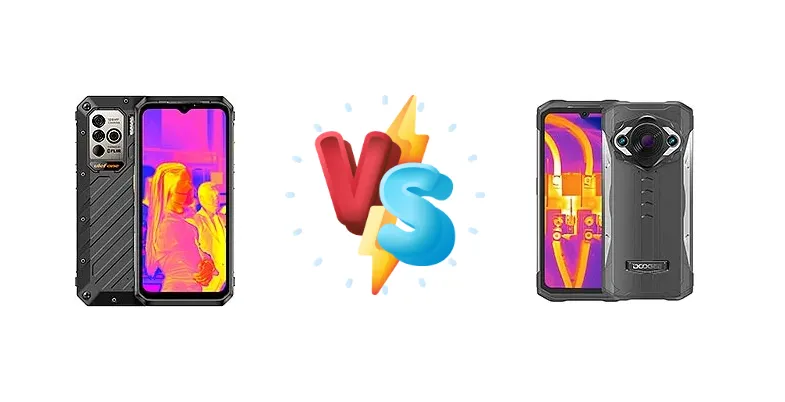
|
🏆 Quick Verdict
For users prioritizing performance and faster charging, the Ulefone Power Armor 18T is the clear winner. Its Dimensity 900 chipset offers a significant performance uplift over the Doogee S98 Pro’s Helio G96, making it better suited for demanding tasks and gaming. While the Doogee offers a solid rugged experience, the Ulefone’s superior processing power justifies the price difference for power users.
| PHONES | ||
|---|---|---|
| Phone Names | Ulefone Power Armor 18T | Doogee S98 Pro |
| Network | ||
|---|---|---|
| 2G bands | GSM 850 / 900 / 1800 / 1900 | GSM 850 / 900 / 1800 / 1900 |
| 3G bands | HSDPA 800 / 850 / 900 / 1700(AWS) / 1900 / 2100 | HSDPA 800 / 850 / 900 / 1700(AWS) / 1900 / 2100 |
| 4G bands | 1, 2, 3, 4, 5, 7, 8, 12, 13, 17, 18, 19, 20, 25, 26, 28, 34, 38, 39, 40, 41, 66, 71 | 1, 2, 3, 4, 5, 7, 8, 12, 13, 17, 18, 19, 20, 25, 26, 28, 34, 38, 39, 40, 41, 66 |
| 5G bands | 1, 2, 3, 5, 7, 8, 20, 25, 28, 38, 41, 66, 77, 78, 79 SA/NSA/Sub6 | - |
| Speed | HSPA, LTE, 5G | HSPA, LTE |
| Technology | GSM / CDMA / HSPA / CDMA2000 / LTE / 5G | GSM / CDMA / HSPA / LTE |
| CDMA2000 1x | - | |
| Launch | ||
|---|---|---|
| Announced | 2022, October 31 | 2022, May 27 |
| Status | Available. Released 2022, October 31 | Available. Released 2022, June 06 |
| Body | ||
|---|---|---|
| Dimensions | 175.2 x 83.4 x 18.8 mm (6.90 x 3.28 x 0.74 in) | 172 x 82 x 15.5 mm (6.77 x 3.23 x 0.61 in) |
| SIM | Nano-SIM + Nano-SIM | Nano-SIM + Nano-SIM |
| Weight | 409 g (14.43 oz) | 320 g (11.29 oz) |
| IP68/IP69K dust/water resistant (up to 1.5m for 30 min) Drop-to-concrete resistance from up to 1.5m MIL-STD-810G compliant Accessory connector (ulefone endoscope, microscope) | - | |
| Display | ||
|---|---|---|
| Protection | Corning Gorilla Glass 5 | Corning Gorilla Glass |
| Resolution | 1080 x 2408 pixels, 20:9 ratio (~401 ppi density) | 1080 x 2340 pixels, 19.5:9 ratio (~409 ppi density) |
| Size | 6.58 inches, 104.3 cm2 (~71.4% screen-to-body ratio) | 6.3 inches, 97.4 cm2 (~69.1% screen-to-body ratio) |
| Type | IPS LCD, 120Hz | IPS LCD, 500 nits (peak) |
| Platform | ||
|---|---|---|
| CPU | Octa-core (2x2.4 GHz Cortex-A78 & 6x2.0 GHz Cortex-A55) | Octa-core (2x2.05 GHz Cortex-A76 & 6x2.0 GHz Cortex-A55) |
| Chipset | Mediatek Dimensity 900 (6 nm) | Mediatek MT6781 Helio G96 (12 nm) |
| GPU | Mali-G68 MC4 | Mali-G57 MC2 |
| OS | Android 12 | Android 12 |
| Memory | ||
|---|---|---|
| Card slot | microSDXC (uses shared SIM slot) | microSDXC (dedicated slot) |
| Internal | 256GB 12GB RAM | 256GB 8GB RAM |
| Main Camera | ||
|---|---|---|
| Features | Hexa-LED flash, HDR, panorama | Dual-LED flash, HDR, panorama |
| Single | 32 MP, f/2.0, (wide), 1.2µm | - |
| Triple | 108 MP, f/1.9, (wide), 1/1.52", 0.7µm, PDAF 5 MP (macro) FLIR thermal camera (Lepton module) 5 MP (for thermal module) | 48 MP, f/1.8, (wide), PDAF 20 MP, f/1.8, (night vision), 2 infrared night vision lights Thermal imaging camera |
| Video | 4K@30fps, 1080p@30fps | 1440p, 1080p |
| Selfie camera | ||
|---|---|---|
| Single | 32 MP, f/2.0, (wide), 1.2µm | 16 MP, f/2.0, (wide) |
| Video | 1080p@30fps | 1080p |
| Sound | ||
|---|---|---|
| 3.5mm jack | Yes | - |
| 35mm jack | Yes | Unspecified |
| Loudspeaker | Yes | Yes |
| Comms | ||
|---|---|---|
| Bluetooth | 5.0, A2DP, LE | 5.1, A2DP, LE |
| NFC | Yes | Yes |
| Positioning | GPS (L1+L5), GLONASS, GALILEO, BDS, NavIC | GPS, GLONASS, BDS, GALILEO |
| Radio | Wireless FM radio, RDS, recording | FM radio |
| USB | USB Type-C 2.0, OTG, magnetic connector | USB Type-C 2.0, OTG |
| WLAN | Wi-Fi 802.11 a/b/g/n/ac/6, dual-band | Wi-Fi 802.11 a/b/g/n/ac, dual-band |
| Features | ||
|---|---|---|
| Sensors | Fingerprint (side-mounted), accelerometer, gyro, proximity, compass, barometer | Fingerprint (side-mounted), accelerometer, gyro, proximity, compass |
| Battery | ||
|---|---|---|
| Charging | 66W wired, 52% in 30 min 15W wireless 5W wireless reversed | 33W wired 15W wireless |
| Type | Li-Po 9600 mAh | 6000 mAh |
| Misc | ||
|---|---|---|
| Colors | Black | Black |
| Price | About 640 EUR | About 470 EUR |
Ulefone Power Armor 18T
- Significantly faster 66W charging
- More powerful Dimensity 900 chipset
- Improved thermal efficiency for sustained performance
- Potentially higher price point
- Rugged design may be less refined than Doogee
Doogee S98 Pro
- Established rugged design and build quality
- Potentially lower price point
- Solid performance for everyday tasks
- Slower 33W charging
- Less powerful Helio G96 chipset
- Potential for throttling under heavy load
Display Comparison
Neither device’s display specifications are provided, so a direct comparison is limited. However, considering the Ulefone 18T targets a higher performance tier, it’s reasonable to expect a slightly better panel in terms of brightness and color accuracy. The Doogee S98 Pro, likely focusing on cost optimization, may utilize a more standard LCD panel. Bezels are likely similar given the rugged design constraints of both devices.
Camera Comparison
Without detailed camera specifications, a precise comparison is difficult. However, the chipset difference suggests the Ulefone 18T has a more powerful ISP (Image Signal Processor) capable of handling more complex image processing algorithms. This could result in better dynamic range, noise reduction, and overall image quality. The Doogee S98 Pro’s camera will likely be sufficient for casual photography, but may lack the refinement and detail capture of the Ulefone 18T. We can assume both devices will include a macro lens, but these are often of limited utility.
Performance
The Ulefone Power Armor 18T’s Mediatek Dimensity 900 (6nm) represents a substantial leap in performance over the Doogee S98 Pro’s Helio G96 (12nm). The Dimensity 900’s Cortex-A78 cores, clocked at 2.4 GHz, provide significantly more processing power than the G96’s Cortex-A76 cores at 2.05 GHz. The 6nm process node also translates to improved thermal efficiency, reducing the likelihood of throttling during sustained workloads. This means the Ulefone 18T will handle demanding games and applications with greater ease and maintain higher frame rates for longer periods. The G96 is adequate for everyday tasks, but will struggle with graphically intensive games or heavy multitasking.
Battery Life
While battery capacities aren’t specified, the Ulefone Power Armor 18T’s 66W wired charging is a major advantage. It can achieve 52% charge in just 30 minutes, significantly faster than the Doogee S98 Pro’s 33W charging. Both devices offer 15W wireless charging and 5W reverse wireless charging. The faster charging speed of the Ulefone 18T is crucial for users who need to quickly top up their battery during demanding workdays or outdoor adventures. Even with a similar battery capacity, the Ulefone’s charging speed provides a tangible benefit.
Buying Guide
Buy the Ulefone Power Armor 18T if you need a rugged phone capable of handling demanding applications, extended gaming sessions, or frequent multitasking. Its Dimensity 900 chipset and 66W charging are ideal for users who value speed and efficiency. Buy the Doogee S98 Pro if you prioritize a more established rugged design and are primarily focused on basic smartphone functionality, with less emphasis on raw processing power. It’s a good choice for those needing a durable device for work or outdoor activities without pushing the limits of performance.