
Ulefone Power Armor 18T vs Cat S62 Pro: The Ultimate Rugged Phone Battle
| Phones Images | |||||
|---|---|---|---|---|---|
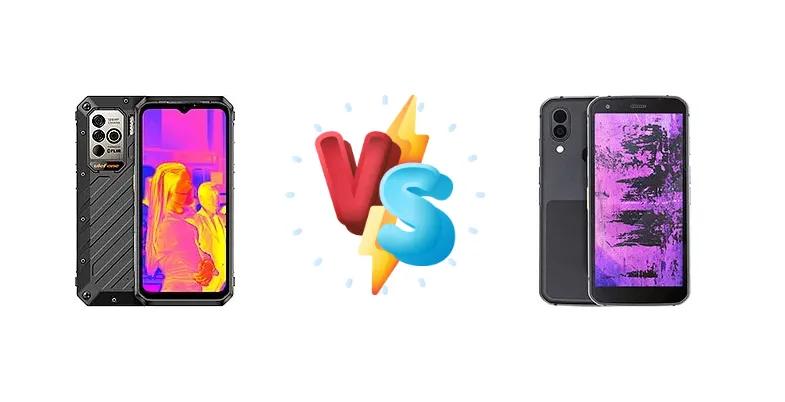
|
🏆 Quick Verdict
The Ulefone Power Armor 18T wins on performance and charging speed thanks to its Dimensity 900 chipset and 66W charging. However, the Cat S62 Pro retains its edge with its thermal imaging camera, making it ideal for specific professional use cases. It depends on your priorities.
| PHONES | ||
|---|---|---|
| Phone Names | Ulefone Power Armor 18T | Cat S62 Pro |
| Network | ||
|---|---|---|
| 2G bands | GSM 850 / 900 / 1800 / 1900 | GSM 850 / 900 / 1800 / 1900 |
| 3G bands | HSDPA 800 / 850 / 900 / 1700(AWS) / 1900 / 2100 | HSDPA 850 / 900 / 1700(AWS) / 1900 / 2100 |
| 4G bands | 1, 2, 3, 4, 5, 7, 8, 12, 13, 17, 18, 19, 20, 25, 26, 28, 34, 38, 39, 40, 41, 66, 71 | 1, 2, 3, 4, 5, 7, 8, 20, 28, 38, 40 |
| 5G bands | 1, 2, 3, 5, 7, 8, 20, 25, 28, 38, 41, 66, 77, 78, 79 SA/NSA/Sub6 | - |
| Speed | HSPA, LTE, 5G | HSPA 42.2/5.76 Mbps, LTE (2CA) Cat13 400/150 Mbps |
| Technology | GSM / CDMA / HSPA / CDMA2000 / LTE / 5G | GSM / HSPA / LTE |
| CDMA2000 1x | - | |
| Launch | ||
|---|---|---|
| Announced | 2022, October 31 | 2020, June 28. Released 2020, August 17 |
| Status | Available. Released 2022, October 31 | Discontinued |
| Body | ||
|---|---|---|
| Build | - | Glass front (Gorilla Glass 6), plastic back, aluminum frame |
| Dimensions | 175.2 x 83.4 x 18.8 mm (6.90 x 3.28 x 0.74 in) | 158.5 x 76.7 x 11.9 mm (6.24 x 3.02 x 0.47 in) |
| SIM | Nano-SIM + Nano-SIM | · Nano-SIM· Nano-SIM + Nano-SIM |
| Weight | 409 g (14.43 oz) | 248 g (8.75 oz) |
| IP68/IP69K dust/water resistant (up to 1.5m for 30 min) Drop-to-concrete resistance from up to 1.5m MIL-STD-810G compliant Accessory connector (ulefone endoscope, microscope) | IP68/IP69 dust/water resistant (up to 1.5m for 35 mins) Drop-to-concrete resistance from up to 1.8m MIL-STD-810H compliant | |
| Display | ||
|---|---|---|
| Protection | Corning Gorilla Glass 5 | Corning Gorilla Glass 6 |
| Resolution | 1080 x 2408 pixels, 20:9 ratio (~401 ppi density) | 1080 x 2160 pixels, 18:9 ratio (~424 ppi density) |
| Size | 6.58 inches, 104.3 cm2 (~71.4% screen-to-body ratio) | 5.7 inches, 83.8 cm2 (~69.0% screen-to-body ratio) |
| Type | IPS LCD, 120Hz | IPS LCD |
| Platform | ||
|---|---|---|
| CPU | Octa-core (2x2.4 GHz Cortex-A78 & 6x2.0 GHz Cortex-A55) | Octa-core (4x2.2 GHz Kryo 260 Gold & 4x1.8 GHz Kryo 260 Silver) |
| Chipset | Mediatek Dimensity 900 (6 nm) | Qualcomm SDM660 Snapdragon 660 (14 nm) |
| GPU | Mali-G68 MC4 | Adreno 512 |
| OS | Android 12 | Android 10 |
| Memory | ||
|---|---|---|
| Card slot | microSDXC (uses shared SIM slot) | microSDXC (dedicated slot) |
| Internal | 256GB 12GB RAM | 128GB 6GB RAM |
| Main Camera | ||
|---|---|---|
| Dual | - | 12 MP, f/1.8, (wide), 1/2.55", 1.4µm, dual pixel PDAF FLIR thermal camera (Lepton 3.5 module) |
| Features | Hexa-LED flash, HDR, panorama | Thermal imaging, heat palettes, temp. spot meter, LED flash |
| Single | 32 MP, f/2.0, (wide), 1.2µm | - |
| Triple | 108 MP, f/1.9, (wide), 1/1.52", 0.7µm, PDAF 5 MP (macro) FLIR thermal camera (Lepton module) 5 MP (for thermal module) | - |
| Video | 4K@30fps, 1080p@30fps | 1080p@30fps, gyro-EIS |
| Selfie camera | ||
|---|---|---|
| Single | 32 MP, f/2.0, (wide), 1.2µm | 8 MP |
| Video | 1080p@30fps | 1080p@30fps |
| Sound | ||
|---|---|---|
| 3.5mm jack | Yes | No |
| 35mm jack | Yes | No |
| Loudspeaker | Yes | Yes |
| Comms | ||
|---|---|---|
| Bluetooth | 5.0, A2DP, LE | 5.0, A2DP, LE |
| NFC | Yes | Yes |
| Positioning | GPS (L1+L5), GLONASS, GALILEO, BDS, NavIC | GPS, GLONASS, GALILEO, BDS |
| Radio | Wireless FM radio, RDS, recording | FM radio |
| USB | USB Type-C 2.0, OTG, magnetic connector | USB Type-C 2.0, OTG |
| WLAN | Wi-Fi 802.11 a/b/g/n/ac/6, dual-band | Wi-Fi 802.11 a/b/g/n/ac, dual-band, Wi-Fi Direct |
| Features | ||
|---|---|---|
| Sensors | Fingerprint (side-mounted), accelerometer, gyro, proximity, compass, barometer | Fingerprint (rear-mounted), accelerometer, gyro, proximity, compass |
| Battery | ||
|---|---|---|
| Charging | 66W wired, 52% in 30 min 15W wireless 5W wireless reversed | - |
| Type | Li-Po 9600 mAh | Li-Ion 4000 mAh |
| Misc | ||
|---|---|---|
| Colors | Black | Black |
| Price | About 640 EUR | About 530 EUR |
Ulefone Power Armor 18T
- Superior Performance
- Fast Charging (66W)
- Large Battery Capacity
- Wireless Charging
- Reverse Wireless Charging
- Thermal Camera Absent
- Potentially Less Rugged Design (subjective)
- Software Support Uncertain
Cat S62 Pro
- Integrated Thermal Camera
- Rugged and Durable Design
- Good Outdoor Visibility Display
- Established Brand Reputation
- Slower Performance
- Slower Charging
- Older Chipset
- Higher Price Point
Display Comparison
Both phones feature durable displays, but the Ulefone 18T likely has a slightly more modern panel. The Cat S62 Pro's display is known for its good outdoor visibility. Resolution and size are comparable, though specific details may vary slightly.
Camera Comparison
The Cat S62 Pro's standout feature is its integrated FLIR thermal camera, offering unique capabilities for inspections and situational awareness. The Ulefone 18T likely has a more conventional camera setup, potentially offering better image quality in standard conditions, but lacks the thermal imaging functionality.
Performance
The Ulefone Power Armor 18T boasts a significantly more powerful Mediatek Dimensity 900 chipset compared to the Cat S62 Pro's Snapdragon 660. This translates to noticeably faster app loading, smoother multitasking, and better gaming performance on the Ulefone.
Battery Life
The Ulefone Power Armor 18T has a larger battery capacity and significantly faster charging speeds (66W wired, 15W wireless). The Cat S62 Pro offers respectable battery life, but charging is slower.
Buying Guide
The Ulefone Power Armor 18T is ideal for users prioritizing performance, fast charging, and a large battery in a rugged package. The Cat S62 Pro is best suited for professionals (construction, inspection, etc.) who need the unique functionality of a thermal imaging camera, even if it means sacrificing some processing power.