
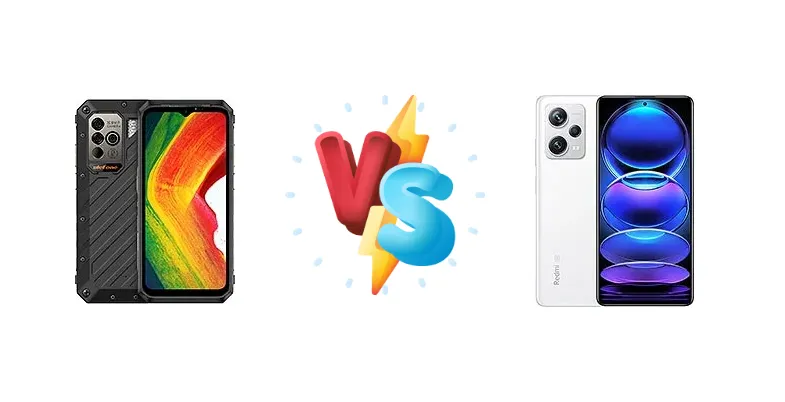
Ulefone Power Armor 18 vs Xiaomi Redmi Note 12 Pro+: The Ultimate Showdown
| Phones Images | |||||
|---|---|---|---|---|---|
|
🏆 Quick Verdict
The Xiaomi Redmi Note 12 Pro+ takes the crown for overall performance and features, boasting a significantly faster charging speed and a potentially better camera. However, the Ulefone Power Armor 18 is the clear winner for those needing a robust, drop-proof, and water-resistant device for demanding environments.
| PHONES | ||
|---|---|---|
| Phone Names | Ulefone Power Armor 18 | Xiaomi Redmi Note 12 Pro+ |
| Network | ||
|---|---|---|
| 2G bands | GSM 850 / 900 / 1800 / 1900 | GSM 850 / 900 / 1800 / 1900 - SIM 1 & SIM 2 |
| 3G bands | HSDPA 800 / 850 / 900 / 1700(AWS) / 1900 / 2100 | HSDPA 800 / 850 / 900 / 1900 / 2100 |
| 4G bands | 1, 2, 3, 4, 5, 7, 8, 12, 13, 17, 18, 19, 20, 25, 26, 28, 34, 38, 39, 40, 41, 66, 71 | 1, 3, 5, 8, 19, 34, 38, 39, 40, 41 - International, China |
| 5G bands | 1, 2, 3, 5, 7, 8, 20, 25, 28, 38, 40, 41, 66, 71, 77, 78, 79 SA/NSA/Sub6 | 1, 3, 5, 8, 28, 38, 40, 41, 77, 78 SA/NSA - International |
| Speed | HSPA, LTE, 5G | HSPA, LTE-A (CA), 5G |
| Technology | GSM / CDMA / HSPA / CDMA2000 / LTE / 5G | GSM / CDMA / HSPA / EVDO / LTE / 5G |
| CDMA2000 1x | 1, 3, 5, 8, 28, 38, 41, 77, 78 SA/NSA - China | |
| Launch | ||
|---|---|---|
| Announced | 2022, December 05 | 2022, October 27 |
| Status | Available. Released 2022, December 05 | Available. Released 2022, November 01 |
| Body | ||
|---|---|---|
| Build | - | Glass front (Gorilla Glass 5), glass back |
| Dimensions | 175.2 x 83.4 x 18.8 mm (6.90 x 3.28 x 0.74 in) | 162.9 x 76 x 8.9 mm (6.41 x 2.99 x 0.35 in) |
| SIM | Nano-SIM + Nano-SIM | Dual SIM (Nano-SIM, dual stand-by) |
| Weight | 409 g (14.43 oz) | 208.4 g (7.34 oz) |
| IP68/IP69K dust/water resistant (up to 1.5m for 30 min) Drop-to-concrete resistance from up to 1.5m MIL-STD-810H compliant Accessory connector (ulefone endoscope, microscope) | IP53, dust and splash resistant | |
| Display | ||
|---|---|---|
| Protection | Corning Gorilla Glass 5 | Corning Gorilla Glass 5 |
| Resolution | 1080 x 2408 pixels, 20:9 ratio (~401 ppi density) | 1080 x 2400 pixels, 20:9 ratio (~395 ppi density) |
| Size | 6.58 inches, 104.3 cm2 (~71.4% screen-to-body ratio) | 6.67 inches, 107.4 cm2 (~86.8% screen-to-body ratio) |
| Type | IPS LCD, 120Hz | OLED, 1B colors, 120Hz, Dolby Vision, HDR10+, 500 nits (typ), 900 nits (HBM) |
| Platform | ||
|---|---|---|
| CPU | Octa-core (2x2.4 GHz Cortex-A78 & 6x2.0 GHz Cortex-A55) | Octa-core (2x2.6 GHz Cortex-A78 & 6x2.0 GHz Cortex-A55) |
| Chipset | Mediatek Dimensity 900 (6 nm) | Mediatek MT6877V Dimensity 1080 (6 nm) |
| GPU | Mali-G68 MC4 | Mali-G68 MC4 |
| OS | Android 12 | Android 12, MIUI 13 |
| Memory | ||
|---|---|---|
| Card slot | microSDXC (uses shared SIM slot) | No |
| Internal | 256GB 12GB RAM | 256GB 8GB RAM, 256GB 12GB RAM |
| - | UFS 2.2 | |
| Main Camera | ||
|---|---|---|
| Features | Hexa-LED flash, HDR, panorama | Dual-LED dual-tone flash, HDR, panorama |
| Single | 32 MP, f/2.0, (wide), 1.2µm | - |
| Triple | 108 MP, f/1.9, (wide), 1/1.52", 0.7µm, PDAF 8 MP, f/2.2, 119˚ (ultrawide) 5 MP (macro) | 200 MP, f/1.7, 24mm (wide), 1/1.4", 0.56µm, PDAF, OIS 8 MP, f/2.2, 120˚ (ultrawide), 1/4", 1.12µm 2 MP, f/2.4, (macro) |
| Video | 4K@30fps, 1080p@30fps | 4K@30fps, 1080p@30/60/120fps, 720p@960fps |
| Selfie camera | ||
|---|---|---|
| Features | - | HDR |
| Single | 32 MP, f/2.0, (wide), 1.2µm | 16 MP, f/2.5, (wide), 1/3.06", 1.0µm |
| Video | 1080p@30fps | 1080p@30/60fps |
| Sound | ||
|---|---|---|
| 3.5mm jack | Yes | Yes |
| 35mm jack | Yes | - |
| Loudspeaker | Yes | Yes, with stereo speakers |
| - | 24-bit/192kHz audio | |
| Comms | ||
|---|---|---|
| Bluetooth | 5.0, A2DP, LE | 5.2, A2DP, LE |
| Infrared port | - | Yes |
| NFC | Yes | Yes (market/region dependent) |
| Positioning | GPS (L1+L5), GLONASS, GALILEO, BDS, NavIC | GPS (L1), GLONASS (G1), BDS (B1I+B1c), GALILEO (E1), QZSS (L1) |
| Radio | Wireless FM radio, RDS, recording | No |
| USB | USB Type-C 2.0, OTG, magnetic connector | USB Type-C 2.0, OTG |
| WLAN | Wi-Fi 802.11 a/b/g/n/ac/6, dual-band | Wi-Fi 802.11 a/b/g/n/ac/6, dual-band, Wi-Fi Direct |
| Features | ||
|---|---|---|
| Sensors | Fingerprint (side-mounted), accelerometer, gyro, proximity, compass, barometer, thermometer | Fingerprint (side-mounted), accelerometer, proximity, gyro, compass |
| Battery | ||
|---|---|---|
| Charging | 66W wired, 52% in 30 min 15W wireless 5W wireless reversed | 120W wired, PD3.0, 100% in 19 min (advertised) |
| Type | Li-Po 9600 mAh | Li-Po 5000 mAh, non-removable |
| Misc | ||
|---|---|---|
| Colors | Black | Arctic White, Iceberg Blue, Obsidian Black, Trend edition |
| Models | - | 22101316UCP, 22101316UG |
| Price | About 400 EUR | $ 348.00 / £ 439.00 / € 399.00 / ₹ 29,949 |
| Tests | ||
|---|---|---|
| Battery life | - | Endurance rating 88h |
| Camera | - | Photo / Video |
| Display | - | Contrast ratio: Infinite (nominal) |
| Loudspeaker | - | -26.7 LUFS (Good) |
| Performance | - | AnTuTu: 498710 (v9) GeekBench: 2208 (v5.1), 2372 (v6) GFXBench: 22fps (ES 3.1 onscreen) |
Ulefone Power Armor 18
- Extremely durable and rugged
- Water and dust resistant
- Large battery capacity
- Wireless charging (including reverse)
- Potentially better grip due to rugged design
- Less powerful processor
- Lower quality display
- Less impressive camera
- Slower charging speed
- Bulkier and heavier design
Xiaomi Redmi Note 12 Pro+
- Blazing-fast 120W charging
- Potentially better camera system
- Vibrant and high-resolution display
- Sleeker and more modern design
- Generally better performance
- Less durable than the Power Armor 18
- More fragile design
- No IP rating for ruggedness
- Wireless charging is slower
Display Comparison
The Redmi Note 12 Pro+ likely has a superior display due to its higher resolution and potentially better color accuracy. While the Power Armor 18's display is functional, it's likely less vibrant and sharp. The 'infinite' contrast ratio claim for the Redmi Note 12 Pro+ suggests excellent blacks and dynamic range, though this is a nominal value.
Camera Comparison
The Redmi Note 12 Pro+ is expected to have a more advanced camera system, potentially with a higher resolution main sensor and improved image processing. While the Power Armor 18's camera is adequate, it likely won't match the Redmi Note 12 Pro+'s image quality, especially in low light.
Performance
Both phones utilize Mediatek Dimensity chips, but the Redmi Note 12 Pro+'s Dimensity 1080 has a slightly higher CPU clock speed, suggesting a small performance edge in everyday tasks and gaming. However, real-world performance will also depend on software optimization.
Battery Life
The Ulefone Power Armor 18's battery capacity is likely larger, but the Redmi Note 12 Pro+'s 120W charging is a game-changer. It can charge from 0 to 100% in under 20 minutes, while the Power Armor 18's 66W charging will take considerably longer.
Buying Guide
The Ulefone Power Armor 18 is ideal for construction workers, outdoor enthusiasts, or anyone needing a phone that can withstand harsh conditions. The Xiaomi Redmi Note 12 Pro+ is perfect for users who prioritize a vibrant display, fast charging, and a versatile camera system, without needing extreme durability.