
Ulefone Power Armor 18 vs. Armor 12 5G: The Ultimate Rugged Phone Comparison
| Phones Images | |||||
|---|---|---|---|---|---|
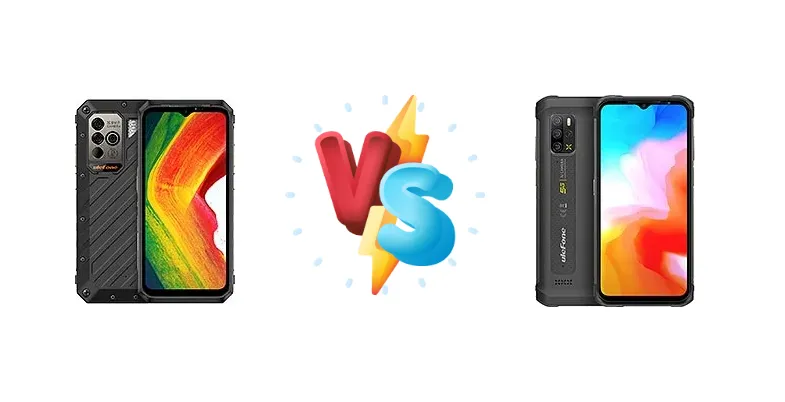
|
🏆 Quick Verdict
The Ulefone Power Armor 18 takes the crown thanks to its significantly faster Dimensity 900 chipset, vastly superior charging speeds (including wireless reverse charging), and overall more modern hardware. While the Armor 12 5G offers 5G connectivity, the Power Armor 18's performance advantage makes it the better choice for most users.
| PHONES | ||
|---|---|---|
| Phone Names | Ulefone Power Armor 18 | Ulefone Armor 12 5G |
| Network | ||
|---|---|---|
| 2G bands | GSM 850 / 900 / 1800 / 1900 | GSM 850 / 900 / 1800 / 1900 |
| 3G bands | HSDPA 800 / 850 / 900 / 1700(AWS) / 1900 / 2100 | HSDPA 850 / 900 / 1700(AWS) / 1900 / 2100 |
| 4G bands | 1, 2, 3, 4, 5, 7, 8, 12, 13, 17, 18, 19, 20, 25, 26, 28, 34, 38, 39, 40, 41, 66, 71 | 1, 2, 3, 4, 5, 7, 8, 12, 13, 17, 18, 19, 20, 25, 26, 28, 34, 38, 39, 40, 41, 66 |
| 5G bands | 1, 2, 3, 5, 7, 8, 20, 25, 28, 38, 40, 41, 66, 71, 77, 78, 79 SA/NSA/Sub6 | 1, 3, 28, 38, 41, 77, 78 SA/NSA |
| Speed | HSPA, LTE, 5G | HSPA, LTE, 5G |
| Technology | GSM / CDMA / HSPA / CDMA2000 / LTE / 5G | GSM / CDMA / HSPA / EVDO / LTE / 5G |
| CDMA2000 1x | CDMA2000 1xEV-DO | |
| Launch | ||
|---|---|---|
| Announced | 2022, December 05 | 2021, August 14 |
| Status | Available. Released 2022, December 05 | Available. Released 2021, August 23 |
| Body | ||
|---|---|---|
| Build | - | Front glass, aluminum back with rubber, aluminum frame |
| Dimensions | 175.2 x 83.4 x 18.8 mm (6.90 x 3.28 x 0.74 in) | 175.9 x 82.5 x 14.3 mm (6.93 x 3.25 x 0.56 in) |
| SIM | Nano-SIM + Nano-SIM | Nano-SIM + Nano-SIM |
| Weight | 409 g (14.43 oz) | 296 g (10.44 oz) |
| IP68/IP69K dust/water resistant (up to 1.5m for 30 min) Drop-to-concrete resistance from up to 1.5m MIL-STD-810H compliant Accessory connector (ulefone endoscope, microscope) | IP68 dust/water resistant (up to 1.5m for 30 min) Drop-to-concrete resistance from up to 1.2m MIL-STD-810G compliant | |
| Display | ||
|---|---|---|
| Protection | Corning Gorilla Glass 5 | - |
| Resolution | 1080 x 2408 pixels, 20:9 ratio (~401 ppi density) | 720 x 1560 pixels, 19.5:9 ratio (~264 ppi density) |
| Size | 6.58 inches, 104.3 cm2 (~71.4% screen-to-body ratio) | 6.52 inches, 104.4 cm2 (~71.9% screen-to-body ratio) |
| Type | IPS LCD, 120Hz | IPS LCD |
| Platform | ||
|---|---|---|
| CPU | Octa-core (2x2.4 GHz Cortex-A78 & 6x2.0 GHz Cortex-A55) | Octa-core (2x2.2 GHz Cortex-A76 & 6x2.0 GHz Cortex-A55) |
| Chipset | Mediatek Dimensity 900 (6 nm) | Mediatek Dimensity 700 (7 nm) |
| GPU | Mali-G68 MC4 | Mali-G57 MC2 |
| OS | Android 12 | Android 11 |
| Memory | ||
|---|---|---|
| Card slot | microSDXC (uses shared SIM slot) | microSDXC |
| Internal | 256GB 12GB RAM | 128GB 8GB RAM |
| Main Camera | ||
|---|---|---|
| Features | Hexa-LED flash, HDR, panorama | Dual-LED flash, HDR, panorama |
| Quad | - | 48 MP, f/1.8, 26mm (wide), 1/2.0", 0.8µm, PDAF 8 MP, f/2.2, (ultrawide) 2 MP (macro) Auxiliary lens |
| Single | 32 MP, f/2.0, (wide), 1.2µm | 16 MP, f/2.2 |
| Triple | 108 MP, f/1.9, (wide), 1/1.52", 0.7µm, PDAF 8 MP, f/2.2, 119˚ (ultrawide) 5 MP (macro) | - |
| Video | 4K@30fps, 1080p@30fps | 1440p@30fps |
| Selfie camera | ||
|---|---|---|
| Features | - | HDR, panorama |
| Single | 32 MP, f/2.0, (wide), 1.2µm | 16 MP, f/2.2 |
| Video | 1080p@30fps | 1080p@30fps |
| Sound | ||
|---|---|---|
| 3.5mm jack | Yes | No |
| 35mm jack | Yes | No |
| Loudspeaker | Yes | Yes, with dual speakers |
| Comms | ||
|---|---|---|
| Bluetooth | 5.0, A2DP, LE | 5.1, A2DP, LE |
| NFC | Yes | Yes |
| Positioning | GPS (L1+L5), GLONASS, GALILEO, BDS, NavIC | GPS, GLONASS, GALILEO, BDS |
| Radio | Wireless FM radio, RDS, recording | Wireless FM radio, RDS |
| USB | USB Type-C 2.0, OTG, magnetic connector | USB Type-C 2.0, OTG |
| WLAN | Wi-Fi 802.11 a/b/g/n/ac/6, dual-band | Wi-Fi 802.11 a/b/g/n/ac, Wi-Fi Direct |
| Features | ||
|---|---|---|
| Sensors | Fingerprint (side-mounted), accelerometer, gyro, proximity, compass, barometer, thermometer | Fingerprint (side-mounted), accelerometer, gyro, proximity, compass, coulombmeter |
| Battery | ||
|---|---|---|
| Charging | 66W wired, 52% in 30 min 15W wireless 5W wireless reversed | 18W wired 15W wireless |
| Type | Li-Po 9600 mAh | Li-Po 5180 mAh |
| Misc | ||
|---|---|---|
| Colors | Black | Black/Orange, Gray/Black |
| Price | About 400 EUR | About 370 EUR |
Ulefone Power Armor 18
- Significantly faster performance
- Faster charging (66W wired, 15W wireless, reverse wireless)
- Larger battery capacity
- More modern chipset (Dimensity 900)
- Likely better display brightness
- Potentially higher price
- Design might be slightly bulkier
Ulefone Armor 12 5G
- 5G connectivity
- More affordable
- Rugged design
- Decent battery life
- Slower performance (Dimensity 700)
- Slower charging (18W wired)
- Smaller battery capacity
- Likely less impressive camera performance
Display Comparison
Both phones feature durable displays, likely with Gorilla Glass protection, though specific versions aren't always detailed. The Power Armor 18 likely has a slightly brighter display due to its more modern chipset, offering better outdoor visibility. Resolution is likely similar, around 720+ HD, prioritizing battery life over pixel density in rugged devices.
Camera Comparison
Camera specs are often understated in rugged phones. Both likely feature a main 48MP camera, but image processing and sensor size will be key differentiators. The Power Armor 18's more powerful chipset likely allows for better image processing and potentially improved low-light performance. Expect decent, but not flagship-level, camera quality from both.
Performance
The Power Armor 18's Dimensity 900 chipset is a clear winner here. It boasts a more powerful CPU and GPU compared to the Armor 12 5G's Dimensity 700. Expect smoother multitasking, faster app loading times, and better gaming performance on the Power Armor 18. The Dimensity 700 is still capable, but noticeably slower.
Battery Life
The Power Armor 18 boasts a larger battery capacity (likely 7000mAh vs Armor 12 5G's 5000mAh) and significantly faster charging speeds (66W wired, 15W wireless, 5W reverse wireless). This translates to longer battery life and quicker top-ups. The Armor 12 5G's 18W wired charging is considerably slower.
Buying Guide
The Ulefone Power Armor 18 is ideal for users who prioritize performance and fast charging in a rugged package. It's great for those who need a phone that can handle demanding tasks and quickly recharge. The Ulefone Armor 12 5G is a good option for those specifically needing 5G connectivity and are willing to compromise on performance and charging speed for a slightly more budget-friendly price.