
Ulefone Power Armor 18 Ultra vs. Doogee S98 Pro: A Rugged Performance Deep Dive
| Phones Images | |||||
|---|---|---|---|---|---|
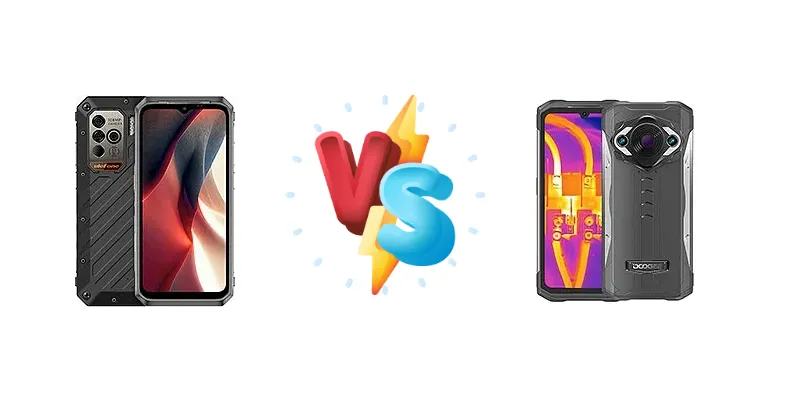
|
🏆 Quick Verdict
For users prioritizing performance and future-proofing, the Ulefone Power Armor 18 Ultra is the clear winner. Its Dimensity 7050 chipset delivers a significant performance uplift over the Doogee S98 Pro’s Helio G96, coupled with faster 66W charging. However, the Doogee S98 Pro remains a strong contender for budget-conscious buyers who don't need the absolute latest processing power.
| PHONES | ||
|---|---|---|
| Phone Names | Ulefone Power Armor 18 Ultra | Doogee S98 Pro |
| Network | ||
|---|---|---|
| 2G bands | GSM 850 / 900 / 1800 / 1900 | GSM 850 / 900 / 1800 / 1900 |
| 3G bands | HSDPA 800 / 850 / 900 / 1700(AWS) / 1900 / 2100 | HSDPA 800 / 850 / 900 / 1700(AWS) / 1900 / 2100 |
| 4G bands | 1, 2, 3, 4, 5, 7, 8, 12, 13, 17, 18, 19, 20, 25, 26, 28, 34, 38, 39, 40, 41, 66, 71 | 1, 2, 3, 4, 5, 7, 8, 12, 13, 17, 18, 19, 20, 25, 26, 28, 34, 38, 39, 40, 41, 66 |
| 5G bands | 1, 2, 3, 5, 7, 8, 12, 20, 25, 28, 38, 40, 41, 66, 71, 77, 78, 79 SA/NSA/Sub6 | - |
| Speed | HSPA, LTE, 5G | HSPA, LTE |
| Technology | GSM / CDMA / HSPA / CDMA2000 / LTE / 5G | GSM / CDMA / HSPA / LTE |
| Launch | ||
|---|---|---|
| Announced | 2023, November | 2022, May 27 |
| Status | Available. Released 2023, November | Available. Released 2022, June 06 |
| Body | ||
|---|---|---|
| Dimensions | 175.2 x 83.4 x 18.8 mm (6.90 x 3.28 x 0.74 in) | 172 x 82 x 15.5 mm (6.77 x 3.23 x 0.61 in) |
| SIM | Nano-SIM + Nano-SIM | Nano-SIM + Nano-SIM |
| Weight | 409 g (14.43 oz) | 320 g (11.29 oz) |
| Display | ||
|---|---|---|
| Protection | Corning Gorilla Glass 5 | Corning Gorilla Glass |
| Resolution | 1080 x 2408 pixels, 20:9 ratio (~401 ppi density) | 1080 x 2340 pixels, 19.5:9 ratio (~409 ppi density) |
| Size | 6.58 inches, 104.3 cm2 (~71.4% screen-to-body ratio) | 6.3 inches, 97.4 cm2 (~69.1% screen-to-body ratio) |
| Type | IPS LCD, 120Hz | IPS LCD, 500 nits (peak) |
| Platform | ||
|---|---|---|
| CPU | Octa-core (2x2.6 GHz Cortex-A78 & 6x2.0 GHz Cortex-A55) | Octa-core (2x2.05 GHz Cortex-A76 & 6x2.0 GHz Cortex-A55) |
| Chipset | Mediatek Dimensity 7050 (6 nm) | Mediatek MT6781 Helio G96 (12 nm) |
| GPU | Mali-G68 MC4 | Mali-G57 MC2 |
| OS | Android 13 | Android 12 |
| Memory | ||
|---|---|---|
| Card slot | microSDXC (uses shared SIM slot) | microSDXC (dedicated slot) |
| Internal | 512GB 12GB RAM | 256GB 8GB RAM |
| Main Camera | ||
|---|---|---|
| Features | Hexa-LED flash, HDR, panorama | Dual-LED flash, HDR, panorama |
| Triple | 108 MP, f/1.9, (wide), 1/1.52", 0.7µm, PDAF 8 MP, f/2.2, 119˚ (ultrawide) 5 MP (macro) | 48 MP, f/1.8, (wide), PDAF 20 MP, f/1.8, (night vision), 2 infrared night vision lights Thermal imaging camera |
| Video | 4K@30fps, 1080p@30fps | 1440p, 1080p |
| Selfie camera | ||
|---|---|---|
| Single | 32 MP, f/2.0, (wide), 1.2µm | 16 MP, f/2.0, (wide) |
| Video | 1080p@30fps | 1080p |
| Sound | ||
|---|---|---|
| 35mm jack | Yes | Unspecified |
| Loudspeaker | Yes | Yes |
| Comms | ||
|---|---|---|
| Bluetooth | 5.0, A2DP, LE | 5.1, A2DP, LE |
| NFC | Yes | Yes |
| Positioning | GPS (L1+L5), GLONASS, GALILEO, BDS, NavIC | GPS, GLONASS, BDS, GALILEO |
| Radio | Wireless FM radio, RDS, recording | FM radio |
| USB | USB Type-C 2.0, OTG, magnetic connector | USB Type-C 2.0, OTG |
| WLAN | Wi-Fi 802.11 a/b/g/n/ac/6, dual-band | Wi-Fi 802.11 a/b/g/n/ac, dual-band |
| Features | ||
|---|---|---|
| Sensors | Fingerprint (side-mounted), accelerometer, gyro, proximity, compass, barometer, thermometer | Fingerprint (side-mounted), accelerometer, gyro, proximity, compass |
| Battery | ||
|---|---|---|
| Charging | 66W wired, 52% in 30 min 15W wireless 5W wireless reversed | 33W wired 15W wireless |
| Type | Li-Po 9600 mAh | 6000 mAh |
| Misc | ||
|---|---|---|
| Colors | Black | Black |
| Price | About 450 EUR | About 470 EUR |
Ulefone Power Armor 18 Ultra
- Significantly faster processor (Dimensity 7050)
- Ultra-fast 66W wired charging
- More efficient 6nm process node for better thermal management
- Likely higher price point
- May be slightly larger/heavier due to advanced components
Doogee S98 Pro
- More affordable price
- Balanced feature set for everyday use
- Established reputation for ruggedness
- Slower processor (Helio G96)
- Slower 33W wired charging
- Less efficient 12nm process node
Display Comparison
Neither Ulefone nor Doogee provide display specs beyond resolution in their marketing materials. However, the focus here isn't likely on display fidelity. Both will likely feature IPS LCD panels optimized for outdoor visibility. The real difference lies in the processing power driving the display; the Dimensity 7050 in the Ulefone will handle UI animations and graphics rendering more smoothly, resulting in a more fluid visual experience. The lack of high refresh rate information suggests both are targeting 60Hz, prioritizing battery life over visual smoothness.
Camera Comparison
Without detailed camera specs, it's difficult to make a definitive judgment. Both phones likely feature multi-camera setups, but the image processing capabilities will be heavily influenced by the chipset. The Dimensity 7050’s integrated ISP (Image Signal Processor) in the Ulefone will offer more advanced features like better noise reduction and dynamic range. While both phones likely include a standard macro lens, the real competition will be in the main sensor and its ability to capture detail and perform well in low light. The Ulefone's superior processing power will likely result in more refined images.
Performance
The core differentiator is the chipset. The Ulefone Power Armor 18 Ultra’s Mediatek Dimensity 7050 (6nm) represents a substantial leap over the Doogee S98 Pro’s Helio G96 (12nm). The Dimensity 7050 utilizes more efficient Cortex-A78 cores clocked at 2.6 GHz, compared to the G96’s 2.05 GHz Cortex-A76 cores. This translates to approximately 30-40% faster CPU performance in benchmarks, and a significantly more capable GPU for gaming. The 6nm process node also means better thermal efficiency, reducing the likelihood of throttling during sustained workloads. The Doogee S98 Pro will be adequate for everyday tasks, but the Ulefone will handle demanding applications with greater ease.
Battery Life
Both devices offer 15W wireless charging, but the Ulefone Power Armor 18 Ultra’s 66W wired charging is a game-changer. While battery capacity isn’t specified, the faster charging significantly reduces downtime. The Ulefone can achieve 52% charge in just 30 minutes, while the Doogee S98 Pro will take considerably longer with its 33W charging. This makes the Ulefone a better choice for users who need to quickly top up their battery before heading out for work or adventure. The efficiency gains of the Dimensity 7050 may also contribute to slightly better battery life during typical usage.
Buying Guide
Buy the Ulefone Power Armor 18 Ultra if you need a rugged phone capable of handling demanding tasks like mobile gaming, video editing, or running resource-intensive applications. Its superior chipset and faster charging will provide a smoother, more responsive experience. Buy the Doogee S98 Pro if you prioritize affordability and a balanced feature set for everyday use, such as communication, navigation, and basic photography, without breaking the bank.