
Ulefone Power Armor 16S vs. Blackview BV8800: A Rugged Smartphone Showdown
| Phones Images | |||||
|---|---|---|---|---|---|
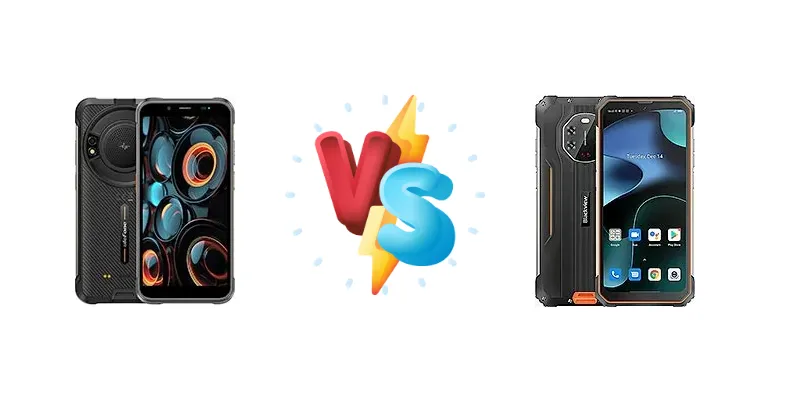
|
🏆 Quick Verdict
For the average user prioritizing responsiveness and future-proofing, the Blackview BV8800 emerges as the stronger choice. Its Mediatek Helio G96 chipset provides a noticeable performance edge, and the 33W fast charging significantly reduces downtime, despite both phones offering similar endurance ratings.
| PHONES | ||
|---|---|---|
| Phone Names | Ulefone Power Armor 16S | Blackview BV8800 |
| Network | ||
|---|---|---|
| 2G bands | GSM 850 / 900 / 1800 / 1900 | GSM 850 / 900 / 1800 / 1900 |
| 3G bands | HSDPA 850 / 900 / 1700(AWS) / 1900 / 2100 | HSDPA 800 / 850 / 900 / 1700(AWS) / 1900 / 2100 |
| 4G bands | 1, 2, 3, 4, 5, 7, 8, 12, 17, 18, 19, 20, 25, 26, 28, 66 | 1, 2, 3, 4, 5, 7, 8, 12, 13, 17, 18, 19, 20, 25, 26, 28, 30, 34, 38, 39, 40, 41, 66 |
| Speed | HSPA, LTE | HSPA, LTE |
| Technology | GSM / HSPA / LTE | GSM / CDMA / HSPA / CDMA2000 / LTE |
| - | CDMA2000 1x | |
| Launch | ||
|---|---|---|
| Announced | 2024, March 14 | 2021, December 24 |
| Status | Available. Released 2024, March 14 | Available. Released 2022, January 10 |
| Body | ||
|---|---|---|
| Dimensions | 173.4 x 83.4 x 18.3 mm (6.83 x 3.28 x 0.72 in) | 176.2 x 83.5 x 17.7 mm (6.94 x 3.29 x 0.70 in) |
| SIM | Nano-SIM + Nano-SIM | Nano-SIM + Nano-SIM |
| Weight | 406 g (14.32 oz) | 367 g (12.95 oz) |
| - | IP68/IP69K dust/water resistant (up to 1.5m for 30 min) Drop-to-concrete resistance from up to 1.5m MIL-STD-810H compliant | |
| Display | ||
|---|---|---|
| Resolution | 720 x 1440 pixels, 18:9 ratio (~271 ppi density) | 1080 x 2408 pixels, 20:9 ratio (~401 ppi density) |
| Size | 5.93 inches, 90.7 cm2 (~62.8% screen-to-body ratio) | 6.58 inches, 104.3 cm2 (~70.9% screen-to-body ratio) |
| Type | IPS LCD | IPS LCD, 90Hz, 480 nits |
| Platform | ||
|---|---|---|
| CPU | Octa-core (2x2.0 GHz Cortex-A75 & 6x1.8 GHz Cortex-A55) | Octa-core (2x2.05 GHz Cortex-A76 & 6x2.0 GHz Cortex-A55) |
| Chipset | Unisoc Tiger T616 (12 nm) | Mediatek MT6781 Helio G96 (12 nm) |
| GPU | Mali-G57 MP1 | Mali-G57 MC2 |
| OS | Android 13 | Android 11, Doke-OS 3.0 |
| Memory | ||
|---|---|---|
| Card slot | microSDXC (dedicated slot) | No |
| Internal | 128GB 8GB RAM | 128GB 8GB RAM |
| - | UFS 2.1 | |
| Main Camera | ||
|---|---|---|
| Dual | 50 MP, f/1.8, (wide), 1/2.76", 0.64µm, PDAF Auxiliary lens | - |
| Features | LED flash, HDR, panorama | Dual-LED flash, HDR, panorama |
| Quad | - | 50 MP, f/1.8, (wide), PDAF 8 MP, f/2.2, 117˚ (ultrawide) 20 MP, f/1.8, (IR camera), 2 IR emitters Auxiliary lens |
| Single | - | 16 MP, f/2.0, (wide) |
| Video | 1080p@30fps | 1440p@30fps |
| Selfie camera | ||
|---|---|---|
| Single | 8 MP, f/2.0, (wide), 1.12µm | 16 MP, f/2.0, (wide) |
| Video | 1080p@30fps | 1080p@30fps |
| Sound | ||
|---|---|---|
| 3.5mm jack | - | No |
| 35mm jack | Yes | No |
| Loudspeaker | Yes (122-decibel) | Yes |
| Comms | ||
|---|---|---|
| Bluetooth | 5.0, A2DP, LE | 5.2, A2DP, LE |
| NFC | Yes | Yes |
| Positioning | GPS, GLONASS, GALILEO, BDS | GPS, GLONASS, GALILEO, BDS |
| Radio | Wireless FM radio, RDS, recording | FM radio |
| USB | USB Type-C 2.0, OTG, magnetic connector | USB Type-C 2.0, OTG |
| WLAN | Wi-Fi 802.11 a/b/g/n/ac, dual-band | Wi-Fi 802.11 a/b/g/n/ac |
| Features | ||
|---|---|---|
| Sensors | Fingerprint (side-mounted), accelerometer, gyro, proximity, compass | Fingerprint (side-mounted), accelerometer, gyro, proximity, compass, barometer |
| Battery | ||
|---|---|---|
| Charging | 18W wired 5W reverse wired | 33W wired, 31% in 30 min, 100% in 90 min Reverse wired |
| Type | Li-Po 9600 mAh | 8380 mAh |
| Misc | ||
|---|---|---|
| Colors | Black/Orange | Black, Orange, Green |
| Price | About 60 EUR | About 350 EUR |
| Tests | ||
|---|---|---|
| Battery life | - | Endurance rating 199h |
| Camera | - | Photo / Video |
| Display | - | Contrast ratio: 1348:1 (nominal) |
| Loudspeaker | - | -29.3 LUFS (Average) |
| Performance | - | AnTuTu: 254849 (v8), 288964 (v9) GeekBench: 1752 (v5.1) GFXBench: 10fps (ES 3.1 onscreen) |
Ulefone Power Armor 16S
- Potentially lower price point
- 5W reverse wired charging
- Rugged build quality
- Less powerful Unisoc T616 chipset
- Slower 18W charging
Blackview BV8800
- Faster Mediatek Helio G96 chipset
- 33W fast charging
- Higher peak display brightness
- Potentially higher price
- Similar battery endurance to the Ulefone
Display Comparison
Both devices share a contrast ratio of 1348:1, suggesting similar color reproduction capabilities. However, the Blackview BV8800 boasts a measured peak brightness of 501 nits, which, while not exceptional, provides a slightly more visible display in direct sunlight compared to the Ulefone 16S (brightness data unavailable). The lack of high refresh rate panels on either device is typical for this segment, prioritizing battery life over visual fluidity.
Camera Comparison
Both phones list 'Photo / Video' capabilities, but lack specific details. Without sensor size or aperture information, a direct comparison is difficult. However, the market positioning of Blackview often includes more aggressive image processing, potentially leading to more vibrant, albeit less natural, photos. The presence of a dedicated macro camera on many Blackview models (though not confirmed here) is often a low-resolution addition that provides limited practical benefit. Focusing on the primary sensor’s quality will be crucial for discerning image quality.
Performance
The Blackview BV8800’s Mediatek Helio G96 chipset, featuring two Cortex-A76 cores clocked at 2.05 GHz, demonstrably outperforms the Ulefone Power Armor 16S’s Unisoc Tiger T616. The G96’s architecture, while also a 12nm process, benefits from the more efficient Cortex-A76 cores, resulting in faster application loading and smoother multitasking. The T616’s Cortex-A75 cores, clocked at 2.0 GHz, are a generation older and offer less performance. This difference will be most noticeable in graphically intensive tasks and gaming.
Battery Life
Both the Ulefone Power Armor 16S and Blackview BV8800 achieve an endurance rating of 199 hours, indicating comparable battery life under similar usage conditions. However, the Blackview BV8800’s 33W wired charging capability is a significant advantage. Achieving a 31% charge in 30 minutes and a full charge in 90 minutes drastically reduces downtime compared to the Ulefone 16S’s slower 18W charging. The 5W reverse wired charging on the Ulefone is a niche feature, useful for topping up small accessories but unlikely to be a primary charging method.
Buying Guide
Buy the Ulefone Power Armor 16S if you prioritize a lower price point and are comfortable with a more basic level of performance for everyday tasks. Buy the Blackview BV8800 if you need a more responsive experience for multitasking, gaming, or running demanding applications, and value the convenience of faster charging for extended field work.