
Ulefone Power Armor 16 Pro vs Blackview BV9300: The Ultimate Rugged Phone Battle
| Phones Images | |||||
|---|---|---|---|---|---|
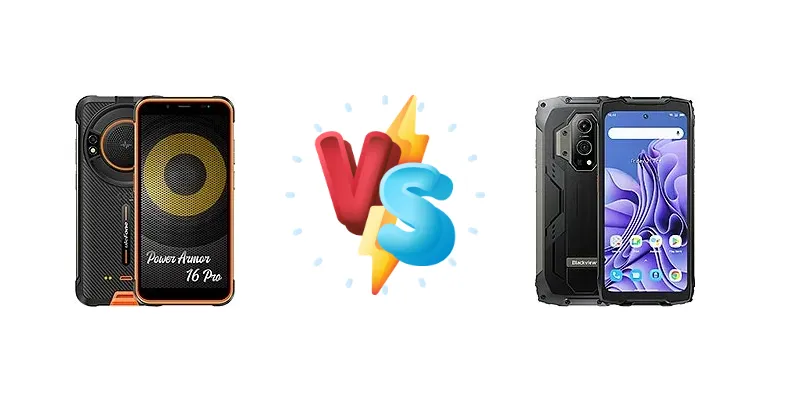
|
🏆 Quick Verdict
The Blackview BV9300 takes the crown. Its significantly more powerful Helio G99 chipset provides a noticeable performance boost, while the faster 33W charging and generally improved specs make it the better choice despite a potentially higher price.
| PHONES | ||
|---|---|---|
| Phone Names | Ulefone Power Armor 16 Pro | Blackview BV9300 |
| Network | ||
|---|---|---|
| 2G bands | GSM 850 / 900 / 1800 / 1900 | GSM 850 / 900 / 1800 / 1900 |
| 3G bands | HSDPA 800 / 850 / 900 / 1700(AWS) / 1900 / 2100 | HSDPA 850 / 900 / 1700(AWS) / 1900 / 2100 |
| 4G bands | 1, 2, 3, 4, 5, 7, 8, 12, 13, 17, 18, 19, 20, 25, 26, 28, 66 | 1, 2, 3, 4, 5, 7, 8, 12, 13, 17, 18, 19, 20, 25, 26, 28, 30, 34, 38, 39, 40, 41, 66 |
| Speed | HSPA, LTE | HSPA, LTE |
| Technology | GSM / HSPA / LTE | GSM / CDMA / HSPA / LTE |
| eMMC 5.1 | CDMA 800 / 1900 | |
| Launch | ||
|---|---|---|
| Announced | 2022, September 16 | 2023, May 10 |
| Status | Available. Released 2022, September 16 | Available. Released 2023, May 10 |
| Body | ||
|---|---|---|
| Dimensions | 173.4 x 83.4 x 18.3 mm (6.83 x 3.28 x 0.72 in) | 184.6 x 85.6 x 22.8 mm (7.27 x 3.37 x 0.90 in) |
| SIM | Nano-SIM + Nano-SIM | Nano-SIM + Nano-SIM |
| Weight | 405 g (14.29 oz) | 520 g (1.15 lb) |
| IP68/IP69K dust/water resistant (up to 1.5m for 30 min) Drop-to-concrete resistance from up to 1.5m MIL-STD-810G compliant Flashlight with a dedicated button Accessory connector (ulefone endoscope, microscope) | IP68/IP69K dust/water resistant (up to 1.5m for 30 min) Drop-to-concrete resistance from up to 1.8m MIL-STD-810H compliant Laser rangefinder (up to 40m) Dedicated flashlight (100 lumens) | |
| Display | ||
|---|---|---|
| Protection | - | Corning Gorilla Glass 5 |
| Resolution | 720 x 1440 pixels, 18:9 ratio (~271 ppi density) | 1080 x 2388 pixels (~391 ppi density) |
| Size | 5.93 inches, 90.7 cm2 (~62.8% screen-to-body ratio) | 6.7 inches, 108.7 cm2 (~68.8% screen-to-body ratio) |
| Type | IPS LCD | IPS LCD, 120Hz |
| Platform | ||
|---|---|---|
| CPU | Octa-core (4x2.0 GHz Cortex-A53 & 4x1.5 GHz Cortex-A53) | Octa-core (2x2.2 GHz Cortex-A76 & 6x2.0 GHz Cortex-A55) |
| Chipset | Mediatek MT6762G Helio G25 (12 nm) | Mediatek Helio G99 (6 nm) |
| GPU | PowerVR GE8320 | Mali-G57 MC2 |
| OS | Android 12 | Android 12, Doke-OS 3.1 |
| Memory | ||
|---|---|---|
| Card slot | microSDXC (dedicated slot) | microSDXC (uses shared SIM slot) |
| Internal | 64GB 4GB RAM | 256GB 12GB RAM |
| - | UFS 2.1 | |
| Main Camera | ||
|---|---|---|
| Dual | 16 MP, f/1.8, (wide), 1.12µm, PDAF 2 MP (macro) | - |
| Features | LED flash, HDR, panorama | LED flash, HDR, panorama |
| Single | 8 MP, f/2.0, (wide), 1.12µm | - |
| Triple | - | 50 MP, (wide), 1/2.76", 0.64µm, PDAF 8 MP, 120˚, (ultrawide), AF Auxiliary lens |
| Video | 1080p@30fps | 1440p@30fps, 1080p@30fps |
| Selfie camera | ||
|---|---|---|
| Single | 8 MP, f/2.0, (wide), 1.12µm | 32 MP, (wide) |
| Video | 1080p@30fps | 1080p |
| Sound | ||
|---|---|---|
| 3.5mm jack | Yes | No |
| 35mm jack | Yes | No |
| Loudspeaker | Yes (122-decibel) | Yes |
| Comms | ||
|---|---|---|
| Bluetooth | 5.0, A2DP, LE | 5.2, A2DP, LE |
| NFC | Yes | Yes |
| Positioning | GPS, GLONASS, GALILEO, BDS | GPS, GLONASS, GALILEO, BDS |
| Radio | Wireless FM radio, RDS, recording | FM radio |
| USB | USB Type-C 2.0, OTG, magnetic connector | USB Type-C, OTG |
| WLAN | Wi-Fi 802.11 a/b/g/n/ac, dual-band | Wi-Fi 802.11 a/b/g/n/ac, dual-band |
| Features | ||
|---|---|---|
| Sensors | Fingerprint (side-mounted), accelerometer, proximity, compass | Fingerprint (side-mounted), accelerometer, proximity, compass |
| Battery | ||
|---|---|---|
| Charging | 18W wired 5W reverse wired | 33W wired 5W reverse wired |
| Type | Li-Po 9600 mAh | 15080 mAh |
| Misc | ||
|---|---|---|
| Colors | Black, Black/Orange | Black, Orange, Green |
| Price | About 220 EUR | About 390 EUR |
Ulefone Power Armor 16 Pro
- Extremely durable build
- Lower price point
- Reverse wired charging
- Large battery capacity
- Outdated chipset
- Slow charging
- Lower performance
- Potentially lower screen quality
Blackview BV9300
- Powerful Helio G99 chipset
- Faster 33W charging
- Improved performance
- Likely better camera quality
- Potentially higher price
- Rugged design can be bulky
- May lack some niche rugged features of the Ulefone
Display Comparison
Both phones feature large, rugged displays, likely with Corning Gorilla Glass for protection. The BV9300 likely has a slightly better panel due to its newer chipset allowing for more advanced display technology, potentially offering better color accuracy and brightness. Expect both to be functional and durable, but not flagship-level in terms of visual quality.
Camera Comparison
Camera specs are likely similar in megapixel count, but the BV9300's more powerful processor will likely result in better image processing and overall photo quality. Expect improved low-light performance and more detail in photos taken with the BV9300. Both will likely offer decent, but not exceptional, camera performance.
Performance
This is where the BV9300 shines. The Helio G99 is a substantial upgrade over the Helio G25. Expect smoother multitasking, faster app loading times, and better gaming performance on the BV9300. The Power Armor 16 Pro will handle basic tasks adequately, but will struggle with demanding applications.
Battery Life
Both phones boast large batteries (likely 5000-6000mAh). However, the BV9300's 33W charging significantly reduces charging times compared to the Power Armor 16 Pro's 18W charging. Battery life itself will likely be comparable under similar usage conditions.
Buying Guide
The Ulefone Power Armor 16 Pro is ideal for users prioritizing extreme durability and a lower price point, who aren't overly concerned with top-tier performance. The Blackview BV9300 is for those who want a rugged phone with a more modern processor, faster charging, and a better overall user experience, even if it means spending a bit more.