
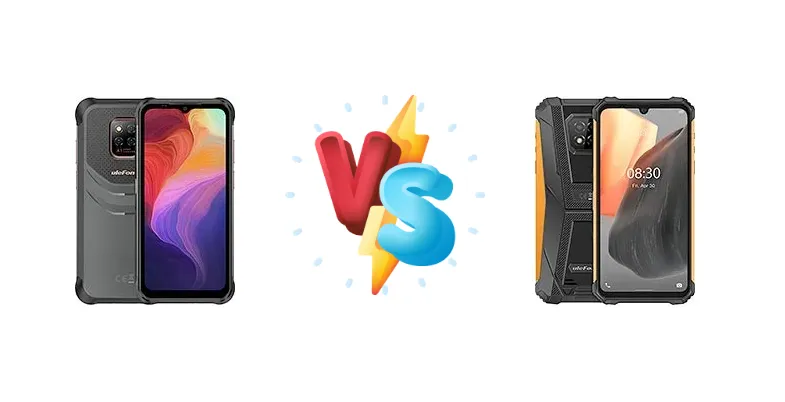
Ulefone Power Armor 14 vs. Armor 8 Pro: The Ultimate Rugged Phone Comparison
| Phones Images | |||||
|---|---|---|---|---|---|
|
🏆 Quick Verdict
The Power Armor 14 offers a slightly more modern chipset and wireless charging, giving it a performance edge. However, the Armor 8 Pro remains a solid choice, especially if wired charging is your preference and you prioritize a potentially lower price point. The Armor 14 is the overall winner.
| PHONES | ||
|---|---|---|
| Phone Names | Ulefone Power Armor 14 | Ulefone Armor 8 Pro |
| Network | ||
|---|---|---|
| 2G bands | GSM 850 / 900 / 1800 / 1900 | GSM 850 / 900 / 1800 / 1900 |
| 3G bands | HSDPA 850 / 900 / 1700(AWS) / 1900 / 2100 | HSDPA 850 / 900 / 1700(AWS) / 1900 / 2100 |
| 4G bands | 1, 2, 3, 4, 5, 7, 8, 12, 13, 17, 18, 19, 20, 25, 26, 28, 38, 40 | 1, 2, 3, 4, 5, 7, 8, 12, 13, 17, 18, 19, 20, 25, 26, 28, 66 |
| Speed | HSPA, LTE | HSPA 42.2/11.5 Mbps, LTE Cat7 300/150 Mbps |
| Technology | GSM / HSPA / LTE | GSM / HSPA / LTE |
| Launch | ||
|---|---|---|
| Announced | 2021, October 15 | 2021, April 28 |
| Status | Available. Released 2021, October 15 | Available. Released 2021, April 28 |
| Body | ||
|---|---|---|
| Build | - | Front glass, aluminum back with rubber, aluminum frame |
| Dimensions | 175.6 x 82.5 x 17.2 mm (6.91 x 3.25 x 0.68 in) | 166 x 81.8 x 15 mm (6.54 x 3.22 x 0.59 in) |
| SIM | Nano-SIM + Nano-SIM | Nano-SIM + Nano-SIM |
| Weight | 358.2 g (12.63 oz) | 282 g (9.95 oz) |
| IP68 dust/water resistant (up to 1.5m for 30 min) Drop-to-concrete resistance from up to 1.5m MIL-STD-810G compliant | IP68 dust/water resistant (up to 1.5m for 30 min) Drop-to-concrete resistance from up to 1.2m MIL-STD-810G compliant | |
| Display | ||
|---|---|---|
| Protection | Corning Gorilla Glass 3 | Scratch-resistant glass, oleophobic coating |
| Resolution | 720 x 1600 pixels, 20:9 ratio (~269 ppi density) | 720 x 1560 pixels, 19.5:9 ratio (~282 ppi density) |
| Size | 6.52 inches, 102.6 cm2 (~70.8% screen-to-body ratio) | 6.1 inches, 91.3 cm2 (~67.3% screen-to-body ratio) |
| Type | IPS LCD | IPS LCD |
| Platform | ||
|---|---|---|
| CPU | Octa-core (4x2.3 GHz Cortex-A53 & 4x1.8 GHz Cortex-A53) | Octa-core (4x2.0 GHz Cortex-A73 & 4x2.0 GHz Cortex-A53) |
| Chipset | Mediatek MT6765G Helio G35 (12 nm) | Mediatek MT6771 Helio P60 (12 nm) |
| GPU | PowerVR GE8320 | Mali-G72 MP3 |
| OS | Android 11 | Android 11 |
| Memory | ||
|---|---|---|
| Card slot | microSDXC (uses shared SIM slot) | microSDXC (uses shared SIM slot) |
| Internal | 64GB 4GB RAM | 128GB 6GB RAM, 128GB 8GB RAM |
| eMMC 5.1 | - | |
| Main Camera | ||
|---|---|---|
| Features | LED flash, HDR, panorama | LED flash, Panorama, HDR |
| Single | 16 MP, f/2.2 | 8 MP, f/2.2 |
| Triple | 20 MP, f/1.8, 26mm (wide), 1/2.78", 1.0µm, PDAF 2 MP (macro) Auxiliary lens | 16 MP, f/2.2, (wide), PDAF 5 MP (macro) Auxiliary lens |
| Video | 1080p@30fps | 1080p@30fps |
| Selfie camera | ||
|---|---|---|
| Features | HDR, panorama | - |
| Single | 16 MP, f/2.2 | 8 MP, f/2.2 |
| Video | 1080p@30fps | 1080p@30fps |
| Sound | ||
|---|---|---|
| 3.5mm jack | Yes | Yes |
| 35mm jack | Yes | Yes |
| Loudspeaker | Yes | Yes |
| Comms | ||
|---|---|---|
| Bluetooth | 5.0, A2DP, LE | 4.2, A2DP, LE |
| NFC | Yes | Yes |
| Positioning | GPS, GLONASS, GALILEO, BDS | GPS, GLONASS, GALILEO, BDS |
| Radio | FM radio, RDS, recording | FM radio, RDS, recording |
| USB | USB Type-C 2.0, OTG | USB Type-C 2.0, OTG |
| WLAN | Wi-Fi 802.11 a/b/g/n/ac, dual-band | Wi-Fi 802.11 a/b/g/n/ac, Wi-Fi Direct |
| Features | ||
|---|---|---|
| Sensors | Fingerprint (side-mounted), accelerometer, proximity, compass | Fingerprint (side-mounted), accelerometer, gyro, proximity, compass |
| Battery | ||
|---|---|---|
| Charging | 18W wired 15W wireless | 15W wired |
| Type | Li-Po 10000 mAh | Li-Po 5580 mAh |
| Misc | ||
|---|---|---|
| Colors | Black | Black, Orange, Red |
| Price | About 230 EUR | About 190 EUR |
Ulefone Power Armor 14
- More powerful chipset (Helio G35)
- Wireless charging
- Slightly larger battery
- Potentially brighter display
- Potentially higher price
- Design may be bulkier
Ulefone Armor 8 Pro
- Potentially lower price
- Proven durability
- Compact design
- Older chipset (Helio P60)
- No wireless charging
- Slightly smaller battery
Display Comparison
Both phones feature similar display technology (likely IPS LCD) and resolution, though the Power Armor 14 may have a slightly brighter screen. Expect decent viewing angles and color reproduction, but don't expect flagship-level display quality. The Armor 8 Pro's screen is likely slightly smaller.
Camera Comparison
Camera specs are likely comparable, with both phones featuring a multi-lens setup (likely including a main sensor, macro lens, and depth sensor). Image quality will be decent in good lighting conditions, but low-light performance will be average. The Power Armor 14 might have slightly improved image processing due to its newer chipset.
Performance
The Power Armor 14's Helio G35 chipset is a noticeable upgrade over the Armor 8 Pro's Helio P60. While both are octa-core, the G35's newer architecture and slightly higher clock speeds translate to smoother multitasking and better gaming performance. Expect the Armor 14 to handle demanding apps with more ease.
Battery Life
Both phones boast large batteries, typical for the rugged phone category. The Power Armor 14 has a slightly larger capacity. While the Armor 8 Pro has 15W wired charging, the Power Armor 14 adds 15W wireless charging, offering added convenience.
Buying Guide
The Ulefone Power Armor 14 is ideal for users who need a bit more processing power, appreciate wireless charging, and want the latest features. The Ulefone Armor 8 Pro is a great option for those on a tighter budget who still want a rugged and reliable device with a proven track record.