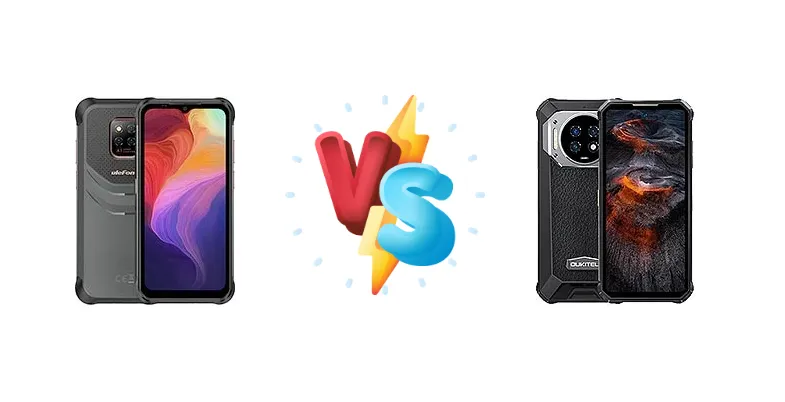
The rugged smartphone market caters to a specific user: those needing durability and reliability in challenging environments. Both the Ulefone Power Armor 14 and Oukitel WP19 aim to deliver on this promise, but they diverge significantly in their internal hardware. This comparison dissects those differences, focusing on how the chipset and charging capabilities impact real-world performance and usability.
🏆 Quick Verdict
For the average user prioritizing performance and faster charging, the Oukitel WP19 is the clear winner. Its Helio G95 chipset offers a substantial performance uplift over the Ulefone Power Armor 14’s Helio G35, making it better suited for demanding tasks. However, the Power Armor 14 remains a viable option for those on a tighter budget or prioritizing wireless charging.
| Network |
|---|
| 2G bands | GSM 850 / 900 / 1800 / 1900 | GSM 850 / 900 / 1800 / 1900 |
| 3G bands | HSDPA 850 / 900 / 1700(AWS) / 1900 / 2100 | HSDPA 850 / 900 / 1700(AWS) / 1900 / 2100 |
| 4G bands | 1, 2, 3, 4, 5, 7, 8, 12, 13, 17, 18, 19, 20, 25, 26, 28, 38, 40 | LTE |
| Speed | HSPA, LTE | HSPA, LTE |
| Technology | GSM / HSPA / LTE | GSM / HSPA / LTE |
| Launch |
|---|
| Announced | 2021, October 15 | 2022, June |
| Status | Available. Released 2021, October 15 | Available. Released 2022, July |
| Body |
|---|
| Dimensions | 175.6 x 82.5 x 17.2 mm (6.91 x 3.25 x 0.68 in) | - |
| SIM | Nano-SIM + Nano-SIM | Nano-SIM + Nano-SIM |
| Weight | 358.2 g (12.63 oz) | - |
| | IP68 dust/water resistant (up to 1.5m for 30 min)
Drop-to-concrete resistance from up to 1.5m
MIL-STD-810G compliant | - |
| Display |
|---|
| Protection | Corning Gorilla Glass 3 | - |
| Resolution | 720 x 1600 pixels, 20:9 ratio (~269 ppi density) | 1080 x 2460 pixels (~396 ppi density) |
| Size | 6.52 inches, 102.6 cm2 (~70.8% screen-to-body ratio) | 6.78 inches, 109.2 cm2 |
| Type | IPS LCD | IPS LCD, 90Hz |
| Platform |
|---|
| CPU | Octa-core (4x2.3 GHz Cortex-A53 & 4x1.8 GHz Cortex-A53) | Octa-core (2x2.05 GHz Cortex-A76 & 6x2.0 GHz Cortex-A55) |
| Chipset | Mediatek MT6765G Helio G35 (12 nm) | Mediatek MT6785V/CD Helio G95 (12 nm) |
| GPU | PowerVR GE8320 | Mali-G76 MC4 |
| OS | Android 11 | Android 12 |
| Memory |
|---|
| Card slot | microSDXC (uses shared SIM slot) | microSDXC (dedicated slot) |
| Internal | 64GB 4GB RAM | 256GB 8GB RAM |
| | eMMC 5.1 | - |
| Main Camera |
|---|
| Features | LED flash, HDR, panorama | LED flash, panorama |
| Single | 16 MP, f/2.2 | - |
| Triple | 20 MP, f/1.8, 26mm (wide), 1/2.78", 1.0µm, PDAF
2 MP (macro)
Auxiliary lens | 64 MP, f/1.8, (wide), PDAF
20 MP, f/2.0, (night vision), 4 infrared night vision lights
2 MP (macro) |
| Video | 1080p@30fps | 4K@30fps, 1080p@30fps |
| Selfie camera |
|---|
| Features | HDR, panorama | - |
| Single | 16 MP, f/2.2 | 16 MP |
| Video | 1080p@30fps | Yes |
| Sound |
|---|
| 3.5mm jack | Yes | - |
| 35mm jack | Yes | Unspecified |
| Loudspeaker | Yes | Yes |
| Comms |
|---|
| Bluetooth | 5.0, A2DP, LE | Yes |
| NFC | Yes | Yes |
| Positioning | GPS, GLONASS, GALILEO, BDS | GPS, GLONASS, GALILEO, BDS |
| Radio | FM radio, RDS, recording | Unspecified |
| USB | USB Type-C 2.0, OTG | USB Type-C 2.0, OTG |
| WLAN | Wi-Fi 802.11 a/b/g/n/ac, dual-band | Yes |
| Features |
|---|
| Sensors | Fingerprint (side-mounted), accelerometer, proximity, compass | Unspecified |
| Battery |
|---|
| Charging | 18W wired
15W wireless | 33W wired |
| Type | Li-Po 10000 mAh | Li-Po 21000 mAh |
| Misc |
|---|
| Colors | Black | Blue, Camo, Camouflage |
| Price | About 230 EUR | About 380 EUR |
Ulefone Power Armor 14
- Wireless charging offers convenient power-up options.
- Potentially lower price point makes it accessible.
- Rugged design provides excellent durability.
- Helio G35 chipset delivers noticeably slower performance.
- Slower 18W wired charging takes longer to replenish the battery.
- Limited processing power for demanding applications.
Oukitel WP19
- Helio G95 chipset provides a significant performance boost.
- 33W fast charging dramatically reduces charging times.
- Improved ISP for better image processing.
- Lacks wireless charging functionality.
- May be slightly more expensive than the Ulefone Power Armor 14.
- Rugged design may add bulk.
Display Comparison
Neither Ulefone nor Oukitel provide detailed display specifications beyond resolution. However, given the price points, we can assume both utilize IPS LCD panels. The focus here isn't display quality, but durability. Both will likely feature Gorilla Glass or similar protection. The lack of high refresh rates or advanced panel tech like LTPO is typical for this segment, prioritizing robustness over visual fidelity.
Camera Comparison
Without detailed sensor information, a direct camera comparison is difficult. However, the chipset difference indirectly impacts camera performance. The G95’s improved ISP (Image Signal Processor) in the WP19 will likely result in faster image processing, better noise reduction, and more accurate color reproduction. While both phones likely feature multiple rear cameras, the quality of the primary sensor will be the most important factor. We can assume both will include standard features like HDR and panorama modes, but the WP19’s processing power gives it an edge in computational photography.
Performance
The core difference lies in the chipsets. The Oukitel WP19’s MediaTek Helio G95 is a significant upgrade over the Ulefone Power Armor 14’s Helio G35. The G95 features a dual-core Cortex-A76 setup clocked at 2.05 GHz alongside six Cortex-A55 cores, offering substantially improved multi-core and single-core performance compared to the G35’s quad-core Cortex-A53 arrangement. This translates to snappier app launches, smoother multitasking, and a more enjoyable gaming experience on the WP19. The G95’s more modern architecture also provides better efficiency, potentially mitigating thermal throttling during sustained workloads. While both are 12nm chips, the architectural improvements of the G95 are key.
Battery Life
Both phones target long battery life, a staple of the rugged phone category. While specific battery capacities aren't provided, the Oukitel WP19’s 33W wired charging is a major advantage. This will significantly reduce charging times compared to the Ulefone Power Armor 14’s 18W wired charging. The 15W wireless charging on the Power Armor 14 is a unique feature, appealing to users who prefer cable-free charging, but it’s considerably slower than the WP19’s wired charging. The faster charging of the WP19 allows for quicker top-ups, crucial for users who rely heavily on their phone throughout the day.
Buying Guide
Buy the Ulefone Power Armor 14 if you need a highly durable phone with wireless charging capabilities and are primarily focused on basic smartphone tasks like communication and light media consumption. Buy the Oukitel WP19 if you prefer a more responsive user experience, faster charging speeds, and occasionally engage in gaming or resource-intensive applications. The WP19 is the better choice for users who demand more from their device.
Frequently Asked Questions
❓ Will the Oukitel WP19 handle demanding games like PUBG Mobile smoothly?
The Helio G95 in the Oukitel WP19 is capable of running PUBG Mobile, but expect to use medium graphics settings for a consistently smooth experience. The G35 in the Ulefone Power Armor 14 will struggle with PUBG, even on the lowest settings.
❓ How much faster is the 33W charging on the Oukitel WP19 compared to the Ulefone Power Armor 14’s 18W charging?
The 33W charging on the WP19 will likely reduce a full charge time by at least 30-45 minutes compared to the 18W charging on the Power Armor 14, assuming similar battery capacities. This is a substantial difference for users who need to quickly top up their battery.
❓ Is the wireless charging on the Ulefone Power Armor 14 fast enough for daily use?
At 15W, the wireless charging on the Power Armor 14 is relatively slow. It's best suited for overnight charging or occasional top-ups, rather than quickly replenishing the battery during the day.
❓ Does the Helio G95 in the Oukitel WP19 generate more heat than the Helio G35?
While the G95 is more powerful, it's also more efficient. It's likely to generate more heat *under sustained load*, but the improved efficiency means it may not necessarily get hotter during typical usage. Both phones will likely have thermal management systems to prevent overheating.