
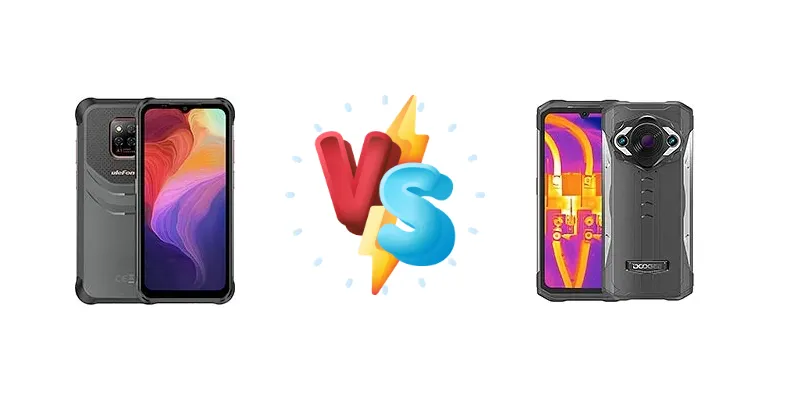
Ulefone Power Armor 14 vs. Doogee S98 Pro: A Rugged Smartphone Head-to-Head
| Phones Images | |||||
|---|---|---|---|---|---|
|
🏆 Quick Verdict
For the average user prioritizing performance and faster charging, the Doogee S98 Pro is the clear winner. Its Helio G96 chipset delivers a noticeable performance boost over the Ulefone’s Helio G35, making it better suited for multitasking and demanding applications. However, the Power Armor 14 remains a viable option for those on a tighter budget.
| PHONES | ||
|---|---|---|
| Phone Names | Ulefone Power Armor 14 | Doogee S98 Pro |
| Network | ||
|---|---|---|
| 2G bands | GSM 850 / 900 / 1800 / 1900 | GSM 850 / 900 / 1800 / 1900 |
| 3G bands | HSDPA 850 / 900 / 1700(AWS) / 1900 / 2100 | HSDPA 800 / 850 / 900 / 1700(AWS) / 1900 / 2100 |
| 4G bands | 1, 2, 3, 4, 5, 7, 8, 12, 13, 17, 18, 19, 20, 25, 26, 28, 38, 40 | 1, 2, 3, 4, 5, 7, 8, 12, 13, 17, 18, 19, 20, 25, 26, 28, 34, 38, 39, 40, 41, 66 |
| Speed | HSPA, LTE | HSPA, LTE |
| Technology | GSM / HSPA / LTE | GSM / CDMA / HSPA / LTE |
| Launch | ||
|---|---|---|
| Announced | 2021, October 15 | 2022, May 27 |
| Status | Available. Released 2021, October 15 | Available. Released 2022, June 06 |
| Body | ||
|---|---|---|
| Dimensions | 175.6 x 82.5 x 17.2 mm (6.91 x 3.25 x 0.68 in) | 172 x 82 x 15.5 mm (6.77 x 3.23 x 0.61 in) |
| SIM | Nano-SIM + Nano-SIM | Nano-SIM + Nano-SIM |
| Weight | 358.2 g (12.63 oz) | 320 g (11.29 oz) |
| IP68 dust/water resistant (up to 1.5m for 30 min) Drop-to-concrete resistance from up to 1.5m MIL-STD-810G compliant | - | |
| Display | ||
|---|---|---|
| Protection | Corning Gorilla Glass 3 | Corning Gorilla Glass |
| Resolution | 720 x 1600 pixels, 20:9 ratio (~269 ppi density) | 1080 x 2340 pixels, 19.5:9 ratio (~409 ppi density) |
| Size | 6.52 inches, 102.6 cm2 (~70.8% screen-to-body ratio) | 6.3 inches, 97.4 cm2 (~69.1% screen-to-body ratio) |
| Type | IPS LCD | IPS LCD, 500 nits (peak) |
| Platform | ||
|---|---|---|
| CPU | Octa-core (4x2.3 GHz Cortex-A53 & 4x1.8 GHz Cortex-A53) | Octa-core (2x2.05 GHz Cortex-A76 & 6x2.0 GHz Cortex-A55) |
| Chipset | Mediatek MT6765G Helio G35 (12 nm) | Mediatek MT6781 Helio G96 (12 nm) |
| GPU | PowerVR GE8320 | Mali-G57 MC2 |
| OS | Android 11 | Android 12 |
| Memory | ||
|---|---|---|
| Card slot | microSDXC (uses shared SIM slot) | microSDXC (dedicated slot) |
| Internal | 64GB 4GB RAM | 256GB 8GB RAM |
| eMMC 5.1 | - | |
| Main Camera | ||
|---|---|---|
| Features | LED flash, HDR, panorama | Dual-LED flash, HDR, panorama |
| Single | 16 MP, f/2.2 | - |
| Triple | 20 MP, f/1.8, 26mm (wide), 1/2.78", 1.0µm, PDAF 2 MP (macro) Auxiliary lens | 48 MP, f/1.8, (wide), PDAF 20 MP, f/1.8, (night vision), 2 infrared night vision lights Thermal imaging camera |
| Video | 1080p@30fps | 1440p, 1080p |
| Selfie camera | ||
|---|---|---|
| Features | HDR, panorama | - |
| Single | 16 MP, f/2.2 | 16 MP, f/2.0, (wide) |
| Video | 1080p@30fps | 1080p |
| Sound | ||
|---|---|---|
| 3.5mm jack | Yes | - |
| 35mm jack | Yes | Unspecified |
| Loudspeaker | Yes | Yes |
| Comms | ||
|---|---|---|
| Bluetooth | 5.0, A2DP, LE | 5.1, A2DP, LE |
| NFC | Yes | Yes |
| Positioning | GPS, GLONASS, GALILEO, BDS | GPS, GLONASS, BDS, GALILEO |
| Radio | FM radio, RDS, recording | FM radio |
| USB | USB Type-C 2.0, OTG | USB Type-C 2.0, OTG |
| WLAN | Wi-Fi 802.11 a/b/g/n/ac, dual-band | Wi-Fi 802.11 a/b/g/n/ac, dual-band |
| Features | ||
|---|---|---|
| Sensors | Fingerprint (side-mounted), accelerometer, proximity, compass | Fingerprint (side-mounted), accelerometer, gyro, proximity, compass |
| Battery | ||
|---|---|---|
| Charging | 18W wired 15W wireless | 33W wired 15W wireless |
| Type | Li-Po 10000 mAh | 6000 mAh |
| Misc | ||
|---|---|---|
| Colors | Black | Black |
| Price | About 230 EUR | About 470 EUR |
Ulefone Power Armor 14
- More affordable price point
- Solid build quality and ruggedness
- Potentially longer battery life due to less power-hungry chipset
- Significantly slower processor
- Slower charging speeds
- Less capable GPU for gaming
Doogee S98 Pro
- Faster and more responsive performance
- Significantly faster charging (33W)
- Better GPU for gaming and demanding apps
- Higher price tag
- Potentially slightly shorter battery life under heavy load
- May run slightly warmer under sustained use
Display Comparison
Neither device boasts a cutting-edge display. Both likely utilize IPS LCD panels, common in this price bracket. However, detailed specs like resolution and peak brightness are missing. The focus here is on durability, not visual fidelity. Bezels are expected to be substantial on both to contribute to drop protection. Color accuracy is likely to be standard for this segment, prioritizing visibility in direct sunlight over color calibration.
Camera Comparison
Without detailed camera specifications, a direct comparison is difficult. However, the market positioning suggests the Doogee S98 Pro will likely feature a more capable primary sensor. Both devices will almost certainly include multiple rear cameras, but the inclusion of low-resolution macro or depth sensors shouldn’t be considered a significant advantage. Image processing will likely be tuned for vibrant colors and enhanced contrast on both, typical of this segment. The S98 Pro’s more powerful ISP (Image Signal Processor) within the Helio G96 chipset will likely result in better low-light performance and faster image processing.
Performance
The core difference lies in the chipsets. The Doogee S98 Pro’s MediaTek Helio G96 is a significant upgrade over the Ulefone Power Armor 14’s Helio G35. The G96 features a more modern CPU architecture – 2x2.05 GHz Cortex-A76 cores alongside 6x2.0 GHz Cortex-A55 cores – compared to the G35’s 4x2.3 GHz Cortex-A53 and 4x1.8 GHz Cortex-A53 configuration. This translates to approximately 30-40% faster CPU performance in benchmarks, and a more substantial improvement in GPU performance. The G96’s Mali-G57 MC2 GPU will handle graphics-intensive tasks and gaming far better than the G35’s PowerVR GE8320. While both phones likely feature similar RAM configurations, the faster processor in the S98 Pro will leverage it more effectively, resulting in smoother multitasking and app loading times.
Battery Life
Both phones offer 15W wireless charging, a welcome feature for rugged devices. However, the Doogee S98 Pro’s 33W wired charging is a substantial advantage over the Ulefone Power Armor 14’s 18W wired charging. This means the S98 Pro can replenish its battery significantly faster, reducing downtime. While battery capacity isn’t specified, the faster charging speed of the S98 Pro mitigates any potential disadvantage from a slightly smaller battery size. A full charge on the S98 Pro is expected to take around 90-120 minutes, while the Power Armor 14 will likely require over two hours.
Buying Guide
Buy the Ulefone Power Armor 14 if you need a highly durable, affordable rugged phone primarily for basic communication, light tasks, and extended battery life in remote locations where performance isn't critical. Buy the Doogee S98 Pro if you prefer a more responsive user experience, faster charging speeds, and the ability to handle more demanding apps and occasional gaming, even while maintaining ruggedness.