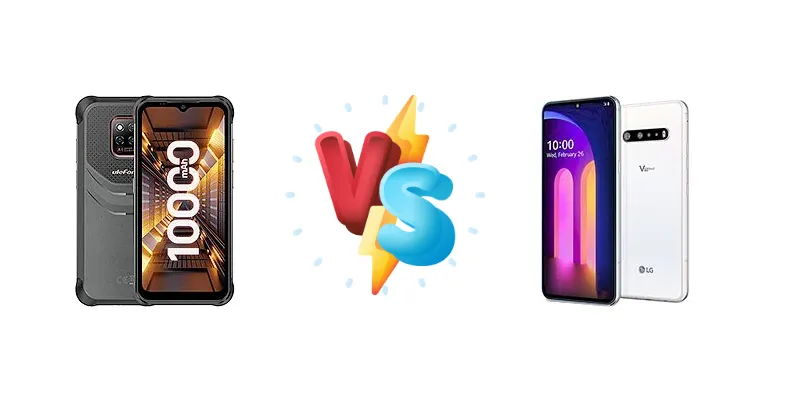
Choosing a new smartphone can be overwhelming. Today, we pit two very different devices against each other: the Ulefone Power Armor 14 Pro, a rugged powerhouse, and the LG V60 ThinQ 5G UW, a premium flagship. Let's dive into a detailed comparison to see which one reigns supreme.
🏆 Quick Verdict
The LG V60 ThinQ 5G UW wins on performance and camera quality thanks to its Snapdragon 865. However, the Ulefone Power Armor 14 Pro offers unmatched durability and a massive battery at a significantly lower price point. It depends on your priorities: premium features or rugged reliability.
| Network |
|---|
| 2G bands | GSM 850 / 900 / 1800 / 1900 | GSM 850 / 900 / 1800 / 1900 |
| 3G bands | HSDPA 850 / 900 / 1700(AWS) / 1900 / 2100 | HSDPA 850 / 900 / 1700(AWS) / 1900 / 2100 |
| 4G bands | 1, 2, 3, 4, 5, 7, 8, 12, 13, 17, 18, 19, 20, 25, 26, 28, 38, 40 | 2, 3, 4, 5, 7, 12, 13, 20, 28, 46, 48, 66 |
| 5G bands | - | 260, 261 mmWave |
| Speed | HSPA, LTE | HSPA 42.2/5.76 Mbps, LTE (7CA) Cat22, 5G |
| Technology | GSM / HSPA / LTE | GSM / CDMA / HSPA / EVDO / LTE / 5G |
| | - | CDMA2000 1xEV-DO |
| Launch |
|---|
| Announced | 2022, March 09 | 2020, February 26. Released 2020, April 02 |
| Status | Available. Released 2022, March 09 | Discontinued |
| Body |
|---|
| Build | - | Glass front (Gorilla Glass 5), glass back (Gorilla Glass 6), aluminum frame |
| Dimensions | 175.6 x 82.5 x 17.2 mm (6.91 x 3.25 x 0.68 in) | 169.3 x 77.6 x 8.9 mm (6.67 x 3.06 x 0.35 in) |
| SIM | Nano-SIM + Nano-SIM | Nano-SIM (pre-installed) |
| Weight | 358.2 g (12.63 oz) | 218 g (7.69 oz) |
| | IP68 dust/water resistant (up to 1.5m for 30 min)
Drop-to-concrete resistance from up to 1.5m
MIL-STD-810G compliant | IP68 dust/water resistant (up to 1.5m for 30 min)
MIL-STD-810G compliant*
Method 516.6, Procedure IV "Transit Drop"
*does not guarantee ruggedness or use in extreme conditions |
| Display |
|---|
| Protection | Corning Gorilla Glass 3 | Corning Gorilla Glass 5 |
| Resolution | 720 x 1600 pixels, 20:9 ratio (~269 ppi density) | 1080 x 2460 pixels (~395 ppi density) |
| Size | 6.52 inches, 102.6 cm2 (~70.8% screen-to-body ratio) | 6.8 inches, 109.8 cm2 (~83.6% screen-to-body ratio) |
| Type | IPS LCD | P-OLED, HDR10+ |
| | - | Always-on display |
| Platform |
|---|
| CPU | Octa-core (2x2.0 GHz Cortex-A75 & 6x1.8 GHz Cortex-A55) | Octa-core (1x2.84 GHz Cortex-A77 & 3x2.42 GHz Cortex-A77 & 4x1.80 GHz Cortex-A55) |
| Chipset | Mediatek MT6769Z Helio G85 (12 nm) | Qualcomm SM8250 Snapdragon 865 5G (7 nm+) |
| GPU | Mali-G52 MC2 | Adreno 650 |
| OS | Android 12 | Android 10, upgradable to Android 13 |
| Memory |
|---|
| Card slot | microSDXC (uses shared SIM slot) | microSDXC (uses shared SIM slot) - dual-SIM model |
| Internal | 128GB 6GB RAM, 128GB 8GB RAM | 128GB 8GB RAM |
| | eMMC 5.1 | UFS 2.1 |
| Main Camera |
|---|
| Dual | - | 64 MP, f/1.8, 27mm (standard), 1/1.72", 0.8µm, dual pixel PDAF, OIS
13 MP, f/1.9, 12mm (ultrawide), 1/3.4", 1.0µm
0.3 MP, TOF 3D, f/1.4, (depth) |
| Features | LED flash, HDR, panorama | Dual-LED dual-tone flash, HDR, panorama |
| Single | 16 MP, f/2.2 | - |
| Triple | 20 MP, f/1.8, 26mm (wide), 1/2.78", 1.0µm, PDAF
2 MP (macro)
Auxiliary lens | - |
| Video | 1080p@30fps | 8K@30fps, 4K@30/60fps, 1080p, HDR10+, 24-bit/192kHz stereo sound rec., gyro-EIS |
| Selfie camera |
|---|
| Features | HDR, panorama | HDR |
| Single | 16 MP, f/2.2 | 10 MP, f/1.9, 30mm (standard), 1/3.1", 1.22µm |
| Video | 1080p@30fps | 4K@30fps, gyro-EIS |
| Sound |
|---|
| 3.5mm jack | Yes | Yes |
| 35mm jack | Yes | Yes |
| Loudspeaker | Yes | Yes, with stereo speakers |
| | - | 32-bit/192kHz audio
24-bit/192kHz audio recording |
| Comms |
|---|
| Bluetooth | 5.0, A2DP, LE | 5.1, A2DP, LE, aptX HD |
| NFC | Yes | Yes |
| Positioning | GPS, GLONASS, GALILEO, BDS | GPS, GLONASS, GALILEO, BDS |
| Radio | FM radio, RDS, recording | FM radio (USA model only) |
| USB | USB Type-C 2.0, OTG | USB Type-C 3.1, OTG |
| WLAN | Wi-Fi 802.11 a/b/g/n/ac, dual-band | Wi-Fi 802.11 a/b/g/n/ac/6, dual-band, Wi-Fi Direct, DLNA |
| Features |
|---|
| Sensors | Fingerprint (side-mounted), accelerometer, proximity, compass | Fingerprint (under display, optical), accelerometer, gyro, proximity, compass, barometer |
| Battery |
|---|
| Charging | 18W wired
15W wireless | Wired, PD2.0, QC4
Wireless |
| Type | Li-Po 10000 mAh | Li-Po 5000 mAh |
| Misc |
|---|
| Colors | Black | Classy Blue, Classy White |
| Models | - | LM-V600VML, LMV600VML |
| Price | About 260 EUR | About 870 EUR |
| SAR | - | 0.85 W/kg (head) 1.12 W/kg (body) |
Ulefone Power Armor 14 Pro
- Exceptional battery life
- Rugged and durable design
- Affordable price
- Water and dust resistant (IP68/IP69K)
- Loud speakers
- Lower performance compared to flagship phones
- Less impressive camera
- IPS LCD display (not as vibrant as OLED)
- Slower charging speeds
LG V60 ThinQ 5G UW
- Flagship performance (Snapdragon 865)
- Excellent camera system
- Vibrant OLED display with 120Hz refresh rate
- 5G connectivity
- PD2.0 and QC4 charging support
- Less durable than the Ulefone
- Shorter battery life
- Higher price
- Discontinued by LG (limited support)
Display Comparison
The LG V60 boasts a 6.8-inch OLED display with a 20.4:9 aspect ratio and a 120Hz refresh rate, offering vibrant colors and smooth scrolling. The Ulefone Power Armor 14 Pro has a 6.53-inch IPS LCD display, likely with a standard refresh rate. While the Ulefone's display is adequate, the LG's is significantly superior in terms of visual quality and smoothness.
Camera Comparison
The LG V60's camera system is more versatile and generally produces higher-quality images. It features a triple-lens setup with a 64MP main sensor, an ultrawide lens, and a telephoto lens. The Ulefone Power Armor 14 Pro likely has a more basic camera setup, prioritizing durability over image quality. Expect better low-light performance and more detail from the LG.
Performance
Here, the LG V60 takes a commanding lead. The Snapdragon 865 is a flagship processor, providing significantly faster performance than the Helio G85 in the Ulefone. Expect smoother multitasking, faster app loading, and better gaming performance on the LG. The Ulefone is still capable for everyday tasks, but struggles with demanding applications.
Battery Life
The Ulefone Power Armor 14 Pro shines in this category. It packs a massive 6000mAh battery, offering exceptional battery life. The LG V60 has a 4000mAh battery, which is decent but doesn't compare to the Ulefone's endurance. Expect the Ulefone to easily last a full day or more, while the LG may require charging before the end of the day with heavy use.
Buying Guide
The Ulefone Power Armor 14 Pro is ideal for those needing a durable phone for outdoor work, construction, or anyone prone to dropping their devices. The LG V60 ThinQ 5G UW is best suited for users prioritizing top-tier performance, a great camera, and 5G connectivity, and who don't need extreme ruggedness.
Frequently Asked Questions
❓ Is the LG V60 still worth buying?
It's a tricky question. The V60 offers excellent specs, but LG has discontinued smartphone production, so software updates and support are limited. If you can find one at a good price and don't need the latest software, it can still be a capable device.
❓ How durable is the Ulefone Power Armor 14 Pro?
The Ulefone Power Armor 14 Pro is built to withstand harsh conditions. It's IP68 and IP69K rated, meaning it's dustproof, waterproof, and can survive submersion in water and high-pressure water jets. It also features reinforced corners and a ruggedized design.