
Ulefone Power Armor 14 Pro vs Blackview BV8800: The Ultimate Rugged Phone Battle
| Phones Images | |||||
|---|---|---|---|---|---|
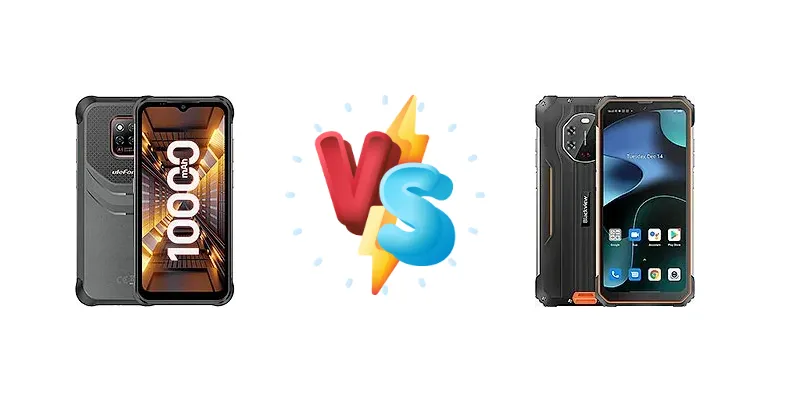
|
🏆 Quick Verdict
The Blackview BV8800 edges out the Ulefone Power Armor 14 Pro thanks to its faster charging, slightly more powerful chipset, and potentially better camera capabilities. Both offer rugged build quality, but the BV8800 provides a more modern and efficient experience.
| PHONES | ||
|---|---|---|
| Phone Names | Ulefone Power Armor 14 Pro | Blackview BV8800 |
| Network | ||
|---|---|---|
| 2G bands | GSM 850 / 900 / 1800 / 1900 | GSM 850 / 900 / 1800 / 1900 |
| 3G bands | HSDPA 850 / 900 / 1700(AWS) / 1900 / 2100 | HSDPA 800 / 850 / 900 / 1700(AWS) / 1900 / 2100 |
| 4G bands | 1, 2, 3, 4, 5, 7, 8, 12, 13, 17, 18, 19, 20, 25, 26, 28, 38, 40 | 1, 2, 3, 4, 5, 7, 8, 12, 13, 17, 18, 19, 20, 25, 26, 28, 30, 34, 38, 39, 40, 41, 66 |
| Speed | HSPA, LTE | HSPA, LTE |
| Technology | GSM / HSPA / LTE | GSM / CDMA / HSPA / CDMA2000 / LTE |
| - | CDMA2000 1x | |
| Launch | ||
|---|---|---|
| Announced | 2022, March 09 | 2021, December 24 |
| Status | Available. Released 2022, March 09 | Available. Released 2022, January 10 |
| Body | ||
|---|---|---|
| Dimensions | 175.6 x 82.5 x 17.2 mm (6.91 x 3.25 x 0.68 in) | 176.2 x 83.5 x 17.7 mm (6.94 x 3.29 x 0.70 in) |
| SIM | Nano-SIM + Nano-SIM | Nano-SIM + Nano-SIM |
| Weight | 358.2 g (12.63 oz) | 367 g (12.95 oz) |
| IP68 dust/water resistant (up to 1.5m for 30 min) Drop-to-concrete resistance from up to 1.5m MIL-STD-810G compliant | IP68/IP69K dust/water resistant (up to 1.5m for 30 min) Drop-to-concrete resistance from up to 1.5m MIL-STD-810H compliant | |
| Display | ||
|---|---|---|
| Protection | Corning Gorilla Glass 3 | - |
| Resolution | 720 x 1600 pixels, 20:9 ratio (~269 ppi density) | 1080 x 2408 pixels, 20:9 ratio (~401 ppi density) |
| Size | 6.52 inches, 102.6 cm2 (~70.8% screen-to-body ratio) | 6.58 inches, 104.3 cm2 (~70.9% screen-to-body ratio) |
| Type | IPS LCD | IPS LCD, 90Hz, 480 nits |
| Platform | ||
|---|---|---|
| CPU | Octa-core (2x2.0 GHz Cortex-A75 & 6x1.8 GHz Cortex-A55) | Octa-core (2x2.05 GHz Cortex-A76 & 6x2.0 GHz Cortex-A55) |
| Chipset | Mediatek MT6769Z Helio G85 (12 nm) | Mediatek MT6781 Helio G96 (12 nm) |
| GPU | Mali-G52 MC2 | Mali-G57 MC2 |
| OS | Android 12 | Android 11, Doke-OS 3.0 |
| Memory | ||
|---|---|---|
| Card slot | microSDXC (uses shared SIM slot) | No |
| Internal | 128GB 6GB RAM, 128GB 8GB RAM | 128GB 8GB RAM |
| eMMC 5.1 | UFS 2.1 | |
| Main Camera | ||
|---|---|---|
| Features | LED flash, HDR, panorama | Dual-LED flash, HDR, panorama |
| Quad | - | 50 MP, f/1.8, (wide), PDAF 8 MP, f/2.2, 117˚ (ultrawide) 20 MP, f/1.8, (IR camera), 2 IR emitters Auxiliary lens |
| Single | 16 MP, f/2.2 | 16 MP, f/2.0, (wide) |
| Triple | 20 MP, f/1.8, 26mm (wide), 1/2.78", 1.0µm, PDAF 2 MP (macro) Auxiliary lens | - |
| Video | 1080p@30fps | 1440p@30fps |
| Selfie camera | ||
|---|---|---|
| Features | HDR, panorama | - |
| Single | 16 MP, f/2.2 | 16 MP, f/2.0, (wide) |
| Video | 1080p@30fps | 1080p@30fps |
| Sound | ||
|---|---|---|
| 3.5mm jack | Yes | No |
| 35mm jack | Yes | No |
| Loudspeaker | Yes | Yes |
| Comms | ||
|---|---|---|
| Bluetooth | 5.0, A2DP, LE | 5.2, A2DP, LE |
| NFC | Yes | Yes |
| Positioning | GPS, GLONASS, GALILEO, BDS | GPS, GLONASS, GALILEO, BDS |
| Radio | FM radio, RDS, recording | FM radio |
| USB | USB Type-C 2.0, OTG | USB Type-C 2.0, OTG |
| WLAN | Wi-Fi 802.11 a/b/g/n/ac, dual-band | Wi-Fi 802.11 a/b/g/n/ac |
| Features | ||
|---|---|---|
| Sensors | Fingerprint (side-mounted), accelerometer, proximity, compass | Fingerprint (side-mounted), accelerometer, gyro, proximity, compass, barometer |
| Battery | ||
|---|---|---|
| Charging | 18W wired 15W wireless | 33W wired, 31% in 30 min, 100% in 90 min Reverse wired |
| Type | Li-Po 10000 mAh | 8380 mAh |
| Misc | ||
|---|---|---|
| Colors | Black | Black, Orange, Green |
| Price | About 260 EUR | About 350 EUR |
| Tests | ||
|---|---|---|
| Battery life | - | Endurance rating 199h |
| Camera | - | Photo / Video |
| Display | - | Contrast ratio: 1348:1 (nominal) |
| Loudspeaker | - | -29.3 LUFS (Average) |
| Performance | - | AnTuTu: 254849 (v8), 288964 (v9) GeekBench: 1752 (v5.1) GFXBench: 10fps (ES 3.1 onscreen) |
Ulefone Power Armor 14 Pro
- Rugged and durable design
- Affordable price point
- Decent battery life
- Wireless charging
- Slower charging speed
- Less powerful chipset
- Camera performance potentially lacking
- Older chipset architecture
Blackview BV8800
- Faster charging (33W)
- More powerful chipset (Helio G96)
- Reverse wired charging
- Higher display brightness
- Potentially better camera
- Potentially higher price
- Rugged design can be bulky
- Specific camera specs unknown
Display Comparison
Both phones feature robust displays, likely with Corning Gorilla Glass protection. The Blackview BV8800 boasts a measured 501 nits brightness, which is a significant advantage for outdoor visibility. While both have a 1348:1 contrast ratio, the BV8800's higher brightness gives it a clearer edge in sunlight. Screen size and resolution are likely similar, around 6.3-6.5 inches with FHD+ resolution.
Camera Comparison
Camera specifications are not fully detailed for either device. However, the Helio G96 in the BV8800 generally supports more advanced camera features and image processing capabilities. Both likely offer multiple rear cameras (wide, ultrawide, macro) and a front-facing camera for selfies. Real-world camera performance will depend on software optimization.
Performance
The Blackview BV8800's MediaTek Helio G96 chipset offers a noticeable performance boost over the Ulefone's Helio G85. The G96's Cortex-A76 cores provide better single-core performance, while both have six Cortex-A55 cores for efficient multitasking. Expect smoother app loading and gaming on the BV8800.
Battery Life
Both phones advertise impressive endurance ratings (199h). However, the Blackview BV8800's 33W wired charging is significantly faster than the Ulefone's 18W. The BV8800 also includes reverse wired charging, a useful feature for topping up other devices.
Buying Guide
The Ulefone Power Armor 14 Pro is ideal for users prioritizing a balance of affordability and ruggedness, particularly those who don't need the absolute fastest performance. The Blackview BV8800 is a better choice for those seeking faster charging, a more powerful processor, and potentially superior camera performance, even if it comes at a slightly higher price.