
Ulefone Power Armor 13 vs. Power Armor 18: Which Rugged Phone Should You Choose?
| Phones Images | |||||
|---|---|---|---|---|---|
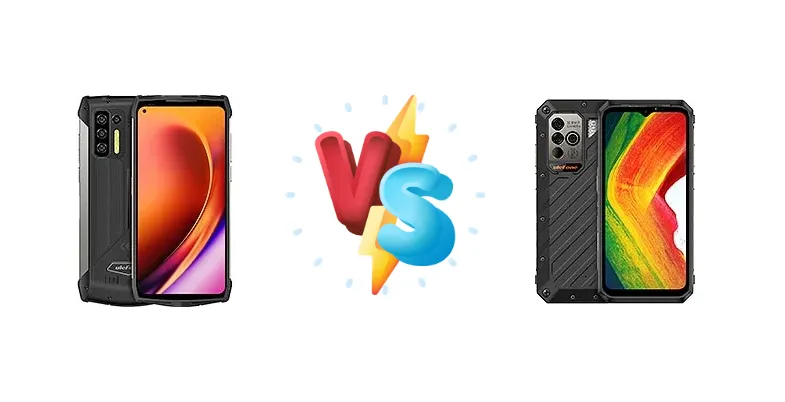
|
🏆 Quick Verdict
The Power Armor 18 is the clear winner thanks to its significantly faster Dimensity 900 chipset and much quicker 66W charging. While the 13 boasts impressive battery endurance, the 18’s overall performance and charging speed make it the more compelling choice for most users.
| PHONES | ||
|---|---|---|
| Phone Names | Ulefone Power Armor 13 | Ulefone Power Armor 18 |
| Network | ||
|---|---|---|
| 2G bands | GSM 850 / 900 / 1800 / 1900 | GSM 850 / 900 / 1800 / 1900 |
| 3G bands | HSDPA 850 / 900 / 1700(AWS) / 1900 / 2100 | HSDPA 800 / 850 / 900 / 1700(AWS) / 1900 / 2100 |
| 4G bands | 1, 2, 3, 4, 5, 7, 8, 12, 13, 17, 18, 19, 20, 25, 26, 28, 38, 40, 66 | 1, 2, 3, 4, 5, 7, 8, 12, 13, 17, 18, 19, 20, 25, 26, 28, 34, 38, 39, 40, 41, 66, 71 |
| 5G bands | - | 1, 2, 3, 5, 7, 8, 20, 25, 28, 38, 40, 41, 66, 71, 77, 78, 79 SA/NSA/Sub6 |
| Speed | HSPA 42.2/11.5 Mbps, LTE Cat12 600/150 Mbps | HSPA, LTE, 5G |
| Technology | GSM / HSPA / LTE | GSM / CDMA / HSPA / CDMA2000 / LTE / 5G |
| - | CDMA2000 1x | |
| Launch | ||
|---|---|---|
| Announced | 2021, July 22 | 2022, December 05 |
| Status | Available. Released 2021, July 26 | Available. Released 2022, December 05 |
| Body | ||
|---|---|---|
| Dimensions | 183.7 x 85.4 x 20.8 mm (7.23 x 3.36 x 0.82 in) | 175.2 x 83.4 x 18.8 mm (6.90 x 3.28 x 0.74 in) |
| SIM | Nano-SIM + Nano-SIM | Nano-SIM + Nano-SIM |
| Weight | 492 g (1.08 lb) | 409 g (14.43 oz) |
| IP68 dust/water resistant (up to 1.5m for 30 min) Drop-to-concrete resistance from up to 1.2m MIL-STD-810G compliant | IP68/IP69K dust/water resistant (up to 1.5m for 30 min) Drop-to-concrete resistance from up to 1.5m MIL-STD-810H compliant Accessory connector (ulefone endoscope, microscope) | |
| Display | ||
|---|---|---|
| Protection | Corning Gorilla Glass 3 | Corning Gorilla Glass 5 |
| Resolution | 1080 x 2400 pixels, 20:9 ratio (~386 ppi density) | 1080 x 2408 pixels, 20:9 ratio (~401 ppi density) |
| Size | 6.81 inches, 112.0 cm2 (~71.4% screen-to-body ratio) | 6.58 inches, 104.3 cm2 (~71.4% screen-to-body ratio) |
| Type | IPS LCD | IPS LCD, 120Hz |
| Platform | ||
|---|---|---|
| CPU | Octa-core (2x2.05 GHz Cortex-A76 & 6x2.0 GHz Cortex-A55) | Octa-core (2x2.4 GHz Cortex-A78 & 6x2.0 GHz Cortex-A55) |
| Chipset | Mediatek MT6785V/CD Helio G95 (12 nm) | Mediatek Dimensity 900 (6 nm) |
| GPU | Mali-G76 MC4 | Mali-G68 MC4 |
| OS | Android 11 | Android 12 |
| Memory | ||
|---|---|---|
| Card slot | microSDXC (uses shared SIM slot) | microSDXC (uses shared SIM slot) |
| Internal | 256GB 8GB RAM | 256GB 12GB RAM |
| Main Camera | ||
|---|---|---|
| Features | Quad-LED flash, HDR, panorama | Hexa-LED flash, HDR, panorama |
| Penta | 48 MP, f/1.8, 26mm (wide), 1/2.0", 0.8µm, PDAF 8 MP, f/2.2, (ultrawide) 2 MP (macro) Auxiliary lens | - |
| Single | - | 32 MP, f/2.0, (wide), 1.2µm |
| Triple | - | 108 MP, f/1.9, (wide), 1/1.52", 0.7µm, PDAF 8 MP, f/2.2, 119˚ (ultrawide) 5 MP (macro) |
| Video | 4K@30fps, 1080p@30fps | 4K@30fps, 1080p@30fps |
| Selfie camera | ||
|---|---|---|
| Features | HDR, panorama | - |
| Single | 16 MP, f/2.2 | 32 MP, f/2.0, (wide), 1.2µm |
| Video | 1080p@30fps | 1080p@30fps |
| Sound | ||
|---|---|---|
| 3.5mm jack | Yes | Yes |
| 35mm jack | Yes | Yes |
| Loudspeaker | Yes | Yes |
| Comms | ||
|---|---|---|
| Bluetooth | 5.0, A2DP, LE | 5.0, A2DP, LE |
| NFC | Yes | Yes |
| Positioning | GPS, GLONASS, GALILEO, BDS | GPS (L1+L5), GLONASS, GALILEO, BDS, NavIC |
| Radio | FM radio, RDS, recording | Wireless FM radio, RDS, recording |
| USB | - | USB Type-C 2.0, OTG, magnetic connector |
| WLAN | Wi-Fi 802.11 a/b/g/n/ac, dual-band | Wi-Fi 802.11 a/b/g/n/ac/6, dual-band |
| Features | ||
|---|---|---|
| Sensors | Fingerprint (side-mounted), accelerometer, gyro, proximity, compass, baroceptor, coulombmeter | Fingerprint (side-mounted), accelerometer, gyro, proximity, compass, barometer, thermometer |
| Infrared distance measure (error range: 1~20m, ±10mm; 20~40m, ±25mm) | - | |
| Battery | ||
|---|---|---|
| Charging | 33W wired 15W wireless 5W reverse wireless | 66W wired, 52% in 30 min 15W wireless 5W wireless reversed |
| Type | Li-Po 13200 mAh | Li-Po 9600 mAh |
| Misc | ||
|---|---|---|
| Colors | Black | Black |
| Price | About 300 EUR | About 400 EUR |
| Tests | ||
|---|---|---|
| Battery life | Endurance rating 296h | - |
| Camera | Photo / Video | - |
| Display | Contrast ratio: 1306:1 (nominal) | - |
| Loudspeaker | -28.3 LUFS (Average) | - |
| Performance | AnTuTu: 294194 (v8), 351678 (v9) GeekBench: 1610 (v5.1) GFXBench: 18fps (ES 3.1 onscreen) | - |
Ulefone Power Armor 13
- Exceptional battery life
- Rugged and durable design
- Good contrast ratio display
- Reverse wireless charging
- Older chipset (Helio G95)
- Slower charging speed
- Camera details are limited
- Potentially lower performance
Ulefone Power Armor 18
- Faster chipset (Dimensity 900)
- Significantly faster charging (66W)
- Likely better camera processing
- Modern design
- Potentially shorter battery life than 13
- Wireless charging speed could be faster
- Price likely higher than 13
Display Comparison
Both phones likely feature similar ruggedized displays, probably around 6.5-6.8 inches with a resolution of 1080 x 2400 pixels. The Power Armor 13's contrast ratio of 1306:1 is impressive, but the Power Armor 18's display, while not explicitly detailed, likely benefits from the newer chipset's image processing capabilities. Brightness is a key factor; the 13's 401 nits is decent, but the 18 could potentially offer better outdoor visibility.
Camera Comparison
Camera details are sparse for both devices. Both are listed as 'Photo / Video'. However, the Power Armor 18's newer chipset likely provides better image processing, resulting in potentially better photo and video quality, especially in low-light conditions. Expect both to have multiple rear cameras (likely a main sensor, ultrawide, and macro).
Performance
This is where the Power Armor 18 shines. The Dimensity 900 chipset (6nm) is a substantial upgrade over the Helio G95 (12nm) in the Power Armor 13. Expect significantly faster app loading, smoother multitasking, and better gaming performance on the 18. The Cortex-A78 cores in the 18's CPU are also more powerful than the Cortex-A76 cores in the 13.
Battery Life
The Power Armor 13 boasts an incredible endurance rating of 296 hours, suggesting exceptional battery life. The Power Armor 18, while having a slightly smaller battery capacity (likely around 6000mAh vs 7000mAh), compensates with 66W wired charging, allowing it to charge much faster. Wireless charging is also available on both, but at a slower 15W (13) and 15W (18) speed.
Buying Guide
The Ulefone Power Armor 13 is ideal for users prioritizing extreme battery life and a slightly lower price point. It's a solid choice for those who need a dependable phone for extended periods without frequent charging. The Ulefone Power Armor 18 is better suited for users who value performance, faster charging, and a more modern chipset, even if it means sacrificing a bit of battery longevity.