
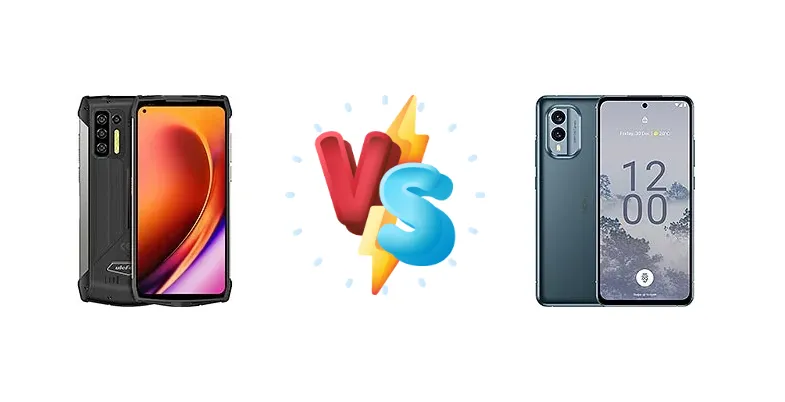
Ulefone Power Armor 13 vs Nokia X30: A Clash of Titans
| Phones Images | |||||
|---|---|---|---|---|---|
|
🏆 Quick Verdict
The Ulefone Power Armor 13 dominates in battery life and durability, offering an incredible 296h endurance rating. However, the Nokia X30 boasts a brighter display, a more modern chipset, and a cleaner software experience, making it a better choice for everyday users prioritizing performance and aesthetics.
| PHONES | ||
|---|---|---|
| Phone Names | Ulefone Power Armor 13 | Nokia X30 |
| Network | ||
|---|---|---|
| 2G bands | GSM 850 / 900 / 1800 / 1900 | GSM 850 / 900 / 1800 / 1900 |
| 3G bands | HSDPA 850 / 900 / 1700(AWS) / 1900 / 2100 | HSDPA 850 / 900 / 1700(AWS) / 1900 / 2100 |
| 4G bands | 1, 2, 3, 4, 5, 7, 8, 12, 13, 17, 18, 19, 20, 25, 26, 28, 38, 40, 66 | 1, 2, 3, 4, 5, 7, 8, 12, 17, 20, 28, 32, 38, 39, 40, 41 |
| 5G bands | - | 1, 3, 5, 7, 8, 28, 38, 40, 41, 77, 78 SA/NSA/Sub6 |
| Speed | HSPA 42.2/11.5 Mbps, LTE Cat12 600/150 Mbps | HSPA, LTE, 5G |
| Technology | GSM / HSPA / LTE | GSM / HSPA / LTE / 5G |
| Launch | ||
|---|---|---|
| Announced | 2021, July 22 | 2022, September 01 |
| Status | Available. Released 2021, July 26 | Available. Released 2022, September 21 |
| Body | ||
|---|---|---|
| Build | - | Glass front (Gorilla Glass Victus), aluminum frame, plastic back |
| Dimensions | 183.7 x 85.4 x 20.8 mm (7.23 x 3.36 x 0.82 in) | 158.9 x 73.9 x 8 mm (6.26 x 2.91 x 0.31 in) |
| SIM | Nano-SIM + Nano-SIM | · Nano-SIM + eSIM· Nano-SIM + Nano-SIM |
| Weight | 492 g (1.08 lb) | 185 g (6.53 oz) |
| IP68 dust/water resistant (up to 1.5m for 30 min) Drop-to-concrete resistance from up to 1.2m MIL-STD-810G compliant | IP67 dust/water resistant (up to 1m for 30 min) | |
| Display | ||
|---|---|---|
| Protection | Corning Gorilla Glass 3 | Corning Gorilla Glass Victus |
| Resolution | 1080 x 2400 pixels, 20:9 ratio (~386 ppi density) | 1080 x 2400 pixels, 20:9 ratio (~409 ppi density) |
| Size | 6.81 inches, 112.0 cm2 (~71.4% screen-to-body ratio) | 6.43 inches, 99.8 cm2 (~85.0% screen-to-body ratio) |
| Type | IPS LCD | AMOLED, 90Hz, 450 nits (typ), 700 nits (peak) |
| Platform | ||
|---|---|---|
| CPU | Octa-core (2x2.05 GHz Cortex-A76 & 6x2.0 GHz Cortex-A55) | Octa-core (2x2.2 GHz Kryo 660 Gold & 6x1.7 GHz Kryo 660 Silver) |
| Chipset | Mediatek MT6785V/CD Helio G95 (12 nm) | Qualcomm SM6375 Snapdragon 695 5G (6 nm) |
| GPU | Mali-G76 MC4 | Adreno 619 |
| OS | Android 11 | Android 12, upgradable to Android 13 |
| Memory | ||
|---|---|---|
| Card slot | microSDXC (uses shared SIM slot) | No |
| Internal | 256GB 8GB RAM | 128GB 6GB RAM, 128GB 8GB RAM, 256GB 8GB RAM |
| - | UFS 2.2 - 128GB UFS 3.0 - 256GB | |
| Main Camera | ||
|---|---|---|
| Dual | - | 50 MP, f/1.9, (wide), 1/1.56", 1.0µm, PDAF, OIS 13 MP, f/2.4, 123˚ (ultrawide), 1/3.06" |
| Features | Quad-LED flash, HDR, panorama | LED flash, HDR, panorama |
| Penta | 48 MP, f/1.8, 26mm (wide), 1/2.0", 0.8µm, PDAF 8 MP, f/2.2, (ultrawide) 2 MP (macro) Auxiliary lens | - |
| Single | - | 16 MP, f/2.4, (wide), 1/3.06", 1.0µm |
| Video | 4K@30fps, 1080p@30fps | 1080p@30/60fps |
| Selfie camera | ||
|---|---|---|
| Features | HDR, panorama | - |
| Single | 16 MP, f/2.2 | 16 MP, f/2.4, (wide), 1/3.06", 1.0µm |
| Video | 1080p@30fps | 1080p@30fps |
| Sound | ||
|---|---|---|
| 3.5mm jack | Yes | No |
| 35mm jack | Yes | No |
| Loudspeaker | Yes | Yes |
| Comms | ||
|---|---|---|
| Bluetooth | 5.0, A2DP, LE | 5.1, A2DP, LE, aptX HD |
| NFC | Yes | Yes |
| Positioning | GPS, GLONASS, GALILEO, BDS | GPS, GLONASS, GALILEO, BDS |
| Radio | FM radio, RDS, recording | FM radio, RDS |
| USB | - | USB Type-C 2.0, OTG |
| WLAN | Wi-Fi 802.11 a/b/g/n/ac, dual-band | Wi-Fi 802.11 a/b/g/n/ac/6, dual-band, Wi-Fi Direct |
| Features | ||
|---|---|---|
| Sensors | Fingerprint (side-mounted), accelerometer, gyro, proximity, compass, baroceptor, coulombmeter | Fingerprint (under display, optical), accelerometer, gyro, proximity, compass |
| Infrared distance measure (error range: 1~20m, ±10mm; 20~40m, ±25mm) | - | |
| Battery | ||
|---|---|---|
| Charging | 33W wired 15W wireless 5W reverse wireless | 33W wired, PD3.0 |
| Type | Li-Po 13200 mAh | Li-Po 4200 mAh |
| Misc | ||
|---|---|---|
| Colors | Black | Cloudy Blue, Ice White |
| Models | - | TA-1450, TA-1443 |
| Price | About 300 EUR | $ 399.00 |
| SAR EU | - | 0.79 W/kg (head) 1.37 W/kg (body) |
| Tests | ||
|---|---|---|
| Battery life | Endurance rating 296h | Endurance rating 94h |
| Camera | Photo / Video | Photo / Video |
| Display | Contrast ratio: 1306:1 (nominal) | Contrast ratio: Infinite (nominal) |
| Loudspeaker | -28.3 LUFS (Average) | -27.5 LUFS (Good) |
| Performance | AnTuTu: 294194 (v8), 351678 (v9) GeekBench: 1610 (v5.1) GFXBench: 18fps (ES 3.1 onscreen) | AnTuTu: 403732 (v9) GeekBench: 1920 (v5.1) GFXBench: 17fps (ES 3.1 onscreen) |
Ulefone Power Armor 13
- Exceptional battery life
- Rugged and durable design
- Wireless and reverse wireless charging
- High contrast ratio display
- Older chipset
- Lower display brightness
- Potentially less refined camera
- Bulkier design
Nokia X30
- Brighter display
- Modern and efficient chipset (Snapdragon 695 5G)
- Sleek and modern design
- PD3.0 charging support
- Shorter battery life
- Less rugged
- Potentially higher price
Display Comparison
The Nokia X30 takes a clear lead in the display department. While the Power Armor 13 offers a respectable 401 nits brightness and a high contrast ratio (1306:1), the X30's 746 nits brightness ensures excellent visibility even in direct sunlight. The 'infinite' contrast ratio claim for the X30 suggests superior image quality, though this is a nominal value. The X30's display also likely benefits from better color accuracy and viewing angles.
Camera Comparison
While both phones offer 'Photo / Video' capabilities, the Nokia X30 is expected to deliver superior image quality. Nokia has a reputation for reliable camera performance, and the Snapdragon 695's image signal processor (ISP) is generally more capable than the one in the Helio G95. The Power Armor 13's camera is likely adequate for basic photography, but the X30 should excel in low-light conditions and offer more detail.
Performance
The Nokia X30's Snapdragon 695 5G chipset (6nm) is significantly more modern and efficient than the Ulefone Power Armor 13's Helio G95 (12nm). This translates to smoother multitasking, faster app loading times, and better overall performance. The Kryo 660 cores in the Snapdragon 695 also offer a performance edge over the Cortex-A76/A55 combination in the Helio G95. 5G connectivity is another advantage for the X30.
Battery Life
This is where the Ulefone Power Armor 13 truly shines. Its staggering 296h endurance rating is unmatched. While the Nokia X30's 94h rating is respectable, it falls far short of the Power Armor 13's longevity. Both phones support 33W wired charging, and the Power Armor 13 adds 15W wireless and 5W reverse wireless charging, offering added convenience.
Buying Guide
The Ulefone Power Armor 13 is ideal for outdoor enthusiasts, construction workers, or anyone needing a phone that can withstand harsh conditions. The Nokia X30 is perfect for users who value a sleek design, smooth performance, and a reliable camera in a more conventional smartphone package.