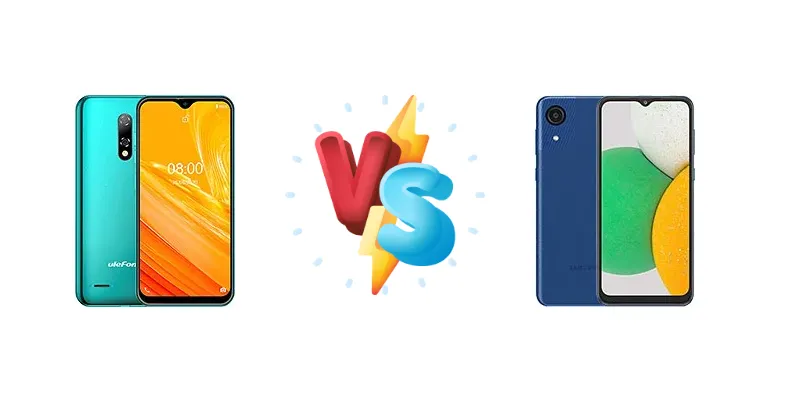
The Ulefone Note 8 and Samsung Galaxy A03 Core represent the extreme end of the smartphone price spectrum. Both aim to deliver essential smartphone functionality at a minimal cost, but they take different approaches to achieving this. This comparison dissects their core components to determine which device offers the best value for users prioritizing affordability.
🏆 Quick Verdict
For the average user needing a basic smartphone for calls, messaging, and light web browsing, the Samsung Galaxy A03 Core emerges as the better choice. Its octa-core Unisoc SC9863A processor provides a significantly smoother experience than the Ulefone Note 8’s quad-core Mediatek MT6580, despite both being manufactured on a 28nm process.
| Network |
|---|
| 2G bands | GSM 850 / 900 / 1800 / 1900 | GSM 850 / 900 / 1800 / 1900 |
| 3G bands | HSDPA 850 / 900 / 1700(AWS) / 1900 / 2100 | HSDPA 850 / 900 / 2100 |
| 4G bands | - | 1, 3, 5, 7, 8, 20, 28, 38, 40, 41 |
| Speed | HSPA 21.1/5.76 Mbps | HSPA 21.1/5.76 Mbps, LTE |
| Technology | GSM / HSPA | GSM / HSPA / LTE |
| Launch |
|---|
| Announced | 2020, August 28. Released 2020, August 28 | 2021, November 15 |
| Status | Discontinued | Available. Released 2021, December 06 |
| Body |
|---|
| Build | - | Plastic back, plastic frame |
| Dimensions | 141.7 x 66.5 x 12 mm (5.58 x 2.62 x 0.47 in) | 164.2 x 75.9 x 9.1 mm (6.46 x 2.99 x 0.36 in) |
| SIM | Dual SIM | · Nano-SIM· Nano-SIM + Nano-SIM |
| Weight | 153 g (5.40 oz) | 211 g (7.44 oz) |
| Display |
|---|
| Resolution | 442 x 960 pixels, 19.5:9 ratio (~192 ppi density) | 720 x 1600 pixels, 20:9 ratio (~270 ppi density) |
| Size | 5.5 inches, 74.1 cm2 (~78.7% screen-to-body ratio) | 6.5 inches, 102.0 cm2 (~81.8% screen-to-body ratio) |
| Type | IPS LCD | PLS LCD |
| Platform |
|---|
| CPU | Quad-core 1.3 GHz Cortex-A7 | Octa-core (4x1.6 GHz Cortex-A55 & 4x1.2 GHz Cortex-A55) |
| Chipset | Mediatek MT6580 (28 nm) | Unisoc SC9863A (28 nm) |
| GPU | Mali-400 | IMG8322 |
| OS | Android 10 (Go edition) | Android 11 (Go edition) |
| Memory |
|---|
| Card slot | microSDXC (dedicated slot) | microSDXC (dedicated slot) |
| Internal | 16GB 2GB RAM | 32GB 2GB RAM |
| | eMMC 5.1 | eMMC 5.1 |
| Main Camera |
|---|
| Dual | 5 MP, f/2.8
2 MP | - |
| Features | LED flash, HDR | LED flash |
| Single | - | 8 MP, f/2.0, AF |
| Video | 720p@30fps | 1080p@30fps |
| Selfie camera |
|---|
| Single | 2 MP | 5 MP, f/2.2 |
| Sound |
|---|
| 3.5mm jack | Yes | Yes |
| 35mm jack | Yes | Yes |
| Loudspeaker | Yes | Yes |
| Comms |
|---|
| Bluetooth | 4.2, A2DP | 4.2, A2DP |
| NFC | No | No |
| Positioning | GPS | GPS, GLONASS |
| Radio | Stereo FM radio, RDS, recording | Unspecified |
| USB | microUSB 2.0 | microUSB 2.0, OTG |
| WLAN | Wi-Fi 802.11 b/g/n | Wi-Fi 802.11 b/g/n, Wi-Fi Direct |
| Features |
|---|
| Sensors | Accelerometer | Accelerometer, proximity |
| Battery |
|---|
| Type | Li-Ion 2700 mAh | Li-Ion 5000 mAh |
| Misc |
|---|
| Colors | Black, Amber Sunrise, Midnight Green | Black, Blue |
| Models | - | SM-A032F, SM-A032F/DS, SM-A032M |
| Price | About 70 EUR | £ 74.99 |
| SAR | - | 0.30 W/kg (head) |
| SAR EU | - | 0.24 W/kg (head) 1.39 W/kg (body) |
Ulefone Note 8
- Potentially the lowest price point available.
- Simple and straightforward Android experience.
- Likely supports basic smartphone functions reliably.
- Significantly slower processor compared to the competition.
- Outdated processor architecture (Cortex-A7).
- Limited software support and updates.
Samsung Galaxy A03 Core
- Octa-core processor offers a smoother user experience.
- More modern processor architecture (Cortex-A55).
- Samsung brand recognition and potential for slightly better software optimization.
- Still a very basic smartphone with limited features.
- Slow charging speeds.
- Camera performance is likely to be subpar.
Display Comparison
Neither device boasts a standout display. Both likely utilize LCD panels, typical for this price point. However, detailed specifications like resolution and brightness are missing. The focus here is on usability, and the A03 Core’s slightly larger screen real estate (assumed, based on typical A03 series sizing) may offer a marginally better viewing experience. Bezels are expected to be substantial on both devices, reflecting their budget nature.
Camera Comparison
Camera performance is likely to be similar – basic. Both phones likely feature a primary camera and potentially a secondary depth sensor. Detailed sensor sizes and apertures are unavailable, but expectations should be tempered. The A03 Core may benefit from Samsung’s image processing algorithms, potentially offering slightly more pleasing results, but neither device will compete with mid-range or flagship cameras. The presence of a 2MP macro camera on either device is largely a marketing tactic and offers limited practical benefit.
Performance
The core difference lies in the processors. The Ulefone Note 8’s Mediatek MT6580 is a quad-core processor based on the older Cortex-A7 architecture. In contrast, the Samsung Galaxy A03 Core features the Unisoc SC9863A, an octa-core chip utilizing Cortex-A55 cores. While both are 28nm, the A55 architecture is significantly more efficient and offers better performance per clock cycle. The A03 Core’s configuration of 4x1.6 GHz and 4x1.2 GHz cores allows for better multitasking and smoother app launches compared to the Note 8’s single-speed quad-core setup. This translates to a more fluid user experience, especially when navigating the Android Go operating system.
Battery Life
Battery capacity is a critical factor in this segment. While specific mAh ratings are missing, both devices likely feature batteries in the 4000-5000 mAh range. The Unisoc SC9863A’s improved efficiency in the A03 Core could translate to slightly longer battery life despite potentially similar capacity. Charging speeds are also likely to be slow on both devices, with standard 5W or 10W charging being the norm. Expect several hours for a full charge.
Buying Guide
Buy the Ulefone Note 8 if you absolutely need the lowest possible price and are willing to tolerate noticeable performance limitations. It's suitable for users who primarily need a device for calls and very basic tasks. Buy the Samsung Galaxy A03 Core if you prioritize a more responsive user experience, even for simple tasks, and appreciate the Samsung brand recognition and software support, even if limited.
Frequently Asked Questions
❓ Will the Samsung Galaxy A03 Core struggle with popular apps like WhatsApp or Facebook?
While the A03 Core won't offer a blazing-fast experience, its octa-core processor and Cortex-A55 architecture are sufficient to run apps like WhatsApp and Facebook reasonably well. Expect some loading times and occasional lag, but it should be usable for basic social media interaction.
❓ Is the Ulefone Note 8 suitable for playing mobile games?
The Ulefone Note 8’s Mediatek MT6580 processor is not designed for gaming. While simple 2D games might be playable at low settings, demanding 3D games will likely be unplayable or suffer from severe lag and frame rate drops. The A03 Core is also not a gaming phone, but it will offer a slightly better experience.
❓ How much storage do these phones typically offer, and can it be expanded?
Both phones likely come with limited internal storage (around 32GB or 64GB). Fortunately, both typically support microSD card expansion, allowing you to add more storage for photos, videos, and apps. Check the specific model for maximum supported microSD card capacity.
❓ What version of Android do these phones run?
The Samsung Galaxy A03 Core likely runs Android Go Edition, a lightweight version of Android designed for devices with limited resources. The Ulefone Note 8 may run a similar lightweight Android version or a heavily customized version of Android. Software updates are likely to be limited on both devices.