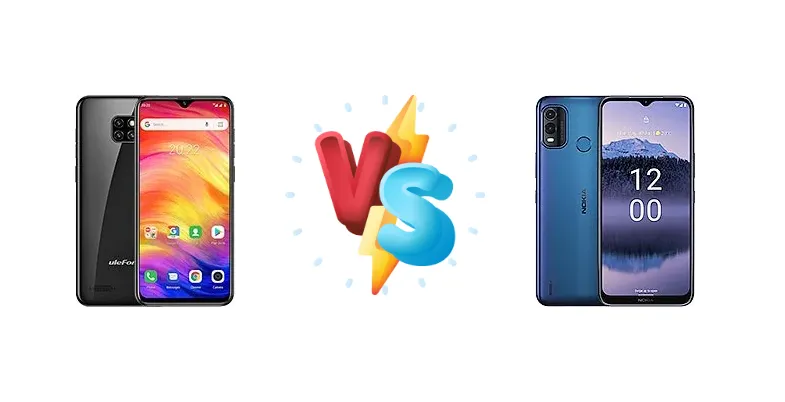
The Ulefone Note 7 and Nokia G11 Plus represent two approaches to the ultra-budget smartphone market. The Ulefone, leveraging an older Mediatek chipset, aims for affordability. The Nokia G11 Plus, with its newer Unisoc processor, attempts to offer a more modern experience. This comparison dissects their key differences to determine which provides the best value.
🏆 Quick Verdict
For the average user prioritizing responsiveness and future-proofing, the Nokia G11 Plus is the clear winner. Its Unisoc T606 chipset, built on a more efficient 12nm process, delivers significantly better performance than the Ulefone Note 7’s aging Mediatek MT6580. While the Ulefone is cheaper, the performance gap justifies the slight price increase for the Nokia.
| Network |
|---|
| 2G bands | GSM 850 / 900 / 1800 / 1900 | GSM 850 / 900 / 1800 / 1900 |
| 3G bands | HSDPA 850 / 900 / 1900 / 2100 | HSDPA 850 / 900 / 2100 - International |
| 4G bands | - | 1, 3, 5, 7, 8, 20, 28, 38, 40, 41 - International |
| Speed | HSPA 21.1/5.76 Mbps | HSPA 42.2/5.76 Mbps, LTE Cat4 150/50 Mbps |
| Technology | GSM / HSPA | GSM / HSPA / LTE |
| | - | 1, 3, 5, 8, 40, 41 - India |
| Launch |
|---|
| Announced | 2019, April. Released 2019, April | 2022, June 29 |
| Status | Discontinued | Available. Released 2022, July 20 |
| Body |
|---|
| Build | - | Glass front, plastic frame, plastic back |
| Dimensions | 156.1 x 73.7 x 9.7 mm (6.15 x 2.90 x 0.38 in) | 164.8 x 75.9 x 8.6 mm (6.49 x 2.99 x 0.34 in) |
| SIM | Nano-SIM + Micro-SIM | · Nano-SIM· Nano-SIM + Nano-SIM |
| Weight | 177.5 g (6.28 oz) | 192 g (6.77 oz) |
| | - | Splash protection |
| Display |
|---|
| Protection | Corning Gorilla Glass 3 | - |
| Resolution | 600 x 1280 pixels (~232 ppi density) | 720 x 1600 pixels, 20:9 ratio (~269 ppi density) |
| Size | 6.1 inches, 92.3 cm2 (~80.2% screen-to-body ratio) | 6.52 inches, 102.6 cm2 (~82.1% screen-to-body ratio) |
| Type | IPS LCD | IPS LCD, 90Hz, 400 nits (typ) |
| Platform |
|---|
| CPU | Quad-core 1.3 GHz Cortex-A7 | Octa-core (2x1.6 GHz Cortex-A75 & 6x1.6 GHz Cortex-A55) |
| Chipset | Mediatek MT6580 (28 nm) | Unisoc T606 (12 nm) |
| GPU | Mali-400 | Mali-G57 MP1 |
| OS | Android 8.1 Oreo (Go edition) | Android 12, upgradable to Android 13 |
| Memory |
|---|
| Card slot | microSDXC (uses shared SIM slot) | microSDXC (dedicated slot) |
| Internal | 32GB 3GB RAM | 32GB 3GB RAM, 64GB 3GB RAM, 64GB 4GB RAM, 128GB 3GB RAM |
| | eMMC 5.1 | eMMC 5.1 |
| Main Camera |
|---|
| Dual | - | 50 MP, f/1.8, (wide), 1/2.67", PDAF
Auxiliary lens |
| Features | LED flash, HDR | LED flash |
| Single | 8 MP, AF | 8 MP, f/2.0, (wide), 1/4.0" |
| Triple | 8 MP, f/1.8, (wide), AF
2 MP
2 MP | - |
| Video | 720p@30fps | 1080p@30fps |
| Selfie camera |
|---|
| Single | 5 MP | 8 MP, f/2.0, (wide), 1/4.0" |
| Video | 720p@30fps | 1080p@30fps |
| Sound |
|---|
| 3.5mm jack | Yes | Yes |
| 35mm jack | Yes | Yes |
| Loudspeaker | Yes | Yes |
| Comms |
|---|
| Bluetooth | 4.0, A2DP | 5.0, A2DP, LE |
| NFC | No | No |
| Positioning | GPS | GPS |
| Radio | Stereo FM radio, RDS, recording | FM radio |
| USB | microUSB 2.0 | USB Type-C 2.0, OTG |
| WLAN | Wi-Fi 802.11 b/g/n | Wi-Fi 802.11 a/b/g/n/ac, dual-band, Wi-Fi Direct |
| Features |
|---|
| Sensors | Accelerometer, proximity | Fingerprint (rear-mounted), accelerometer, proximity |
| Battery |
|---|
| Charging | - | 10W wired |
| Stand-by | Up to 374 h (3G) | - |
| Talk time | Up to 9 h (3G) | - |
| Type | Li-Po 3500 mAh | Li-Ion 5000 mAh |
| Misc |
|---|
| Colors | Black, Gold, Twilight | Lake Blue, Charcoal Grey |
| Models | Q345 | - |
| Price | About 120 EUR | About 130 EUR |
| SAR EU | 0.35 W/kg (head) 0.86 W/kg (body) | - |
Ulefone Note 7
- Lowest possible price point
- Simple and straightforward user experience
- Potentially longer battery life with minimal usage
- Significantly slower performance
- Outdated chipset architecture
- Limited software support
Nokia G11 Plus
- Faster and more responsive performance
- More efficient chipset (Unisoc T606)
- Likely better software support
- 10W charging
- Slightly higher price
- Still a budget device with limitations
- 10W charging is slow
Display Comparison
Neither device boasts a standout display. Details regarding panel type (IPS, TFT) and resolution are missing for both, suggesting basic LCD panels. However, the Nokia G11 Plus benefits from the more modern chipset potentially allowing for better image processing. The Ulefone Note 7’s older chipset may struggle with smoother animations even at lower resolutions. Bezels are likely substantial on both, typical for this price point.
Camera Comparison
Without detailed sensor information, a direct camera comparison is difficult. However, it’s safe to assume both phones feature basic camera setups geared towards casual photography. The Ulefone Note 7 likely relies heavily on software processing to compensate for its older chipset’s limitations. The Nokia G11 Plus’s Unisoc T606 offers a more capable image signal processor (ISP), potentially resulting in better image quality and faster processing times. Expect both to struggle in low-light conditions. The presence of a 2MP macro lens on either device is largely a marketing gimmick and unlikely to deliver meaningful results.
Performance
The core difference lies in the chipsets. The Ulefone Note 7’s Mediatek MT6580, fabricated on a 28nm process, features a quad-core Cortex-A7 CPU. This architecture is several generations old and struggles with modern app demands. Conversely, the Nokia G11 Plus utilizes the Unisoc T606, built on a more efficient 12nm node, and boasts an octa-core configuration – two Cortex-A75 cores for performance and six Cortex-A55 cores for efficiency. This translates to a significantly faster and more responsive experience on the Nokia, particularly noticeable when multitasking or running demanding applications. The Nokia’s CPU architecture is a substantial leap forward, offering better single-core and multi-core performance.
Battery Life
Battery capacity details are missing for the Ulefone Note 7, but given its target market, it’s likely around 3000-4000mAh. The Nokia G11 Plus supports 10W wired charging. While not fast, it’s a standard offering in this segment. The Ulefone’s older chipset is less power-efficient, meaning it will likely drain the battery faster under similar usage conditions. The Nokia G11 Plus’s 12nm process and more efficient CPU cores will contribute to longer battery life, despite potentially having a similar capacity.
Buying Guide
Buy the Ulefone Note 7 if you absolutely need the lowest possible price and your smartphone usage is limited to basic tasks like calls, texts, and light web browsing. Buy the Nokia G11 Plus if you value a smoother user experience, occasional multitasking, and a chipset that will likely receive longer software support, even within the budget segment.
Frequently Asked Questions
❓ Will the Ulefone Note 7 struggle with popular apps like WhatsApp and Facebook?
Yes, the Mediatek MT6580’s limited processing power and older architecture will likely result in noticeable lag and slowdowns when using demanding apps like WhatsApp and Facebook, especially with multiple apps open simultaneously. Expect longer loading times and a less fluid experience.
❓ Is the Unisoc T606 in the Nokia G11 Plus capable of light gaming?
The Unisoc T606 can handle light gaming, such as casual puzzle games or older titles. However, it’s not a gaming powerhouse. Demanding games like PUBG Mobile will likely require significant graphics settings reductions and may still experience frame rate drops. It's suitable for casual gaming, but not for serious mobile gamers.
❓ How long will software updates be supported on each device?
Ulefone typically offers limited software support for its budget devices. The Nokia G11 Plus, benefiting from Nokia’s commitment to Android updates, is likely to receive at least one major Android version update and several security patches, offering a longer software lifespan.
❓ Does the Nokia G11 Plus support fast charging?
No, the Nokia G11 Plus only supports 10W wired charging. While not fast charging, it's a standard offering in this price range. Expect a full charge to take several hours.